Masca
Piedmont · The Po plain and the northern Apennines
Langhe, Roero, Monferrato, Canavese, Cuneo valleys
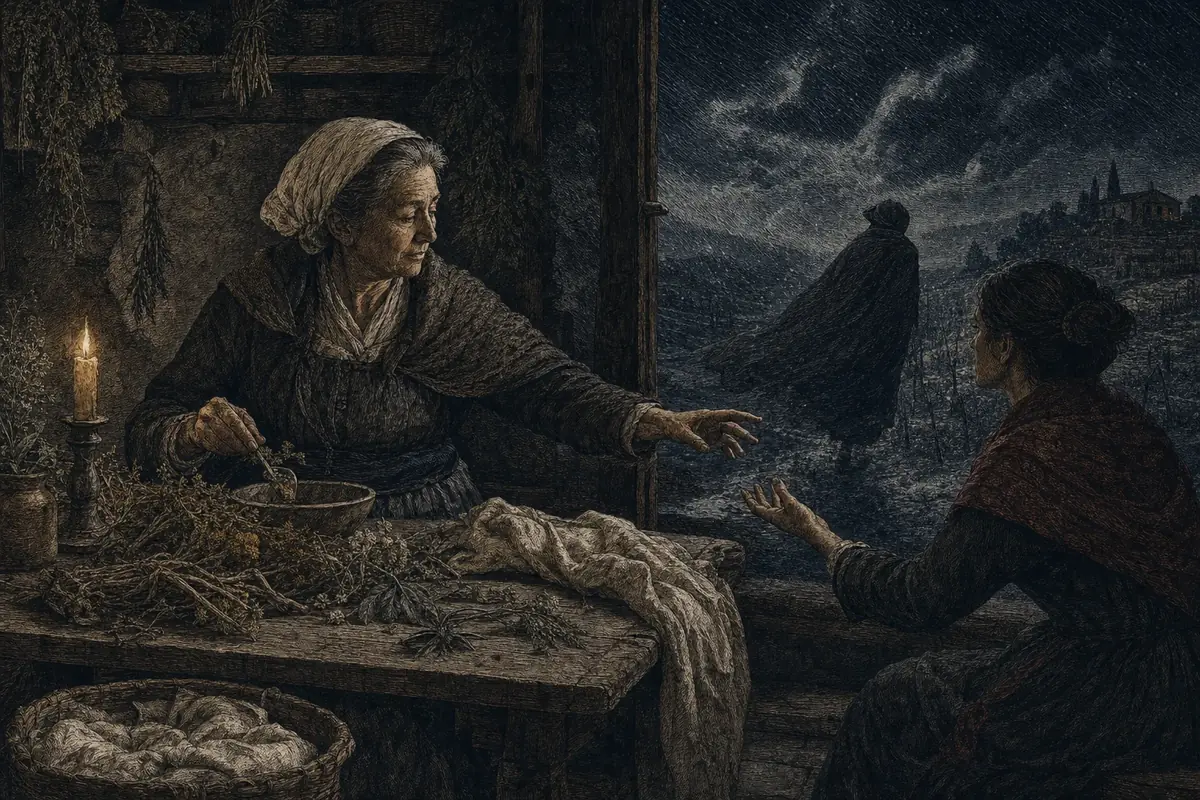
Masca — Piedmontese witch, but not a monster: a real woman of the community, with faculties handed down from mother to daughter at the moment of death.
- Variants and dialect names
- Masca (pl. masche), mascon. Expression still in use: «A-i é le masche»
- What is told
- It is not a monster: it is a real woman of the community, with faculties handed down from mother to daughter. Bilocation, metamorphosis, night flight. Rarely malevolent: she heals, stops haemorrhages, finds lost objects. She cannot die until she has passed the power on to someone who touches her hand.
- What it was forthe author’s reading
- Attribution of misfortune (hail, cattle die-offs, soured milk); ambivalent legitimation of unofficial female medical knowledge — midwives, herbalists, healers; social control of women who are old, alone or economically independent.
- Where it is attested
- Edict of Rothari, AD 643: chapter 376 forbids the killing of a woman accused of being a striga, quem dicunt mascam, adding that the thing «is in no way credible to Christian minds»; the term also occurs at chapter 197. It is the oldest written attestation in the whole atlas, and the Piedmontese witch still bears that name. Then Euclide Milano (1931), Franco Cordero (1971), Donato Bosca.
- Caution
- To call masca a «Lombard term» is imprecise: the Edict uses it as a vernacular gloss, but the current etymology traces it back to a pre-Indo-European base with the sense of «soot, black ghost», not to Germanic. From this also comes the Italian maschera, by way of medieval Latin.
The grade says how well the entry is documented, not how interesting it is. How the grades are assigned.