Myling e utburd
Sweden
Sweden, in particular Småland and Norrland, with Norway, Iceland and Finland
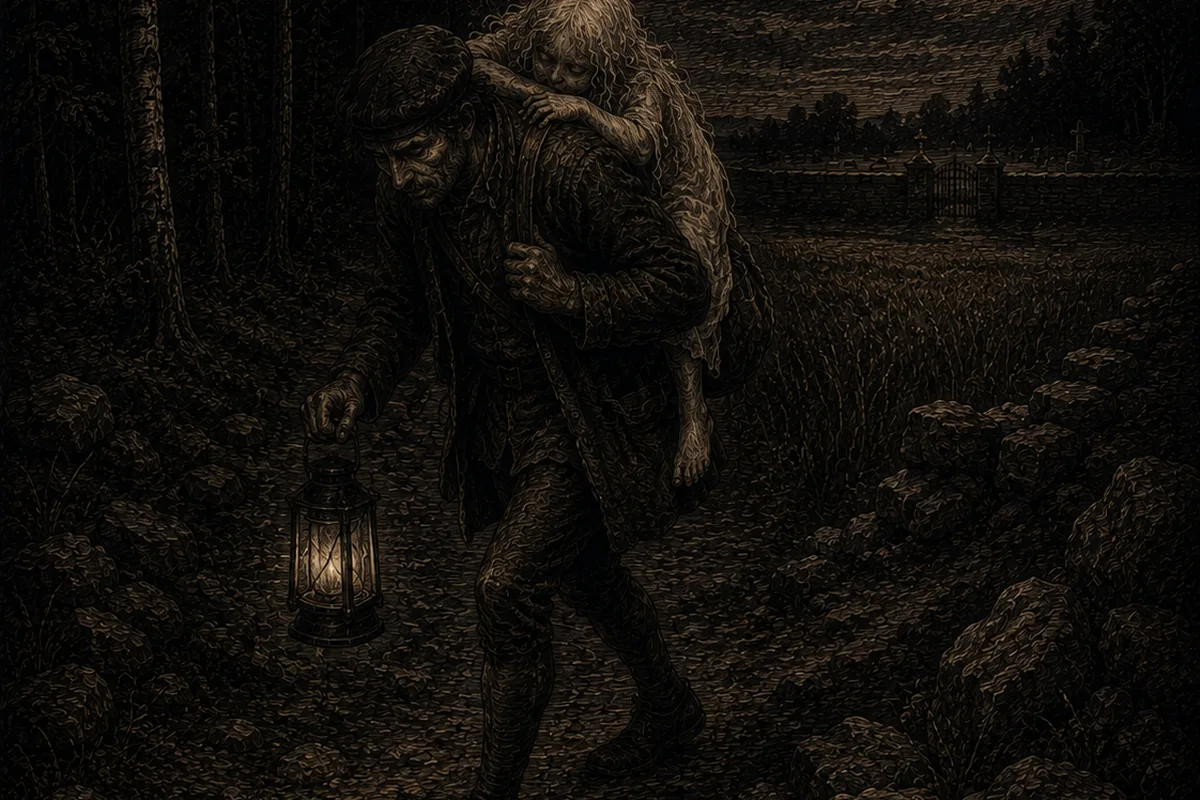
Myling e utburd — the ghost of a newborn killed or exposed by its mother, unbaptised and therefore without burial in consecrated ground.
- Variants and names
- myling in Swedish, plural mylingar; utburd in Norway, that is «the one carried out»; útburður in Iceland; ihtiriekko and liekkiö in Finland
- What is told
- The ghost of a newborn killed or exposed by its mother, unbaptised and therefore without burial in consecrated ground. It manifests itself with an insistent crying at the spot where the body was abandoned, a stony patch, a root, a field margin, the loft. The typical narrative motif is that it assails the solitary traveller at night by leaping onto his back and demanding to be carried to the churchyard, becoming progressively heavier until the bearer sinks into the ground; if he does not reach consecrated ground, he is killed. The resolution consists in giving it a name, often with an emergency baptism, or else in finding its remains and burying them.
- What it was forthe author’s reading
- It codifies in supernatural form the infanticide and exposure of newborns, a real practice in the Scandinavian countryside under conditions of poverty and above all of illegitimacy, which for the mother meant criminal sanction and social destruction. It works as a terrifying deterrent, as an elaboration of trauma and of collective guilt, as a pastoral argument in favour of immediate baptism, and as a marking of genuinely unconsecrated places in the landscape.
- Where it is attested
- Reidar Th. Christiansen, The Migratory Legends, FFC 175, 1958, type ML 4025 «The Ghost of a Murdered Child», with a systematic catalogue of the Norwegian variants; a comparative corpus of Icelandic, Danish, Swedish, Scottish, English and Polish variants annotated by D. L. Ashliman, University of Pittsburgh, from academic collections of the nineteenth and early twentieth centuries; Gunnar Olof Hyltén-Cavallius, Wärend och Wirdarne, two volumes, 1863-68, a regional monograph on Värend in Småland. Archives: Institutet för språk och folkminnen, Uppsala, and Nordiska museet. The medieval Scandinavian provincial laws and the early modern court records document the real historical referent.
- Caution
- The utburd complex and ML 4025 are grade A, but the term myling and the popular version now in international circulation reached the public through late channels, and for this reason the precautionary grade is B: anyone looking for serious documentation should look for utburd, not myling. The etymology of myling from myrða, to kill, plus the suffix -ling is coherent and recurrent in the literature but I have not been able to confirm it in Swedish historical lexicography; that of utburd, from ut and bera, that is to carry out, is by contrast secure. The tradition is extinct as an active belief and its contemporary relevance passes almost entirely through pop culture, which is a channel of transmission but not a source.
The grade says how well the entry is documented, not how interesting it is. How the grades are assigned.