Huldra
Norway
Areas of seter, that is summer mountain pasture, and of charcoal burning: Telemark, Hallingdal, Gudbrandsdalen, Trøndelag
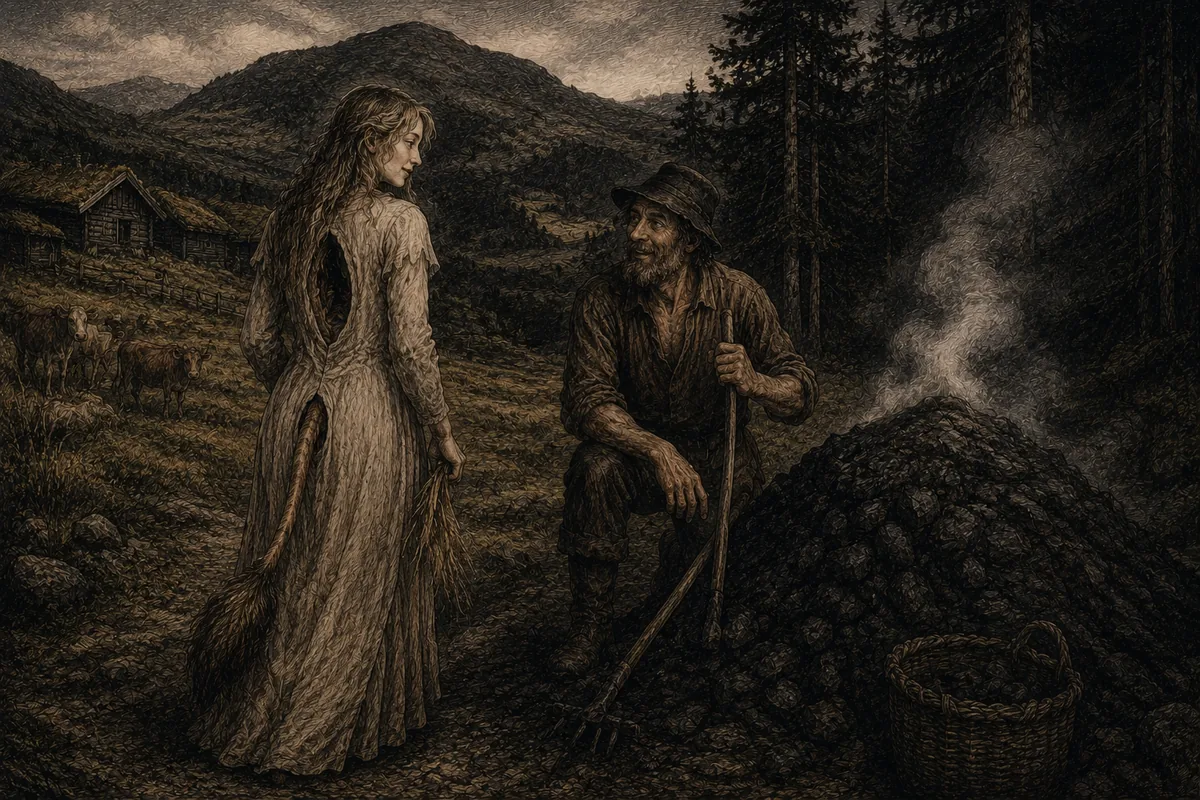
Huldra — a woman of extraordinary beauty who appears to the herdsman, the charcoal burner, the hunter and the woodcutter, that is to men alone for weeks in the forest.
- Variants and names
- huldra or hulder in Norwegian, plural huldrer; masculine huldrekall; collective huldrefolk; in Sweden skogsrå or skogsfru; ulda among the Sámi
- What is told
- A woman of extraordinary beauty who appears to the herdsman, the charcoal burner, the hunter and the woodcutter, that is to men alone for weeks in the forest. The revealing trait is hidden under her long dress: a cow's tail, in Sweden more often a fox's, or else a back hollow as a gutted trunk or covered with bark. If the man treats her with respect she protects the livestock, watches over the charcoal kilns and gives luck in the hunt, while if he offends her she causes loss of the way in the forest, sickness and death among the livestock. If married in church her tail falls off and she becomes an ordinary woman, but she loses her beauty and keeps her superhuman strength.
- What it was forthe author’s reading
- She is the symbolic figure of the seter economy: the women went up for the summer to the mountain pasture to tend the livestock, in isolation, and the men who went up met a sexuality outside communal control. The huldra codifies the desire, the risk and the sanction of that setting, and together with them the contractual relationship with the forest made of respect and of reciprocity of gifts; she serves also to explain losses of the way, accidents and illegitimate births.
- Where it is attested
- Andreas Faye, Norske Sagn, 1833, second edition Norske Folke-Sagn 1844, the first great collection of Norwegian legends modelled on the Grimms' Deutsche Sagen; Peter Christen Asbjørnsen and Jørgen Moe, Norske Folkeeventyr from 1841 and above all Asbjørnsen, Norske Huldre-Eventyr og Folkesagn, 1845-48; Reidar Th. Christiansen, The Migratory Legends, FF Communications 175, Helsinki, 1958, with the types ML 5000-6000. Archives: Norsk Folkeminnesamling, University of Oslo, and Norsk Folkemuseum. Confirmatory toponymy from Huldremose in Denmark to Ulddaidvárri in Norway.
- Caution
- The canonical iconography of Theodor Kittelsen and Erik Werenskiold is a national-romantic artistic reworking of the late nineteenth century, not an ethnographic document, and it has determined the modern image more than any text: it is to be classified B. As with almost all the Scandinavian and Slavic figures, the belief is in all probability much older than its documentation, which begins in the nineteenth century with the great national collections: to present the date of the collection as the date of the belief is a common methodological error.
The grade says how well the entry is documented, not how interesting it is. How the grades are assigned.