Nøkk e fossegrim
Norway
Inland Norway and Sweden: waterfalls, mills, mill-races and lakes; Telemark and Setesdal, home of the hardingfele
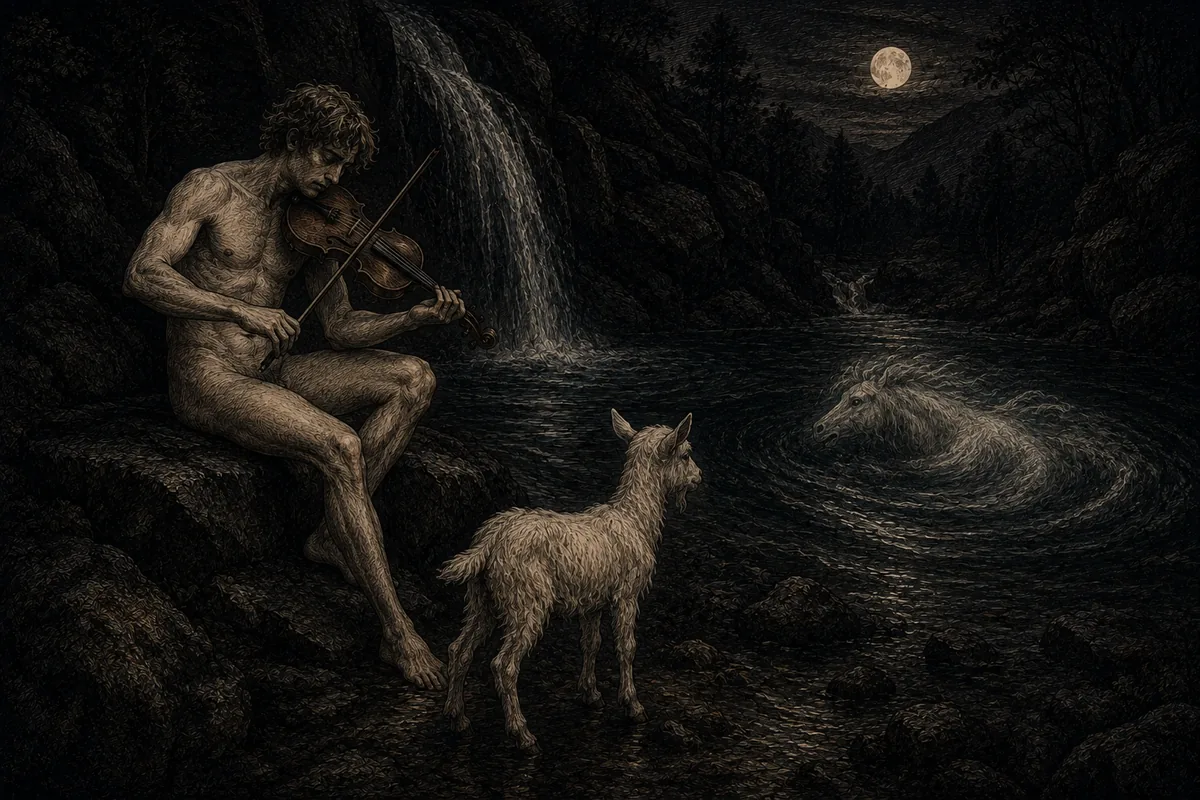
Nøkk e fossegrim — the Nordic spirit of running water, of a double nature: it drowns whoever comes near, or else it teaches playing.
- Variants and names
- nøkk or nøkken in Norwegian; näcken and strömkarlen in Sweden; nøkke and åmand in Denmark; nykur in Iceland; Nix and Nixe in Germany; nykr in Old Norse; fossegrim as the musical specialisation
- What is told
- He has a double nature. As a drowner he is a water spirit who draws children, washerwomen and travellers into the whirlpool, sometimes in the form of a white or grey horse, the bäckahästen, which stretches so as to carry off several children at a time. As a musician he is a young naked man who plays the fiddle in the waterfall, and teaches playing to whoever pays him: the payment is a white kid thrown into a waterfall that flows northwards, with the head turned the other way, or else smoked mutton, offered on a Thursday evening and in secret. If the gift is adequate he takes the pupil's right hand and drags his fingers over the strings until they bleed; the Swedish tradition attributes to the strömkarl eleven variations, of which the eleventh is forbidden because it makes everything living and inanimate dance.
- What it was forthe author’s reading
- A hydrological deterrent, which is the most immediate and universal function, that is keeping children away from mills, mill-races, waterfalls and thin ice. It serves besides to legitimise and at the same time to stigmatise musical talent in a Pietist Lutheran society, where the extraordinary fiddler is suspect: to the great fiddlers Myllarguten, that is Torgeir Augundsson, 1801-1872, and Ole Bull this origin was popularly attributed, a valuable datum because it shows the belief operating on documented historical persons.
- Where it is attested
- Andreas Faye, Norske Sagn, 1833; Asbjørnsen and Moe from 1841 and Asbjørnsen, Norske Huldre-Eventyr og Folkesagn, 1845-48; Reidar Th. Christiansen, The Migratory Legends, FFC 175, 1958, with the types on water beings ML 4050-4090. The term nykr is attested in Old Norse and the figure belongs to the common Germanic stock, as the German Nix and the nicor of Beowulf show. Living transmission in the hardingfele repertoire and in the kappleik, the summer competitions of Norwegian folk music, with the national Landskappleiken.
- Caution
- The often repeated etymology according to which näcken would come from the Swedish naken, that is naked, is false: it is a late folk etymology induced by the iconography, while the correct derivation is from Old Norse nykr, an Indo-European root connected with washing. Theodor Kittelsen's painting Nøkken, 1887-1904, has determined the modern imagery more than any text and is to be classified B as a source.
The grade says how well the entry is documented, not how interesting it is. How the grades are assigned.