Näkki
Finland
The Finnish lakeland; Kallavesi, near Kuopio
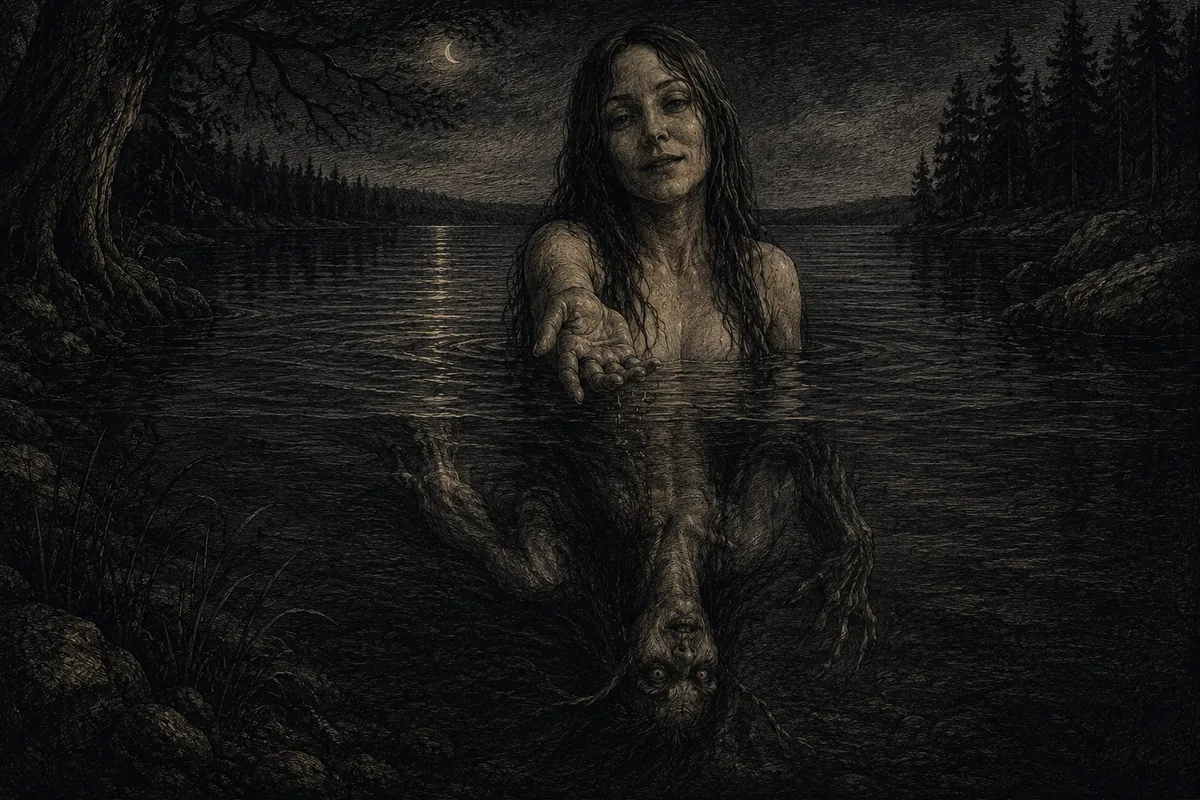
Näkki — the Finnish spirit of the waters, which seizes whoever leans over wells, jetties and the undersides of bridges.
- Variants and names
- Finnish näkki, Estonian näkk. It sits within a well-reconstructed Germanic family — Old Norse nykr, Swedish näcken, Norwegian nøkken, German Nix, English neck, Anglo-Saxon nicor, which appears in Beowulf — going back to a root meaning «to wash». Not to be confused with the vetehinen, which is the transparent Finnic term («water being»), nor with Ahti and Vellamo, the sovereign couple of the waters in the Kalevala, who are benevolent, nor with Iku-Turso, who is an epic monster.
- What is told
- It changes shape: a man, a most beautiful woman, a silver fish, a dog, a horse; in certain descriptions it is handsome from the front and hideous from behind. It does not inhabit the open lake: it inhabits wells, jetties, quays, the underside of bridges — that is, exactly the places where a child leans over to see its own reflection. It is there that it seizes the ankle and pulls down. The defences are iron in the water, the name spoken aloud, the sign of the cross. The language preserves its imprint better than the tales do: the Finnish word for a seashell is näkinkenkä, «the näkki's shoe», and a kind of alga is called näkinparta, «the näkki's beard».
- What it was forthe author’s reading
- The current formula is «Näkki vie» — «the näkki will take you away» — and it is said to children. Finnish folkloristics has a category for these figures: Kaarina Koski calls them pedagogiset fiktit, pedagogical fictions, and defines them as beings that adults did not hold to be real but used to instruct and frighten the young. The corresponding international category is Katharine Briggs's nursery bogies, which also includes the English Jenny Greenteeth, who seizes children with her green fangs and drags them into stagnant pools.
- Where it is attested
- The linguistic picture is solid. The ethnographic picture, so far as I have been able to verify, much less so: see the note. The works that ought to be interrogated exist and are these — Christfrid Ganander, Mythologia Fennica, 1789; Kaarle Krohn, Suomalaisten runojen uskonto, 1915; Uno Harva, Suomalaisten muinaisusko, 1948; Martti Haavio, Suomalainen mytologia, 1967; and the archive of the Suomalaisen Kirjallisuuden Seura, where the material sits among the uskomustarinat, the belief legends, not in the epic. For the category: Kaarina Koski, 2019, University of Turku, and Katharine Briggs, A Dictionary of Fairies, 1976.
- Caution
- Grade B, and the reason is precise: I have not been able to close the loop. That the näkki exists as a figure of belief is beyond question — the language itself says so, having drawn from it the names of a seashell and of an alga. That its function was to keep children away from the water is plausible, coherent and supported from both sides: the analytical category exists in Finnish (Koski's pedagogiset fiktit) and the danger was real and measurable (see the box). What is missing is the centre: I have not found the explicit ethnographic documentation, dated and attributed, that formally connects the näkki to that function. The claim that circulates on Wikipedia is without a source, and the Yle article that reports the formula «Näkki vie» interviews psychiatrists, not folklorists: it attests that it is said today, not that it was said then.
Other gaps, which I declare instead of working around them. The entries in the etymological dictionary of the Institute for the Languages of Finland exist but were not accessible to me: that näkki is a Germanic loan rather than a common root is my own inference, not a lexicographical citation. That the näkki appears in Ganander 1789, in Krohn, in Harva or in the Kalevala I have not confirmed — which does not mean that it is not there: it means that I have not been able to read the right pages. And the motif of the horse that invites one to mount it is firmly attested in Sweden (bäckahästen) and in Scotland (kelpie): whether it is genuinely Finnish or a Scandinavian contamination, I do not know.
The grade says how well the entry is documented, not how interesting it is. How the grades are assigned.