Witte wieven
the Netherlands
Drenthe, Overijssel (Twente and Salland) and Gelderland (Achterhoek, Veluwe); parallels in northern Germany
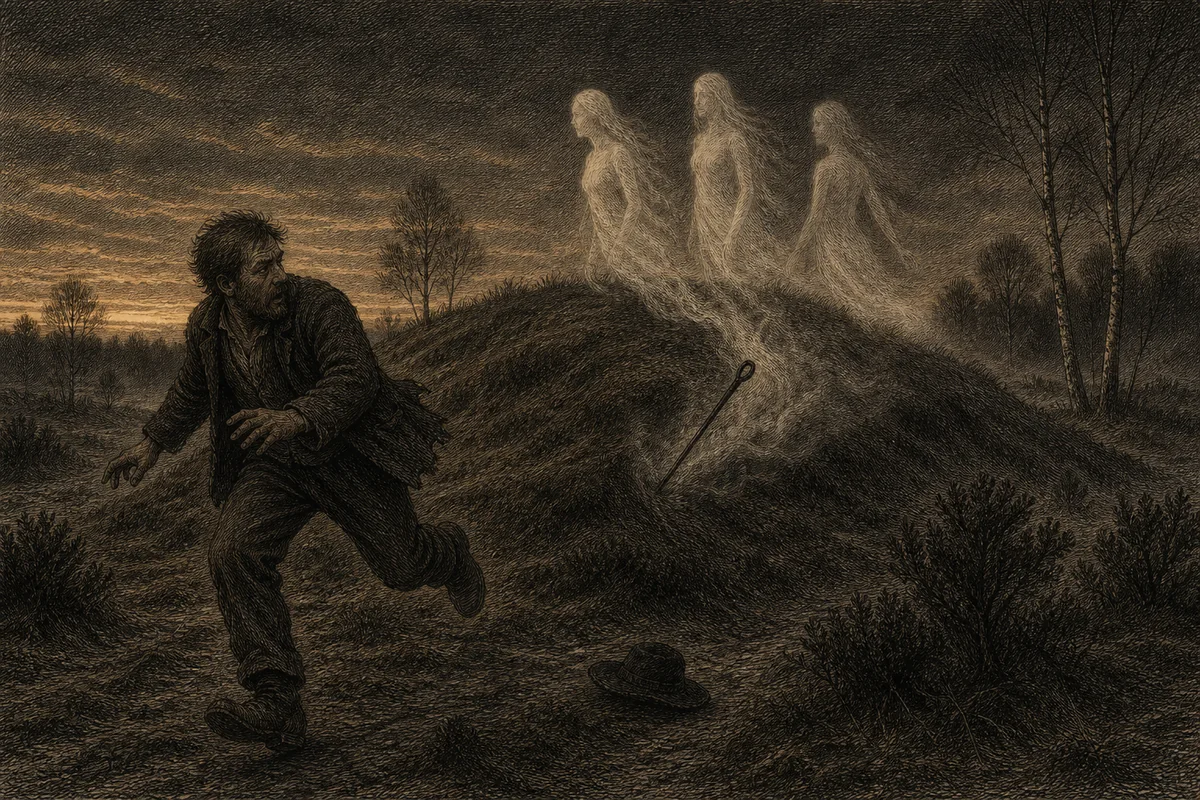
Witte wieven — whitish female figures that appear at dusk near burial mounds, ponds and woods, often indistinguishable from the rising mist — in many versions they are made of mist.
- Variants and names
- witte wieven, «white women» in Dutch Low Saxon. To be distinguished from the witte juffers, who appear near castles and crossroads and are the only ones described as souls in torment. German parallels: weiße Frauen, in Low German witte Wiwer, and in north-western Germany Sibyllen. Toponyms: Witte wievenkuil near Markelo, Wittewievenpoel near Garderen.
- What is told
- Whitish female figures that appear at dusk near burial mounds, ponds and woods, often indistinguishable from the rising mist — in many versions they are made of mist. In 1660 Johan Picardt describes them in favourable terms: they assisted women in labour, foretold the future, pointed out hidden treasure, and were venerated «as something divine». The ritual gesture that concerns them is not an offering but a challenge: a roasting spit was driven into the flank of the mound with the cry «Witte wieven wit, hier breng ik oe het spit, zie moar dat je het gebroad erbie kriegt» — white women white, here is the spit, get the roast for yourselves — and then one ran, because they gave chase.
- What it was forthe author’s reading
- They are the form taken, in a plain without relief, by the point at which the landscape ceases to be legible: the low mist over the heath at sunset, when distances are cancelled and the mounds seem to move. The challenge with the spit is the counter-proof that this is not devotion but dangerous play: it is a rite of male courage, often bound up with wedding invitations, where the risk is precisely the point.
- Where it is attested
- Johan Picardt, Korte Beschryvinge van eenige Vergetene en Verborgene Antiquiteten, 1660 — the cardinal source, which reports that the inhabitants told of witte wieven dwelling in the mounds, and that women in labour were brought there; the volume contains a contemporary engraving. Earlier still, Cornelius Kempius, De origine… Frisiae, 1588. Balthasar Bekker, De betoverde weereld, 1691, discusses the belief and proposes the etymology «wise women». Jacob Grimm, Deutsche Mythologie, 1835, records the phenomenon for Frisia, Drenthe and the Netherlands. Studies: W. de Blécourt, R. A. Koman, J. van der Kooi, T. Meder, Verhalen van stad en streek, Amsterdam 2010; the Volksverhalenbank of the Meertens Instituut (over two hundred legends); A. Idzinga, Nevel, boswezen, of dwalende ziel?, in «Neerlandistiek», 2024.
- Caution
- Four things that are read everywhere and do not hold. The link with the hunebedden, the megalithic dolmens, is not ancient: in the source of 1660 those monuments are attributed to giants, and the witte wieven are in the earthen mounds. The equation with the dolmens, today omnipresent in the tourist promotion of Drenthe, is a later shift. The food left as an offering on the stones is not documented: what is documented is the challenge with the spit, which is the opposite. The «pre-Christian» or «7th-century» origin, repeated from Wikipedia onwards, has no attestation whatever: the oldest solid one is of 1660. And the etymology wit = «who knows» is a conjecture of Bekker’s from 1691, not a modern philological reading: in the neighbouring languages — dames blanches, weiße Frauen, white ladies — the term denotes the colour. A warning about the chain of transmission is to be added: the most cited twentieth-century collections, the sagenboeken of J. R. W. Sinninghe, have been the object of a severe methodological critique by Willem de Blécourt («Volkskundig Bulletin» 7, 1981), who showed that many narratives come from earlier publications and not from the field.
The grade says how well the entry is documented, not how interesting it is. How the grades are assigned.