Frau Holle e Frau Perchta
Germany
Hesse and Thuringia for Holle, the East Upper German area — Bavaria, Austria, Tyrol — for Perchta
Frau Holle e Frau Perchta — the winter Lady of the Germanic and Alpine area, who rewards diligence and punishes those who have not spun: the fairy tale is the most recent layer.
- Variants and names
- Holle, Holla, Holda, Hulda: from Germanic *hulþaz «favourable, benevolent», that is «the Benevolent One» — a euphemistic name, a classic form of taboo. Silesian variant specialised in spinning: Spillaholle. Perchta, Berchta, Berchtlmuada, Rauhweib; Slovene Pehtra Baba. The etymology of Perchta is disputed: «the Shining One» according to Grimm, or else — the reading more economical today — from giberahta naht, «bright night», that is Epiphany: a calendrical name
- What is told
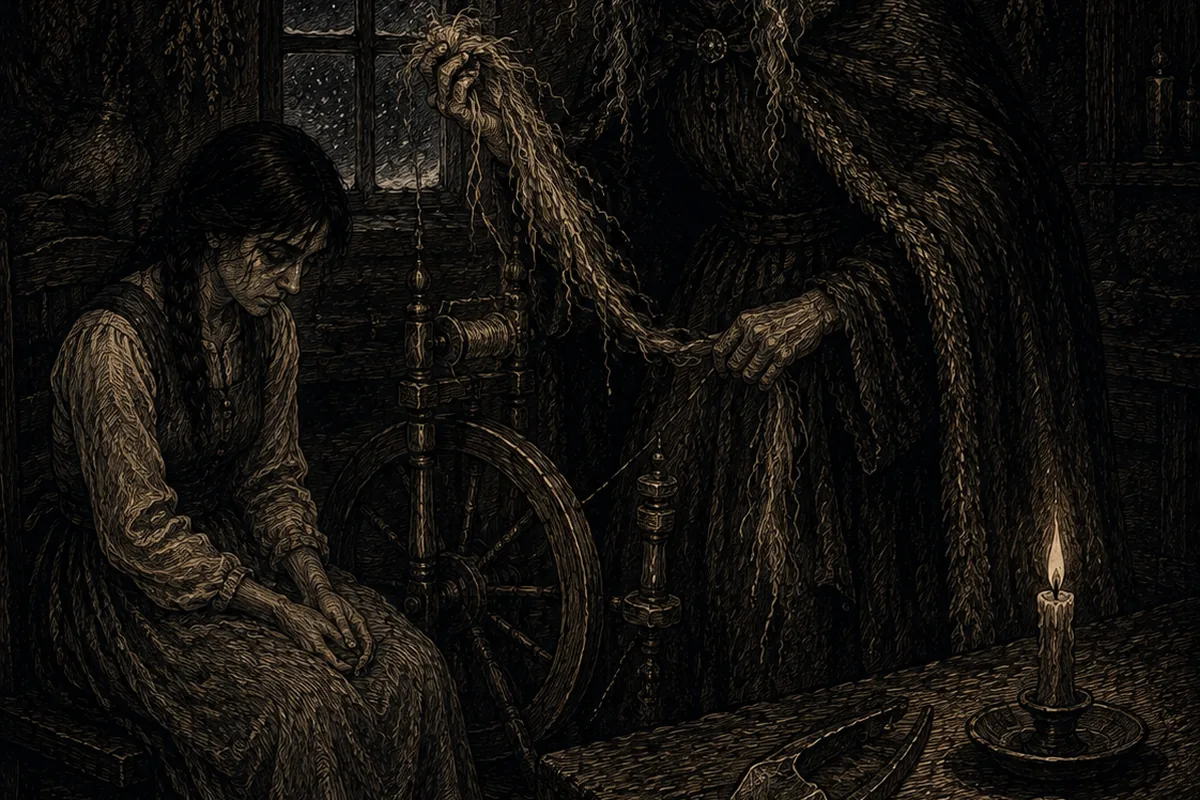
- The fairy tale is the most recent level. The ancient level is a calendrical figure of the Twelve Nights who inspects domestic work and the observance of the festival fast: to those who have not spun, or have spun badly, or have eaten fat on the prescribed days, she opens the belly, draws out the contents and fills it with straw, tow or pebbles, sewing it up again with a ploughshare and a chain. Only much later comes the fairy tale of the girl who falls into the well, serves an old lady and is covered with gold, while the lazy one receives pitch; and the shaking of the featherbeds that makes it snow is a late and local motif.
- What it was forthe author’s reading
- A supernatural sanction upon a calendar of women's work: the closing of the spinning cycle by Epiphany, observance of the days of abstinence, order in the house. It is the standard functional hypothesis and it holds up well ethnographically, but it must be said that the ancient sources we have are clerical condemnations: they tell us what people believed, not why.
- Where it is attested
- Holda appears in Burchard of Worms, Decretum, book XIX, between 1008 and 1012: the women who believe they ride by night with a throng of demons, «quam vulgaris stultitia Holdam vocat». Perchta not before the 13th century, then in Hans Vintler, Pluemen der Tugent, 1411; Thomas Ebendorfer von Haselbach, De decem praeceptis, around 1439; the Bavarian redaction of the Thesaurus pauperum, 1468. In the modern age, Luther in the Fastenpostille of 1522 uses «fraw Hulda» as a polemical metaphor. The Perchtenlauf is mentioned for the first time in 1582, and really documented only from the eighteenth century, by negative evidence: the Salzburg archiepiscopal prohibitions between 1721 and 1750. The fairy tale is KHM 24, in the Kinder- und Hausmärchen from 1812, told to the Grimms by Dortchen Wild at Kassel.
- Caution
- The knot is historiographical and it is the same as that of nineteenth-century Celticism. Jacob Grimm, Deutsche Mythologie, 1835, chapter XIII, treats Holda and Berhta as epithets of a single Germanic goddess. Grimm falsifies nothing: the problem is one of method — he builds the portrait of the ancient mythology out of a blend of medieval texts and modern collections in which the modern collections are preponderant, then backdates the result by a thousand years. Four facts that that reconstruction has to face: all the pre-modern attestations are in Christian sources of condemnation, and there is not a single pagan source; in those same sources the same figure is also called Diana, Herodias, Abundia, that is, by a classical-Christian grid; in Burchard the first certain appearance of Holda is already hooked to the Virgin as regina caeli; and Holle and Perchta have disjoint geographical distributions, with first attestations two centuries apart. The «one single goddess» reading is Grimm's hypothesis, not a datum — and for this reason the map places the point in Hesse, on Holle's area, with Perchta anchored elsewhere.
The grade says how well the entry is documented, not how interesting it is. How the grades are assigned.