Rübezahl
Germany
Giant Mountains, today divided between the Czech Republic and Poland; German-language documentary tradition, with the collection printed at Leipzig
Rübezahl — the spirit of the Giant Mountains, between Silesia and Bohemia — and not the good-natured giant of children's books.
- Variants and names
- old forms Riebenzahl (1553), Rübenczal (1561), Rübezal, Ribezal; Czech Krakonoš, from the name of the massif; Polish Duch Gór, «spirit of the mountains» — whereas Liczyrzepa, «turnip-counter», is not a popular name but a calque coined in 1945. Respectful appellations in use in the sources: Herr Johannes, Berggeist
- What is told
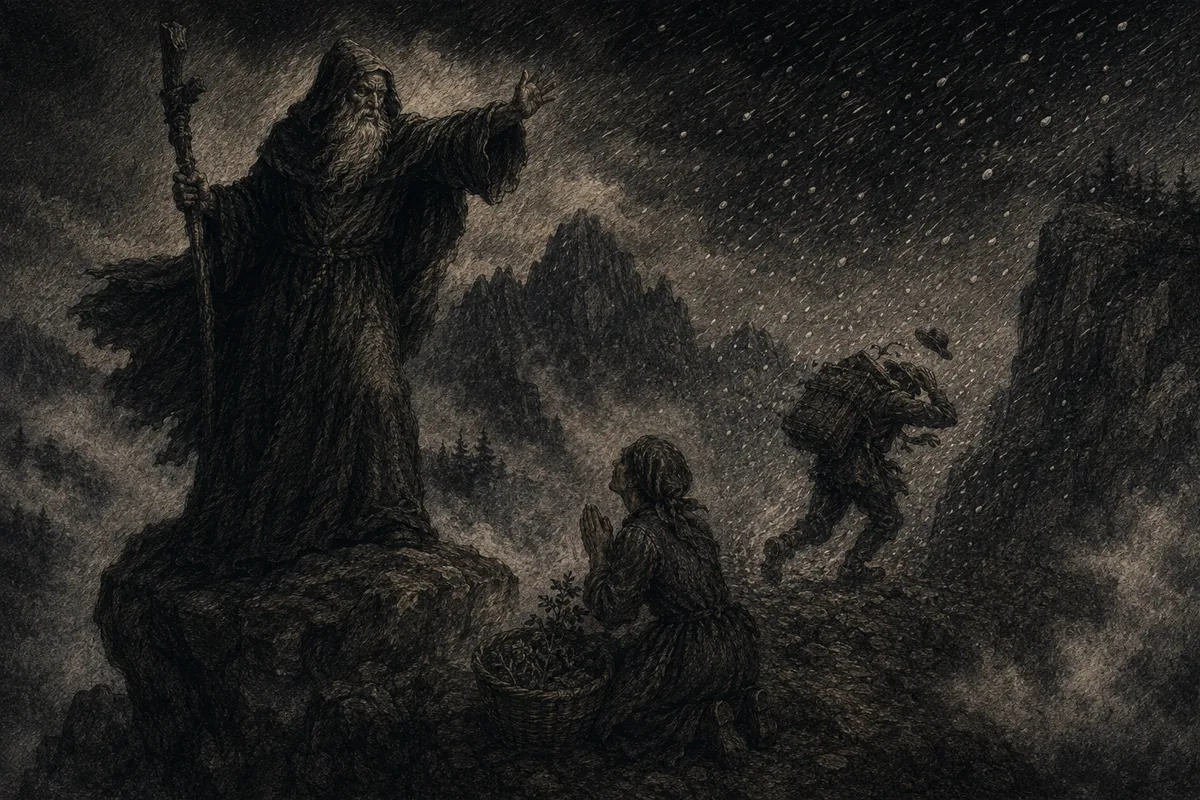
- Not the good-natured giant of children's books. In the seventeenth-century corpus he is a demon of the massif, changeable and touchy: he appears as a monk, a raven, a frog, a mule, an old man, a beggar; he unleashes storm, hail and fog on anyone who names him or mocks him; he rewards the poor, the herb gatherers and honest miners; he punishes greedy merchants and arrogant nobles; he knows the herbs and the metal veins. The fundamental rule is that his name is not to be spoken.
- What it was forthe author’s reading
- Personification of the meteorological risk of high altitude on a massif crossed by miners, gatherers of medicinal herbs, treasure seekers and smugglers; codification of a rule of prudence — do not name, do not boast, do not mock the mountain. Later, an identity marker of a region on a linguistic frontier.
- Where it is attested
- First known mention: 1553, in the itinerary of a gem prospector — which suggests an origin as a mine spirit. First depiction: the map of Silesia of Martin Helwig, 1561, which draws him as a tailed demon. The collection is Johannes Praetorius, Daemonologia Rubinzalii Silesii, Leipzig, three parts between 1662 and 1665: about two hundred and forty stories, still the largest. Then the literary turn of J. K. A. Musäus, Volksmärchen der Deutschen, 1783, which softens the figure; and the brothers Grimm, Deutsche Sagen, 1816-18, who draw on Praetorius.
- Caution
- This entry is filed under Germany for the language of its documentary tradition, but the massif today lies between the Czech Republic and Poland, and the point on the map falls outside the German borders. It is a case in which an atlas organised by states shows its own limit, and I prefer to say so rather than move the dot to make it come out right. On the name: «turnip-counter» is a secondary folk etymology, and is born of the tale in which the spirit, in order to win a princess, must count the turnips of a field, gets it wrong and is mocked — a tale which is by Musäus, 1783. The prevailing philological hypothesis is instead Rübenzagel, «turnip-tail», an abusive nickname for a tailed demon, perfectly consistent with the drawing of 1561. No etymology is demonstrated. And the good character is an Enlightenment and bourgeois product of Musäus, consolidated afterwards by children's literature and by opera.
The grade says how well the entry is documented, not how interesting it is. How the grades are assigned.