The Rumita of Satriano
Basilicata · Appennino centro-meridionale
Satriano di Lucania, province of Potenza
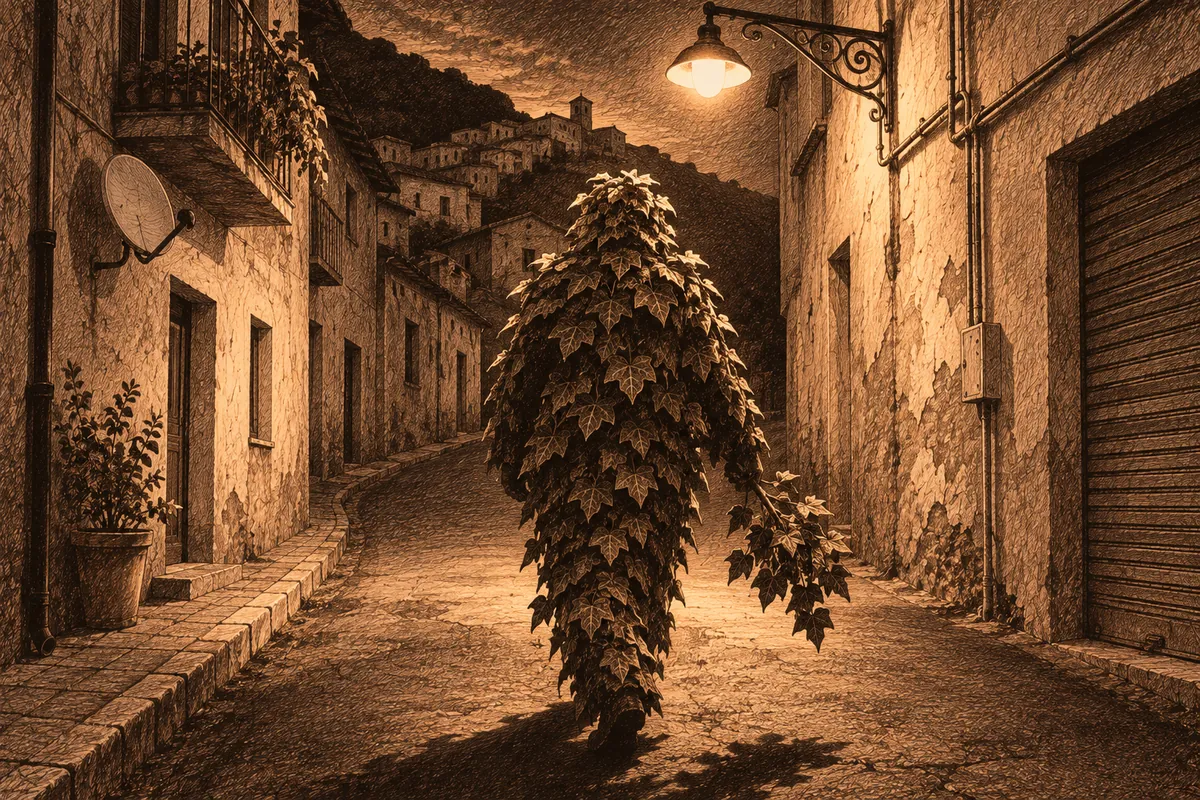
The Rumita of Satriano — a man covered in ivy from head to foot, and the name stands for hermit: from one they became many in 2014, and since then it is argued who decides what shape the mask has.
- Variants and dialect names
- Rumita, and it stands for eremita, hermit: that is the etymology, and none of the sources read disputes it. Since 2014 the procession of many Rumita together is called «la Foresta che Cammina», the walking forest — a new name, not a traditional one
- What is told
- A man covered in ivy from head to foot, so completely that the person is no longer visible: only leaves. In his hand he carries a branch. He walks through the village during carnival.
The name says what he represents: the hermit, the man who lives in the wood outside the community.
Until a few years ago it was one figure, or a few. In 2014 the rite was reconfigured: dozens of figures dressed in ivy walk together, and the ensemble has taken a name of its own, «la Foresta che Cammina». It has become a draw, with a visibility it did not have before.
Of the other masks of the Satriano carnival this entry says nothing, because the sources opened here deal with the Rumita. - What it was forthe author’s reading
- The live question is not what the ivy means. It is who has the right to decide how many figures go out, how they are dressed and what they are called.
Because in 2014 somebody decided, and the decision worked: the Rumita became recognisable outside Basilicata. But a form that changes by somebody's choice is a form with an owner, and on that point the positions inside and outside the village do not coincide. The studies read for this entry are about exactly that: not the symbol, but the contest over authority on the form.
Which is why the Rumita stands in the atlas beside the mamuthones and the Historiantes. In all three the interesting thing is not how old the rite is, but what happens to a rite when it becomes an asset to be shown: who represents it, who administers it, who corrects it. - Where it is attested
- Luigi Ferracuti, in Gazeta de Antropología 41(2), 2025, open access. It is the text that sets out the question of the 2014 reconfiguration and of the contest over the form. It is cited by section and not by page because the journal does not paginate its articles: they are published in continuous format, with no printed numbering.
Ferdinando Mirizzi, in Archivio di Etnografia XI, 1-2 (2016), pp. 35-46; the passage on Satriano is at pp. 44-45.
ICCD record, MODI catalogue, code ICCD14954844: survey of 7 February 2016, compiled by Carminella Bochicchio. It is an act of state cataloguing, with a date and the surveyor's name, and it serves as the official photograph of how the rite presented itself two years after the reconfiguration.
No direct observation on the spot was made, and no participants were interviewed: everything here comes from texts. - Caution
- None of the sources read speaks of pre-Christian origins. Not «no source proves it»: none says it. The green man, the vegetation demon, the pre-Roman tree cult are readings met with in popular material and not in the studies opened for this entry. The only documented etymology is Rumita from eremita, which points to a Christian figure, not a pagan one.
«La Foresta che Cammina» is of 2014. Anyone who finds it presented as an immemorial tradition is warned: the name and the collective format have a date, and the date is recent. That does not make it false — rites are remade continually, and that is normal — but it makes it dated, and that is a difference worth stating.
How many figures go out today is not a number this entry can give. It varies from year to year and depends on who organises; none of the sources read fixes a verified figure, and none is invented here.
The content of the ICCD record was not read in full: its code, survey date and compiler are known. Anyone wanting the official description of the rite will find it there, and it is the first document to open to improve this entry.
What stays outside, and would be the most interesting part: the voices of the village. What people in Satriano think of the 2014 transformation is not known from here, because nobody went and asked.
The grade says how well the entry is documented, not how interesting it is. How the grades are assigned.