The dance of the Historiantes
El Salvador
San Antonio Abad, today a quarter of San Salvador, where the dance is described with the greatest operational precision; the national census counts thirty-two groups in thirty-one municipalities, and the most imposing tradition is that of Izalco, in the department of Sonsonate
The dance of the Historiantes — a Moors-and-Christians battle imported from Spain, learnt by heart and played on a drum that still bears a Nahua name: the text comes from outside, the voice and the rhythm are local, and in some villages the Spaniards lose.
- Variants and names
- historiantes: not moros y cristianos, which is the name of the genre, but those who «do the historia». The rehearsal space is called the morería; the man who directs is the ensayador; the texts are called «los originales»
- What is told
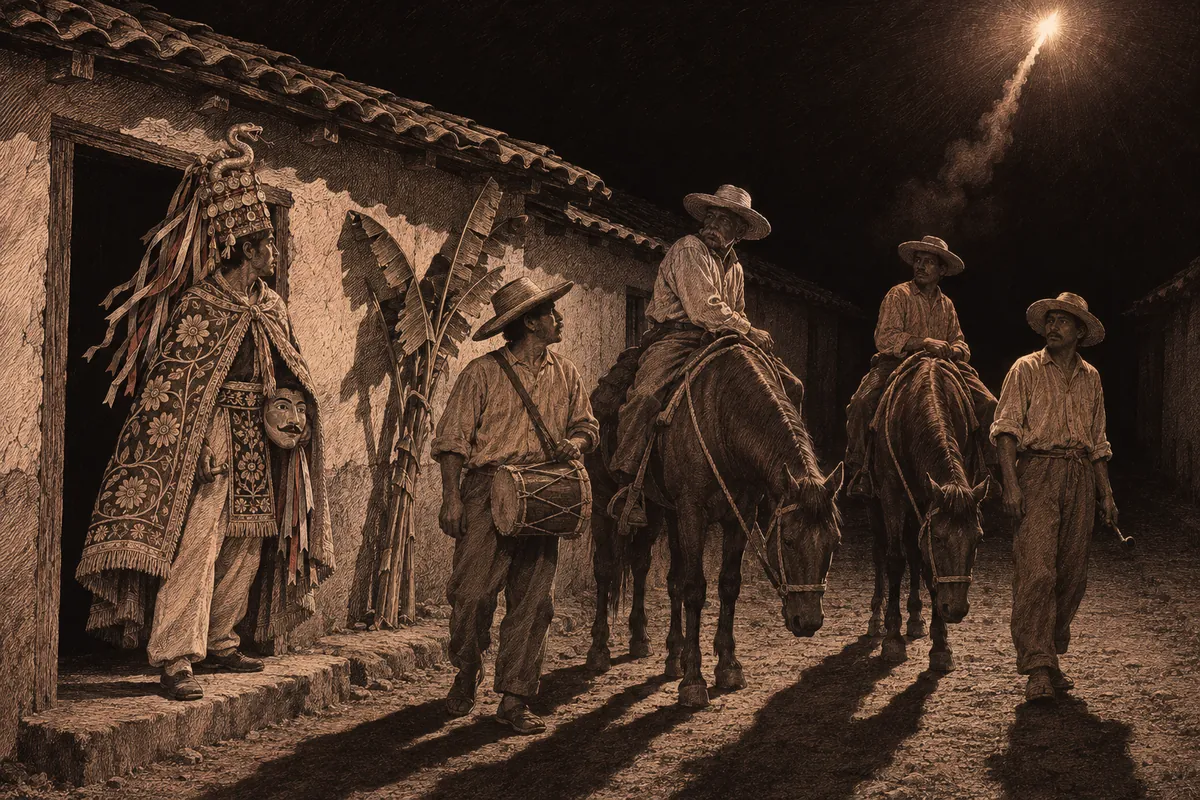
- Twelve masked dancers, six Moors and six Christians, to an accompaniment of two instruments only: a cane pipe and a drum. The Moorish headdresses carry ribbons, coins and figures of mermaids, serpents, dragons or monkeys; the Christian ones flowers and crosses. It is not one battle that is danced: separate titled historias are performed — El Rey y San Bartolomé, La Batalla, Carlos Magno, Los doce pares de Francia, David y Goliat, El Duque de Medina — each group owning its own as property.
The calendar is that of the patronal feasts: at San Antonio Abad 15-17 January, at Izalco 8-16 August, at Nahuizalco 20-25 June, at Cuisnahuat 27-30 November. Two phases have a name: the Encamisada, the group's first round two weeks before the feast, when the ensayador rides out at four in the morning with horses to collect the first dancer and a rocket announces each pick-up; and the Coronamiento, on the eve, before the church, where they only dance and do not recite. - What it was forthe author’s reading
- What separates it from the hundreds of Moors-and-Christians dances of Spain and the Americas is not the plot, which is Iberian: it is what the villages have put inside it. The anachronisms are deliberate and considerable — the bandit Partideño promoted to Moorish king, Aztec emperors in the cast — some groups have replaced the Moorish parts with local figures, and some reverse the outcome and make the Spaniards lose. It is not a dance adopted: it is a dance rewritten against the message it was brought for.
Around it stands a small and documented economy. The ensayador summons, holds rehearsals from September on Sundays from eight to noon in his own house, keeps discipline and sews the costumes, masks and headdresses himself; the piper and the drummer are paid for rehearsals; at Santo Domingo de Guzmán the musicians go house to house to invite the dancers, who offer coffee and bread, and the group joins the procession of the confraternity's mayordomo. - Where it is attested
- Julio Martínez Rivera, «Moros y cristianos. Hacia un mapa conceptual y geográfico en El Salvador», Revista de Museología Kóot, year 7, no. 8, 2017, pp. 203-218 (DOI 10.5377/koot.v0i8.5875): p. 206 for the Spanish origin, p. 207 for the lack of any systematisation of the texts, p. 209 for Izalco and for the prognosis of loss, p. 210 for the teponahuaste and for the pairing of a ladino text with indigenous music, p. 212 for the denial of pre-Columbian continuity, p. 214 for the calendar by municipality, p. 215 for the census.
Ana Lilian Ramírez C. and Gregorio Bello-Suazo C., «Danzas tradicionales de El Salvador: memoria y tradición en dos localidades», Ístmica no. 18, 2015, pp. 131-152: p. 147 for the twelve dancers, the headdresses, «los originales» and the pipe and drum; p. 148 for the summoning and the January dates; p. 150 for the rehearsals, the morería (n. 2), the musicians' pay and the ensayador who makes the costumes, with Celio López named at n. 3; p. 151 for the Encamisada and the Coronamiento; pp. 133, 135 and 140 for Tacuba, where the tradition has died out.
Reynaldo Antonio Rivas, «Los historiantes de Huertas: La danza de los Moros y Cristianos», Kóot no. 12, 2022, pp. 71-87: fieldwork of 2019 at Las Huertas, Ilobasco, with the four generations named one by one and the lost librito on Charlemagne.
Carlos Benjamín Lara Martínez, «Tradicionalismo y modernidad: el sistema de cofradías en Santo Domingo de Guzmán», Religiosidad no. 8, fieldwork of 2000: pp. 42-43 for the line-up and the costumes sewn by the dancers, p. 43 for the texts that «no se logran entender», pp. 43-44 for the reading as a representation of white superiority, p. 46 for the entry into the mayordomo's procession.
Plus Johanna Magdalena Marroquín Joachin, undergraduate thesis in anthropology on Panchimalco, Universidad de El Salvador, September 2009, ch. II § 2.6; and Julio César Martínez Rivera, La fiesta de moros y cristianos o «los historiantes» de El Salvador. Un caso de sincretismo cultural, doctoral thesis, Universidad de Alicante, defended 12 January 2022, 313 pp., handle 10045/122015 — of this only the record was seen, not the text: the repository did not serve the PDF.
Two decisive sources were not opened, and that must be said: Pedro Cortés y Larraz, Descripción geográfico-moral de la diócesis de Goathemala, visitation of 1768-1770, work of 1776, which is the oldest attestation and is known here only through others' citation; and Ministerio de Cultura y Comunicaciones, Etnografía de El Salvador, San Salvador, Dirección de Publicaciones, 1985, which is where the texts should be looked for. That is the reason for grade B. - Caution
- Pre-Columbian continuity does not hold, and the remarkable thing is that none of the specialists maintains it. Martínez Rivera denies it in writing — «no es la historia de los pueblos originarios, aunque muchos la perciben así» (2017, p. 212) — and treats the contrary perception as a phenomenon to be explained; on the origin he writes that «es seguro que las primeras fiestas se realizaron en España y no en América» (p. 206). Ramírez and Bello-Suazo call it introduced by the Spaniards during the conquest (2015, p. 147). Lara Martínez reads it as a representation of the superiority of the white man over the Indian. And — the datum that closes the question — Salvadoran indigenous organisations consider the dance Western and not their own.
Why then is it repeatedly called Pipil? Two vectors, and the second is an hypothesis declared as such. The first is real and material: the drum is called the teponahuaste in the oldest groups, that is, it bears a Nahua name inside a rite of European frame — but that is evidence of instrumental syncretism, of an imported rite played on local instruments, not of a local rite in disguise. The second: in 1983 Smithsonian Folkways issued a recording by David Blair Stiffler entitled The Pipil Indians of El Salvador. A title of that institutional weight is enough on its own to generate decades of claims of pre-Columbian descent, by a simple slide from the ethnographic subject to the origin of the rite. The hypothesis is this writer's and must be checked against the record's booklet, which was not opened.
The family manuscript scripts do not exist, or at least are not documented. It is the thing one reads everywhere and which the enquiry disproved. The attested term is «los originales», and Ramírez and Bello-Suazo specify that the participants «en su mayoría… memorizan» the booklets and that these «les son trasladados muchas veces oralmente» (2015, p. 147). Martínez Rivera is blunter: «no ha existido una sistematización de la danza o teatro» (2017, p. 207), «Los textos originales fueron perdiéndose» (2016). At Las Huertas «no hay un texto escrito» and the librito that existed — on Charlemagne and the twelve peers — is lost; and it was in all likelihood not a family manuscript but a printed chapbook, Nicolás de Piamonte's Historia del emperador Carlomagno, very widely circulated throughout Spanish America: this too is this writer's hypothesis, not a datum. No published transcription, no dating of a script, no archival location. Whoever offers them with author, year and page should be asked to show the page.
And it is not a baile de la conquista. There is no Alvarado, no defeated chieftain. Where Guatemala replaced the Iberian frame with its own conquest, El Salvador kept it abstract and slipped its own anachronisms inside.
One simple thing, finally, remains undocumented because nobody has ever measured it: how long a performance lasts.
The grade says how well the entry is documented, not how interesting it is. How the grades are assigned.