Alkarısı
Türkiye
Anatolia; Yahnikapan, Eskişehir, where a healing «hearth» has been documented in the field up to 2022
Alkarısı — the Anatolian demon that attacks the new mother in the forty days after giving birth and tears out her liver.
- Variants and names
- Turkish Alkarısı, Albastı, Al Anası, Al Kızı; in Azerbaijani Hal anası. In the rest of the Turkic world: albastı in Kazakh, Uzbek, Tatar; albarstı in Kyrgyz and Turkmen; almastı among the Karachay-Balkars. The second element is uncontroversial — bas-tı, «it pressed», hence the demon that presses down. On the first, it is not.
- What is told
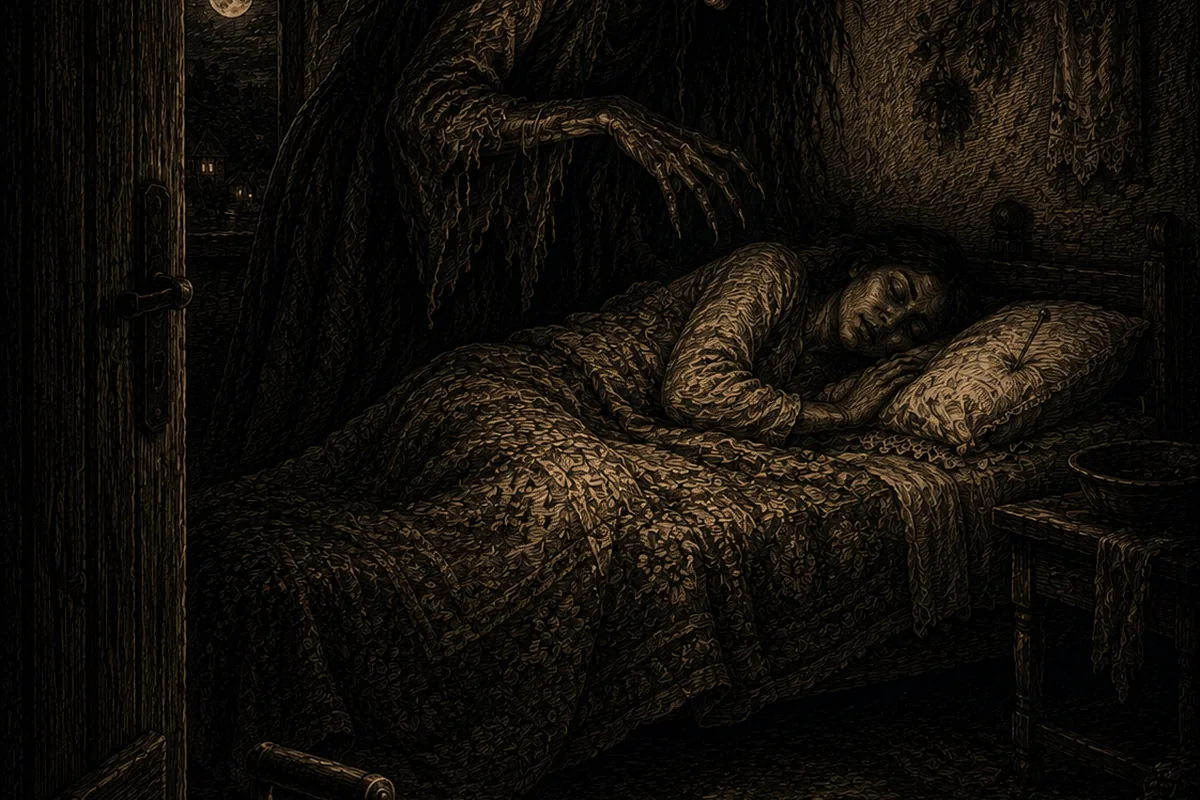
- It attacks the loğusa, the woman in the forty days after giving birth. It tears out her liver — in the Central Asian variants the lungs — and runs towards the water: when the organ touches running water, the woman dies. It is tall, with long tangled hair, enormous breasts thrown back over its shoulders, long nails, horse's teeth, and in certain descriptions feet turned backwards. The defences are all household objects: the needle or the pin in the collar and in the pillow, iron, the knife, garlic and onion, bread, the broom, the Qur'an at the bedside, a red ribbon on the new mother, the light left on and the continuous vigil for forty days. And there is the best motif of all: whoever drives a needle into it keeps it at home as a servant, and loses it the instant the needle is taken out.
- What it was forthe author’s reading
- It gives a name and a face to a death that came suddenly upon a healthy woman. It is not an explanation of suffering in general: it is the explanation of that week, the first after the birth, and it organises around the new mother an apparatus of uninterrupted surveillance.
- Where it is attested
- The most solid synthesis on the name and on the figure is Edina Dallos, «Albasty: A Female Demon of Turkic Peoples», Acta Ethnographica Hungarica 64, 2 (2019), pp. 413-423, open access. For the Anatolian side: Abdülkadir İnan, Tarihte ve Bugün Şamanizm, Türk Tarih Kurumu, 1954, and the entry «Alkarısı» by Abdurrahman Küçük in the Türkiye Diyanet Vakfı İslâm Ansiklopedisi, vol. 2, 1989, p. 469, which defines it without circumlocution as the cause attributed to lohusa humması, puerperal fever. The belief has been documented in the field recently and more than once: Sivas, 114 informants gathered between 2014 and 2017; Ağrı, 2016; Eskişehir, fieldwork 2020-2022; the Kelkit valley and Isparta, 2025.
- Caution
- Grade A: a scholarly encyclopaedia, an article in a peer-reviewed ethnographic journal, and — the thing that weighs most here — five pieces of field research published between 2016 and 2025. This is not archival material: it is a belief that someone has gone and verified in person over the last ten years.
What is not demonstrated is the etymology. That al means «red» is a hypothesis, not a fact. Dallos lists four competing proposals and shows that the most popular one limps: in the mythic texts the albastı is yellow or black, not red. The others invoke an Iranian concept, or Old Turkic alp in the sense of «heavy, dangerous». The «red» is probably folk etymology, reinforced after the fact by the red ribbon of the ritual.
I have not confirmed, and therefore I do not assert: a passage on the albastı in Radloff, an entry «Albasti» in the Encyclopaedia of Islam, a treatment in Jean-Paul Roux, nor the pages of Boratav that are often cited.
The grade says how well the entry is documented, not how interesting it is. How the grades are assigned.