Qarīn
Egypt
Egypt, with the rural documentation collected in Upper Egypt and the urban documentation of the zār rite in Cairo
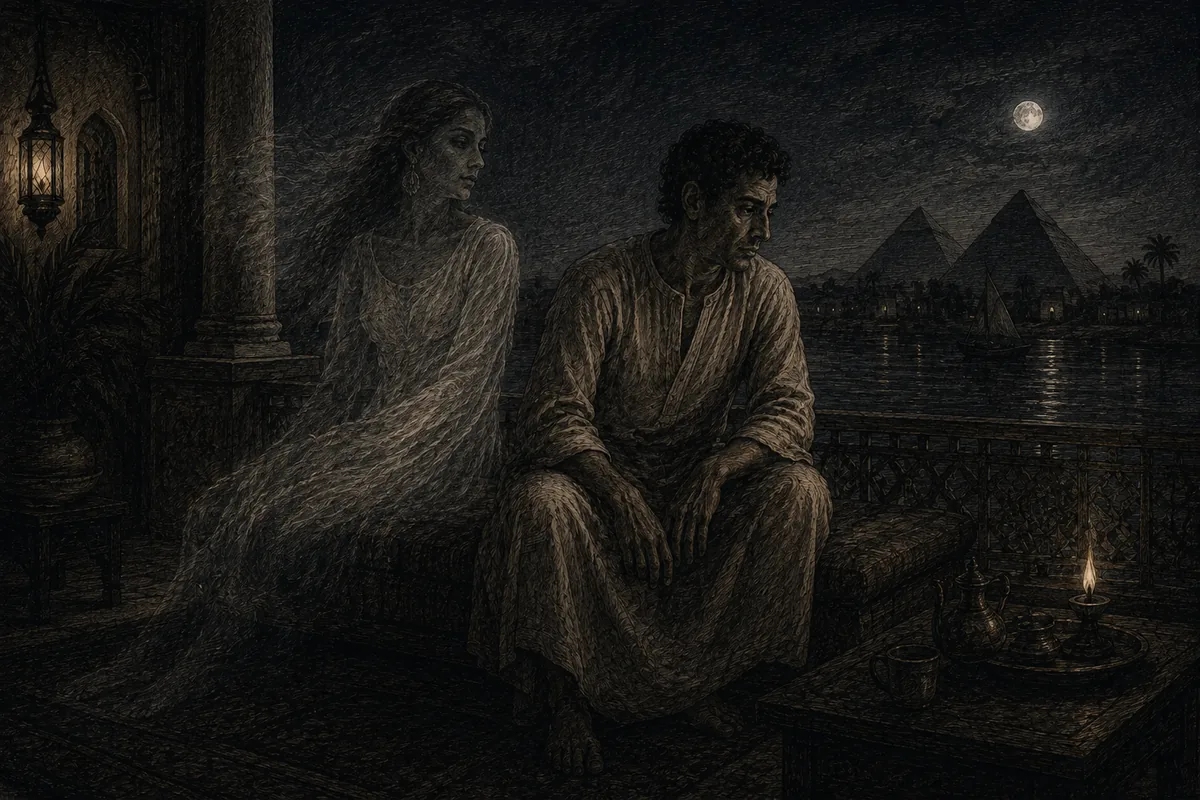
Qarīn — the invisible double that every person has in Egyptian popular belief, of the sex opposite to their own.
- Variants and names
- Arabic qarīn (قرين), «constant companion, the one paired with»; feminine qarīna; Egyptian popular plurals qurana, akrān. In her infanticidal specialisation the female figure takes the name Umm al-Ṣibyān (أم الصبيان), «mother of the children»
- What is told
- Every person has an invisible double, and in Egyptian popular belief it is of the opposite sex: a man's qarīna, a woman's qarīn. It is jealous. The mother's qarīna envies the human children and makes them fall ill or die; Umm al-Ṣibyān sends newborns to their death by making use of the child's own qarīn. The countermeasures are precise and all concern the first days of life: for seven days the child is declared to be of the sex opposite to the real one, cats are not struck, a candle is lit in a basin of water beside the cradle, iron anklets are put on the mother and on the surviving children.
- What it was forthe author’s reading
- Three functions, all interpretative. A domestic theodicy, which gives the death of the newborn an external and non-blaming cause. A protocol of behaviour around the puerperium — seclusion, surveillance, the sebūʿ on the seventh day — which covers exactly the window in which the real risk is greatest. And, in the rite of the zār, an instrument of negotiation: the relationship with the double-spirit allows a woman to formulate publicly demands — expenses, rest, exemptions — that she could not advance in her own person.
- Where it is attested
- The scriptural bases must be weighed with care. The root recurs in the Qur'an eight times as a noun: in 43:36 God assigns a demon as qarīn to whoever turns away from His remembrance, and in 50:27 the qarīn at the Judgement exculpates himself. But in 50:23, the most-cited verse, the majority of the classical commentators — Ibn Kathīr included — understand the recording angel, not the demon. The true foundation of the universal belief is instead a hadith: Ṣaḥīḥ Muslim 2814, from Ibn Masʿūd, where the Prophet says that to each is assigned his own qarīn among the jinn, and that God helped him against his own. For Egypt: Lane 1836; Samuel M. Zwemer, The Influence of Animism on Islam, 1920, chapter VI, the most detailed treatment of the qarīna/Umm al-Ṣibyān complex; Winifred S. Blackman, The Fellāhīn of Upper Egypt, 1927.
- Caution
- Two cautions. The first concerns a source: Zwemer was a Protestant missionary with an apologetic thesis, popular Islam as an animist residue. His data are usable, his frame is not, and the two must be separated. The second concerns doctrine: the «double of the opposite sex» is absent from the Qur'an and from the hadith. It is Egyptian popular tradition, and whoever presents it as Islamic teaching attributes to a religion what belongs to a folklore — the symmetrical error of one who passed off the restless dead as Catholic dogma. Also to be corrected is the equation of qarīn with soulmate: in modern Arabic qarīn(a) also means spouse, but this is a homonymy of usage.
The grade says how well the entry is documented, not how interesting it is. How the grades are assigned.