Curupira
Brazil
Amazonia, with the documentary centre of gravity at Belém and on the lower Amazon
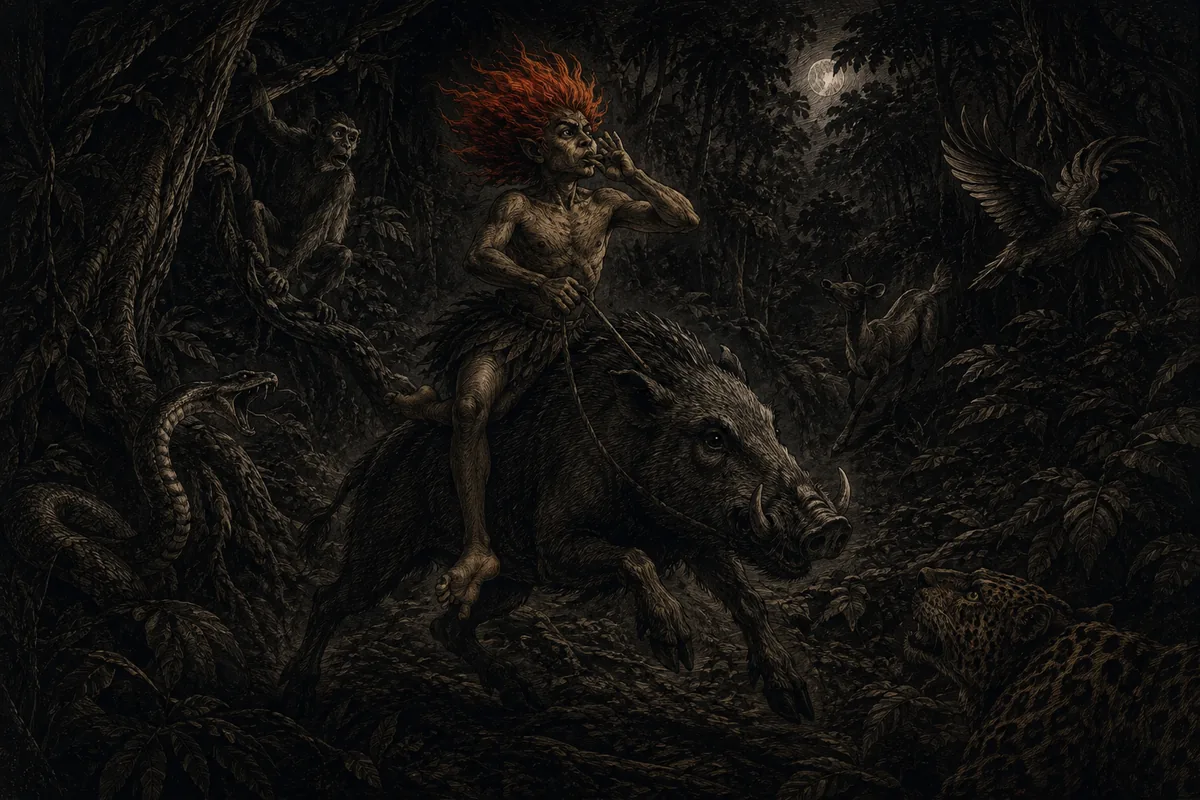
Curupira — a dwarf with hair of fire and feet turned backwards, who rides a peccary, whistles piercingly and rules the forest.
- Variants and names
- Old Tupi kurupira, in the old spellings corupira and currupira; related but distinct is the Caipora or Caapora (Tupi ka'a «forest» + pora «dweller»); Curupi in Paraguay and in Misiones
- What is told
- A dwarf with hair of fire and feet turned backwards, who rides a peccary, whistles piercingly and rules the forest. He punishes those who hunt beyond need, those who kill pregnant females, those who leave nothing for the animals; he is placated with offerings of tobacco and cachaça left on tree stumps. Whoever pursues him by following his tracks walks exactly in the direction from which he came, and is lost. But this is the nineteenth-century form. In the oldest document, of 1560, there is none of this: the corupira is a demon of the scrub who assails the Indians, flogs them, wounds them and kills them, and the offerings left on the paths serve only to avoid being attacked.
- What it was forthe author’s reading
- In the current reading he is a customary regulator of hunting offtake: the Amazonian version of those «masters of the animals» that ethnography finds across half the world, and at the same time the codification of the real danger of getting lost in the forest. From the 1970s the figure was readopted by environmentalism to the point of becoming an institutional mascot. It must be said that the conservation effectiveness attributed to the myth has never been measured: it is a reasonable hypothesis, not a result.
- Where it is attested
- The oldest mention is in the letter of José de Anchieta from São Vicente, May 1560, to the father general of the Society of Jesus: «há certos demônios, que os brasis chamam corupira, que acometem aos índios muitas vezes no mato, dão-lhes açoites, machucam-nos e matam-nos». There follow Fernão Cardim (1584) and Johannes de Laet (1640). The modern collections: Couto de Magalhães, O Selvagem, 1876, with the Nheengatu texts on facing pages; Sílvio Romero, Contos Populares do Brasil, 1885; Luís da Câmara Cascudo, Geografia dos mitos brasileiros, 1947, and Dicionário do folclore brasileiro, 1954.
- Caution
- It is probably the oldest written mention of a being of Brazilian folklore, and it says the exact opposite of what is taught today: the Curupira of 1560 protects no one, he attacks. The ecological guardian is a construction of the last fifty years. The point on the map is at Belém, that is, where the entry is documented and alive today; the first attestation, however, is from São Paulo, two thousand kilometres away, and whoever presents it as an «original Amazonian myth» skips that step. Also to be corrected are the equation of Curupira with Caipora, which Cascudo keeps distinct, and the etymology «body of a boy», which circulates as certain while the morphologically more solid reconstruction is «skin of pustules».
The grade says how well the entry is documented, not how interesting it is. How the grades are assigned.