Aswang
the Philippines
Visayas, southern Luzon and Mindanao, with a symbolic concentration on the province of Capiz, island of Panay
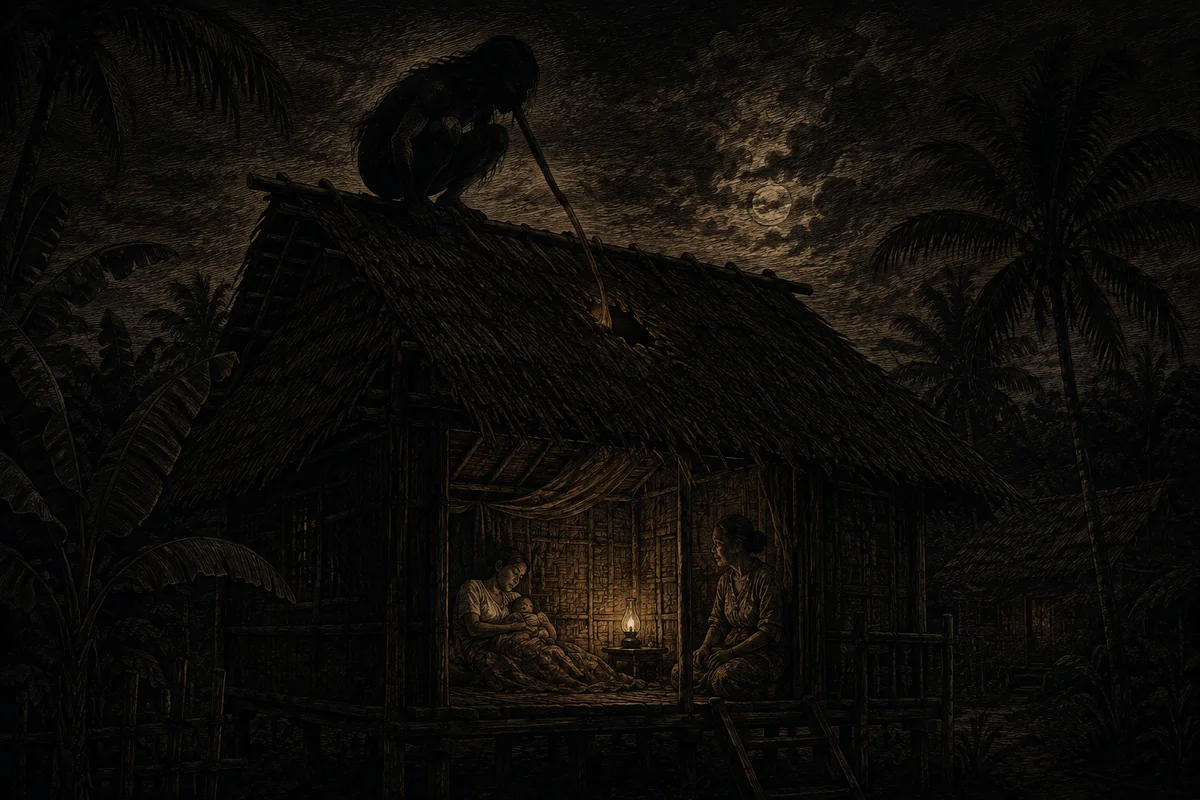
Aswang — the canonical prey is the foetus or the newborn; the secondary victim is the woman in labour.
- Variants and names
- Standard spelling aswang; in colonial and nineteenth-century sources asuang, osuang, usuang; in Bikol asuwang. It is not a creature but a superordinate term — Maximo D. Ramos speaks of an aswang complex, an aggregate that popular vocabulary lumps together: the vampiric aswang (an ordinary, often beautiful woman by day, who feeds by means of a thin, elongated tongue); the manananggal, which splits at the waist and flies away; the shape-shifting weredog; the witch-like aswang, recognisable by the inverted reflection in its pupils; the necrophagous aswang. Neighbouring figures: tik-tik and wakwak, named after the cry that signals their presence, mandurugo, silagan.
- What is told
- The canonical prey is the foetus or the newborn; the secondary victim is the woman in labour. By day the vampiric aswang is an ordinary woman, often beautiful, and by night she reaches the house of the pregnant woman: she feeds by means of a proboscis-like tongue, not with canines. The manananggal separates in two at waist height and the upper half flies away, leaving the legs standing somewhere; the witch-like aswang is recognised because in its pupils your image is upside down. The cry of the tik-tik signals its proximity according to a rule that must be stated in full, because almost everyone inverts it: a loud sound means it is far away, a faint sound that it is close.
- What it was forthe author’s reading
- Two functions, and a third that is disputed. The first is mutual surveillance and the regulation of pregnancy: the story encodes in threatening form a real demographic risk — perinatal mortality in rural communities — and produces an executable protocol: do not leave the pregnant woman alone, keep watch at night, recognise the signs. The second is the marking of social anomaly: the aswang is not a remote entity, it is the next-door neighbour, and it is identified in whoever deviates — those who live in isolation, those who come from elsewhere, those whose appearance or movement is unexplained. On this second point there exists a studied material correlate, and it is the most interesting thing in the whole entry: X-linked dystonia-parkinsonism (XDP), a rare genetic disease identified in the Philippines in 1975, has its world epicentre precisely on the island of Panay — every XDP patient known in the world has Panay ancestry. It produces dystonia: cramps in the feet, twisting of the neck, tongue protrusion, then parkinsonian symptoms. A visible and unexplained hereditary disease supplies the body on which the category stabilises, and the category in its turn produces real stigma against the sick: it is the declared reason why the University of the Philippines took its research to the place itself.
- Where it is attested
- Colonial attestation: Juan de Plasencia, Relación de las costumbres de los Tagalos, 1589, which lists among the Tagalog magical practitioners osuang, silagan and magtatangal; then Pedro Chirino, Relación de las Islas Filipinas, 1600; Tomás Ortiz, Práctica del ministerio, 1713; Joaquín Martínez de Zúñiga, Historia de las Islas Filipinas, 1803. Of these sources I report the record: I have not consulted them in critical editions. Anthropological literature: Maximo D. Ramos, The Aswang Complex in Philippine Folklore, Quezon City, 1971 (Phoenix reprint, 1990) and The Aswang Syncrasy in Philippine Folklore, Philippine Folklore Society, 1971; Frank X. Lynch S.J., «Ang mga Aswang: A Bicol Belief», 1949, later in Philippine Society and the Individual, Ateneo de Manila University, 2004, pp. 184-206; Raul Pertierra, «Viscera-Suckers and Female Sociality: The Philippine Asuang», in Philippine Studies 31/3, 1983; Damiana L. Eugenio, Philippine Folk Literature: The Legends, University of the Philippines Press, 2002. On the medical correlate: University of the Philippines Diliman, College of Science, with the statements of Pia Bagamasbad (National Institute of Molecular Biology and Biotechnology), who carried out research at Capiz in 2019. The oldest Philippine academic sources on the subject that I have seen cited are from the 1920s (Perez 1924, Picazo 1926, Barza 1927) — cited at second hand, not verified directly.
- Caution
- The story of the aswang and the CIA must be told in full, because in full it is more interesting than in the current version. In the memoir In the Midst of Wars (1972) Edward Lansdale recounts an operation of psychological warfare against the Hukbalahap rebellion: a psywar squad is said to have spread the rumour that an asuang lived on the hill occupied by the rebels, then to have laid an ambush, taken the last man of a patrol in silence, made two punctures in his neck, hung the body up by the feet to drain of blood and put the corpse back on the path. Now the cautions. There is no independent documentary corroboration: the thesis of Alexandra Eckhart (Bowling Green State University, 2024) notes «a distinct lack of government documentation», which makes the only first-hand account Lansdale's own. The official history of the Huk insurgency published by the U.S. Army Center of Military History, which deals at length with Lansdale and JUSMAG, does not mention any asuang operation: I have consulted the chapter. The institutional attribution is inaccurate: Lansdale was a United States Air Force officer with JUSMAG-Philippines, and the operation, if it took place, would have been carried out by a psywar squad of the Philippine army. And even in Lansdale's account it is a single local episode, not a campaign nor the turning point of the revolt. I have not opened Lansdale's volume and I supply no page number: every page attributed online to this passage is to be considered unverified. On this point the entry is grade C: it is an assertion by Lansdale, not a fact.
Four further corrections. Plasencia in 1589 does not describe the manananggal: the list has magtatangal, and the backdating of the modern term is an artefact of transcription. The aswang has no fangs: the fangs are a Western iconographic import. There is no study by the University of the Philippines according to which «8 out of 10 Panayans have aswang DNA»: it circulates as an aggregator headline, the real research concerns XDP and has as its declared aim the reduction of stigma. And the fame of Capiz is a twentieth-century social fact — the belief on Panay is documented as early as the 1920s, and therefore precedes the legend of the Teniente Gimo by which it is usually explained.
One divergence remains open, which I report without resolving it: a master's thesis from the Ateneo de Manila (Lumina Alinea O. Aquino, 2018-19) argues that the Spanish clergy superimposed the figure of the aswang onto the babaylan, the indigenous priestesses, in order to delegitimise female spiritual authority; a well-documented popular site rejects the stronger version of the same thesis, stating that there is no historical proof. Neither is, as things stand, decisive.
The grade says how well the entry is documented, not how interesting it is. How the grades are assigned.