Soucouyant
Trinidad and Tobago
The anglophone and francophone Caribbean: Trinidad and Tobago, Guyana, Suriname, Saint Lucia, Dominica, Haiti, Grenada, Barbados, the Bahamas and Louisiana
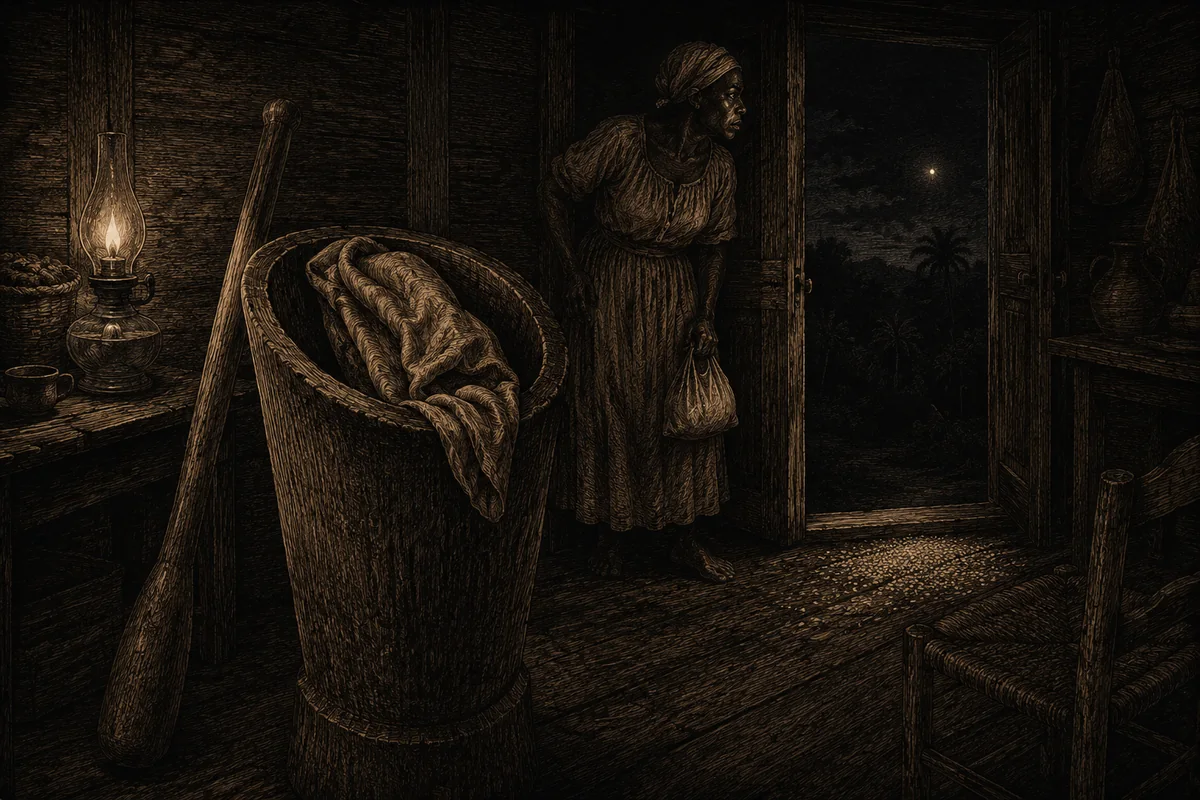
Soucouyant — by day she is an elderly woman living alone who keeps to herself, and her skin looks strangely wrinkled from repeated use.
- Variants and names
- Soucouyant / soucriant in Trinidad and Tobago, Dominica and Saint Lucia; soukougnan, soukounyan, soukounian in the francophone Antilles, in French Guiana and in Suriname; sukunya in Trinidad, Saint Vincent and Guyana; loogaroo or ligaroo in Haiti, Grenada and Dominica, probably from the French loup-garou; jé-rouge «red eyes» in Haiti; old higue in Guyana and Jamaica; hag in the Bahamas and in the Southern United States.
- What is told
- By day she is an elderly woman living alone who keeps to herself, and her skin looks strangely wrinkled from repeated use. By night she slips off her skin and puts it away — canonically in a mortar — and flies as a ball of fire, entering the house by any opening. She sucks the blood of sleepers from the arms, neck, legs and soft parts, leaving bruises; excessive bleeding can kill the victim or turn her in turn into a soucouyant. Before dawn she must return and put the skin back on. The remedies are two, and they have opposite logics. The first: find the skin that has been laid aside and salt it — the soucouyant, trying to get back into it, dies in a paroxysm of burning, or her screams give her away to the neighbourhood. The second: scatter rice on the threshold, on the window sills or at the crossroads, because she is compelled to count every grain before she can go on, and dawn catches her there.
- What it was forthe author’s reading
- The creature is almost always female, and it sanctions exactly the profile of the woman outside the bonds: elderly, hence no longer useful for reproduction; alone, hence not under family control; living apart, hence not open to supervision. The sign that betrays her is the wrinkled skin — that is, ageing itself turned into proof of guilt. The second function is economic: the soucouyant takes blood, that is vital force, from sleepers; she is a figure of hidden extraction, of someone who prospers in the community at the expense of others without it being visible how. In a post-slavery society, where the extraction of labour power was the founding experience, the figure offers a local, domestic and imputable model of a relation that in its real form was anonymous and structural. And she is reversible, which explains her longevity: whoever suffers too much bleeding becomes a soucouyant in turn — the story does not separate victims from perpetrators — and contemporary Caribbean literature has reversed the sign of the figure, reading the woman who takes off her skin and flies as the woman who frees herself of the body that has been assigned to her. The same image does two opposite jobs depending on who is telling it.
- Where it is attested
- Giselle Liza Anatol, The Things That Fly in the Night. Female Vampires in Literature of the Circum-Caribbean and African Diaspora, Rutgers University Press, 2015, 312 pp., ISBN 978-0-8135-6573-6 — I have not opened the volume: I note the record. The positions of Anatol reported here, and the descriptions of the two remedies, come from her popular essay «The Soucouyant» for Humanities Kansas, which I have consulted, and from the publisher's description. Records noted and not consulted: Jacob Delworth Elder, African Survivals in Trinidad and Tobago, London, Karia Press, 1988; Gérard A. Besson, Folklore and Legends of Trinidad and Tobago, Port of Spain, Paria Publishing; Elsie Clews Parsons, Folk-Tales of Andros Island, Bahamas, 1918; Clavel, «Items of Folk-lore from Bahama Negroes», 1904. Lexicographical works that would settle the question of the origin, all left unopened: Oxford English Dictionary, entry soucouyant (paywall; the OED update of September 2021 is devoted to Caribbean English and is the obligatory step for the first dated attestation); Richard Allsopp, Dictionary of Caribbean English Usage, Oxford University Press, 1996; Lise Winer (ed.), Dictionary of the English/Creole of Trinidad & Tobago, McGill-Queen's University Press, 2009.
- Caution
- The Soninke etymology is not verified. The hypothesis that soucouyant goes back to a Soninke term — or Fula, sukunyadyo — for «sorcerer who changes skin» circulates widely, and I have not found it in any academic or lexicographical source that I have been able to open. The form sukunya is attested in the Caribbean, which is compatible both with an African derivation and with a local back-formation. Until the OED, Allsopp 1996 or Winer 2009 are opened, it remains a hypothesis. For the same reason I do not know when soucouyant first appears in writing: the attestations I have been able to identify are from the early twentieth century. Anyone writing «documented from the time of slavery» is asserting something I have not seen.
Four points of precision. She is not «the Caribbean vampire»: she is not a dead person who returns, she is a living person, identifiable, who lives in the community — the underlying model is that of the witch, not of the revenant, and it is this that makes the story operative and socially dangerous, because one can know who she is. The two remedies are not to be mixed up: the salt in the skin is an assault on the body laid aside, the rice on the threshold is a compulsive constraint; salt scattered on the threshold works like the rice, that is as something to be counted. The counting motif is not Caribbean: the demon's compulsive arithmomania is a broad folkloric motif, European and African, and its presence here is a local instance, not a local invention. And «always a woman» should be corrected to «almost always»: at least one source records the male variant, and it is the exception that makes the rule significant.
Two attributions to be refuted. The kinship with the Filipino manananggal is a typological parallel, not a historical relationship: no source consulted proposes a common descent. And Chariandy's novel does not «tell the legend»: it is a novel of forgetting, the story of a son born in Canada who comes back to his Trinidadian mother, who has dementia; the soucouyant functions in it as a figure of memory that returns and will not let itself be spoken.
The grade says how well the entry is documented, not how interesting it is. How the grades are assigned.