Kuntilanak
Indonesia
The Malay-Indonesian world; toponymic anchoring at the confluence of the Kapuas and the Landak, at Pontianak in West Kalimantan
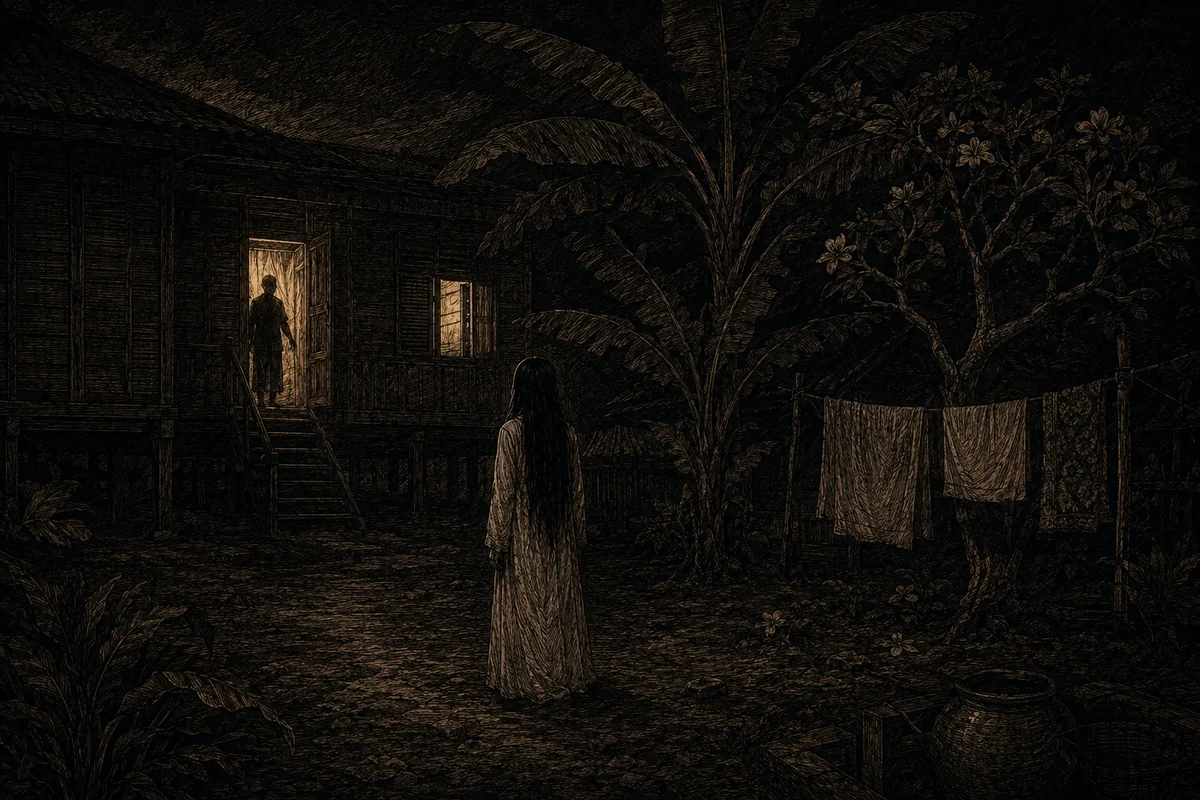
Kuntilanak — a woman in white, very long loose hair, livid skin: beautiful from the front and hideous from behind.
- Variants and names
- Indonesian kuntilanak, Malay pontianak. To be kept distinct from the Javanese sundel bolong, which has a different origin — sundel «prostitute», bolong «holed» — and is bound up with prostitution, violence and abortion, not simply with death in childbirth: today's overlap is recent and largely cinematic. In the Malay classification recorded in 1900 the distinction was sharper still: the langsuir was the spirit of the mother who died in childbirth, the pontianak that of the stillborn child
- What is told
- A woman in white, very long loose hair, livid skin: beautiful from the front and hideous from behind. The apparition is preceded by the scent of frangipani, followed by the smell of carrion. The cry is a newborn's weeping or a laugh, and it obeys an inverse rule: if you hear it loud and far off she is close, if you hear it faint she is far away. By day she is said to be in the banana tree, and the washing is not hung out at night. The countermeasure is a nail driven into the nape, which reduces her to a normal woman, fit to marry — until someone takes it out.
- What it was forthe author’s reading
- Three current readings, all of them hypotheses: the ritual management of «bad death» and of the puerperium, which in the Malay world has a prescribed duration of forty days; the control of female mobility and sexuality; and the demarcation between the Muslim coastal civilisation and the wild interior, which is the reading proposed by the most recent studies on Kalimantan.
- Where it is attested
- The earliest full and verifiable ethnographic description is W. W. Skeat, Malay Magic, Macmillan, London 1900, which describes the langsuir and the pontianak, distinguishes them explicitly and reports the treatments applied to the corpse: eggs under the armpits, needles in the palms, glass beads in the mouth. Earlier attestations in Malay lexicography and in the Dutch colonial periodicals are likely but unverified. Modern studies: Timo Duile, «Kuntilanak: Ghost Narratives and Malay Modernity in Pontianak», Bijdragen tot de Taal-, Land- en Volkenkunde 176, 2020; Rosalind Galt, Alluring Monsters: The Pontianak and Cinemas of Decolonization, Columbia University Press, 2021. On the cinematic side: Pontianak, Cathay-Keris, Singapore, 27 April 1957; in Indonesia Sundelbolong, 1981, with Suzzanna, opens a strand that runs down to the horror boom of the twenties.
- Caution
- The B grade is motivated by three things together: attestation earlier than 1900 is unverified, the etymology is unresolved, and the present form has been heavily reshaped by the media. The folk etymology from perempuan mati beranak, «woman who died giving birth», is very widespread and not demonstrated; pohon tinggi, «tall tree», is a rival candidate. As for the city of Pontianak, its foundation is documented — 23 October 1771, at the confluence of the Kapuas and the Landak, by Syarif Abdurrahman Alkadrie — but the link with the ghost, that is the episode of the cannon fired to drive off the spirits, is oral tradition and not a document of 1771. Also to be corrected: the hole in the back is a feature of the sundel bolong and becomes popular from 1981, whereas in Skeat the hole is in the nape; and the kuntilanak is not to be equated with the Malay penanggalan, the Thai krasue or the Filipino manananggal, which belong to another family — that of the flying head with its entrails. Finally, she is not a «pagan survival»: she is fully integrated into Muslim practice, which classifies her among the jinn and repels her with prayer.
The grade says how well the entry is documented, not how interesting it is. How the grades are assigned.