Mahasona
Sri Lanka
Sinhalese Buddhist tradition of the low country; documented concentration in the Southern and Sabaragamuwa provinces, the Galle area. Ritual and craft centre of reference: Ambalangoda
Mahasona — in the most widespread version Mahasona was in life Ritigala Jayasena, a warrior in the time of King Dutugämunu.
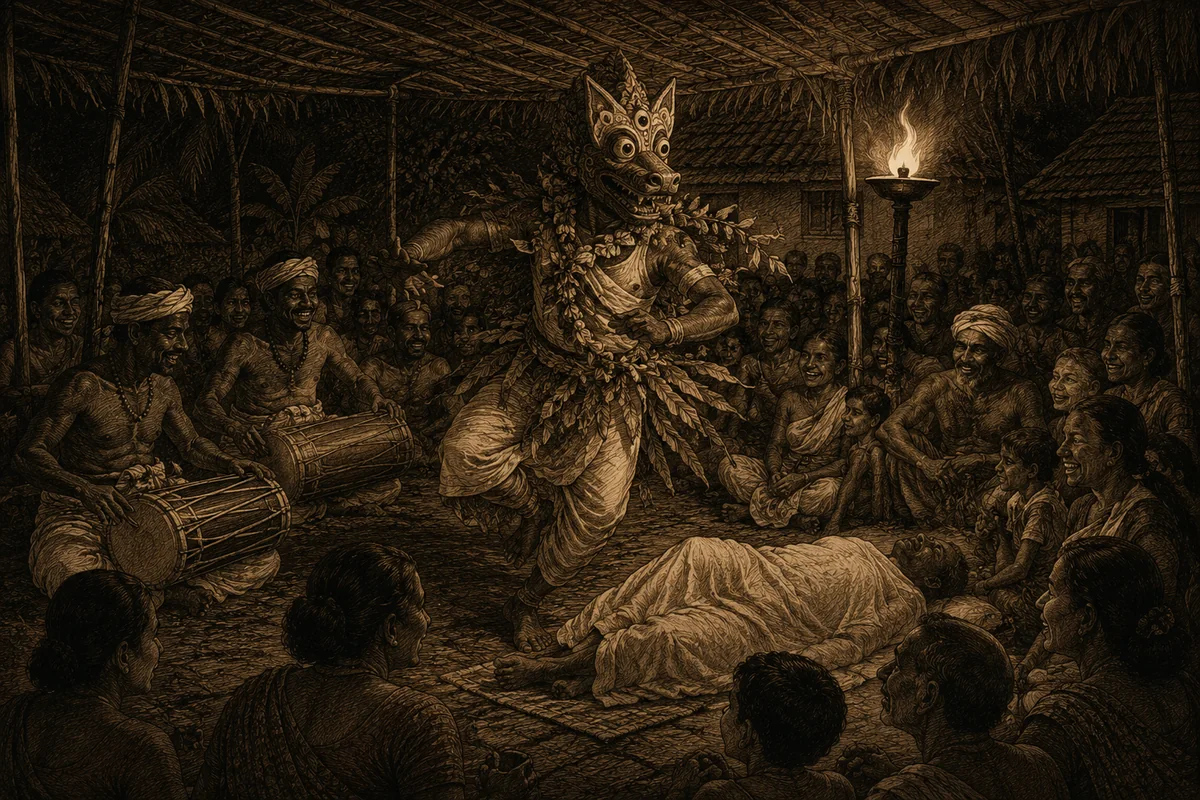
- Variants and names
- Sinhala මහසෝනා, also transliterated Maha Sona, Mahasohona, Mahasohon, Mahā Sōna Yakā. The name means «great demon of the graveyard»: sohona is the cremation ground. A terminological warning, because almost all Western popularisation gets it wrong: the Mahasona Samayama and the Sanni Yakuma are not the same rite. They are two distinct ceremonies of the yaktovil complex — the first dedicated to the demon of the graveyard, the second to the eighteen demons of disease presided over by Kola Sanniya. The celebrated masks of Ambalangoda belong to the second.
- What is told
- In the most widespread version Mahasona was in life Ritigala Jayasena, a warrior in the time of King Dutugämunu. Drunk, he insulted the giant Gotaimbara and accepted his challenge to unarmed combat: Gotaimbara beheaded him with a single kick and left his body in an open cremation ground. A deity intervened to revive him before the body went cold, but not finding the head grafted on him a bear's head, mounted back to front. The resulting appearance terrified anyone who saw him, and the terror made them ill. His attributes: one hundred and twenty-two feet tall, four eyes, four arms, red skin, the head of a bear or of a tiger; he rides a boar and drinks the blood of a buffalo that he holds in his right hand; he commands thirty thousand demons. He kills by striking at night between the shoulder blades, and leaves on the body the raised imprint of a hand. He causes cholera and dysentery. He haunts cremation grounds and three-way crossroads.
- What it was forthe author’s reading
- The rite does not treat illness as an individual fact but as a collective representation: the demonic nosology of the Sanni Yakuma is a classificatory system of eighteen categories covering epilepsy, blindness, deafness, paralysis, fevers, psychiatric disorders. And the therapeutic mechanism is not solemnity, it is exposure and derision: the entity is summoned, embodied, brought on stage, and then humiliated and made ridiculous before the community. Obeyesekere argues this against those who dismissed these ceremonies as entertainment — the comedy is part of the cure, not a residue. With Mahasona the thing reaches a remarkable point: in the Galle district the exorcists consider him benevolent although he causes illness, and they «joke with him, play cards and eat meat, usually right through the night, until the patient is well in the morning». The demon of the graveyard treated as a troublesome guest with whom one sits up all night. The threshold function remains: Mahasona presides over the cremation ground and the three-way crossroads, that is, the two points at which ordered social space ends, and the story is a geography of risk — where not to go at night.
- Where it is attested
- Bruce Kapferer, A Celebration of Demons. Exorcism and the Aesthetics of Healing in Sri Lanka, Indiana University Press, 1983 (2nd ed. Berg, 1991): I have not opened the volume — I note the record, and the current reading of its thesis, not a citation. Gananath Obeyesekere, «The Ritual Drama of the Sanni Demons: Collective Representations of Disease in Ceylon», in Comparative Studies in Society and History, 11/2, April 1969, pp. 174-216, DOI 10.1017/S0010417500005260 — consulted; it concerns the sanni, and Mahasona does not appear in it. Paul Wirz, Exorcism and the Art of Healing in Ceylon, Leiden, Brill, 1954 (German original 1941): the section «The Maha-sohona» is at p. 28 according to the index, but the accessible digitised copy breaks off before it and I have not been able to read it. David Scott, Formations of Ritual. Colonial and Anthropological Discourses on the Sinhala Yaktovil, University of Minnesota Press, 1994 — record noted, not consulted: it is the volume that criticises the way colonial and then anthropological discourse constructed the object «yaktovil». Printed ritual text: Mahasohon samayama, composed by Nivitagala Gaṇitayā, edited by A. D. Silva, Colombo, Laksilumina Press, 1904, 24 pp., in Sinhala. Dated and provenanced material culture: Australian Museum, Sydney — complete set of Daha Ata Sanniya masks acquired in 1911, which is the soundest reference obtainable.
- Caution
- Grade B for Mahasona as a single figure; the ritual complex that contains him would deserve A. The reason can be stated: the two sources that would carry the entry — Wirz p. 28 and Kapferer 1983 — I have not managed to open, and the legend of origin has competing versions declared by the sources themselves, which report alternative popular traditions in which Jayasena's name does not appear. The dating to the 2nd century BC is a chronology internal to the narrative, not a historical dating of the cult. The attributes fluctuate as well: the head of a bear or of a tiger according to the source.
Four things that circulate and do not hold. The masks of Mahasona are not the masks of the eighteen sanni: they are separate sets. The demon-to-disease tables are not canonical: the Australian Museum attributes pneumonia to Kola Sanniya and to Naga «swelling of the face and desquamation», while other lists give Naga the nightmares of snakes; a serious entry has to declare the variability instead of copying a table. The masks of Ambalangoda are not centuries old: few old originals survive, the local museum holds mainly reproductions, and those on sale are contemporary craft production in kaduru wood. And Mahasona is not a vampire: he drinks the blood of a buffalo, which he carries with him, and he kills by striking, not by exsanguination. His presence in Western encyclopedias of vampirism is an external classification imposed by the genre.
A note on the present: the rite is in decline, because of high costs, its night-long duration and — notably — the damage done by the tsunami on the south-western coast.
The grade says how well the entry is documented, not how interesting it is. How the grades are assigned.