Bean sídhe (banshee)
Ireland
Ireland, with a differentiated distribution: bean sí in the west and the north, badhbh in the south-east (Leinster and eastern Munster)
Bean sídhe (banshee) — the woman of the mound who announces an imminent death with weeping: she does not kill, does not threaten and does not touch.
- Variants and names
- bean sí in modern Irish, bean sídhe in the classical spelling, anglicised banshee; regional variants badhbh, badhbh chaointe, bean chaointe; in Scotland Gaelic bean-nighe and caointeach, related but distinct figures
- What is told
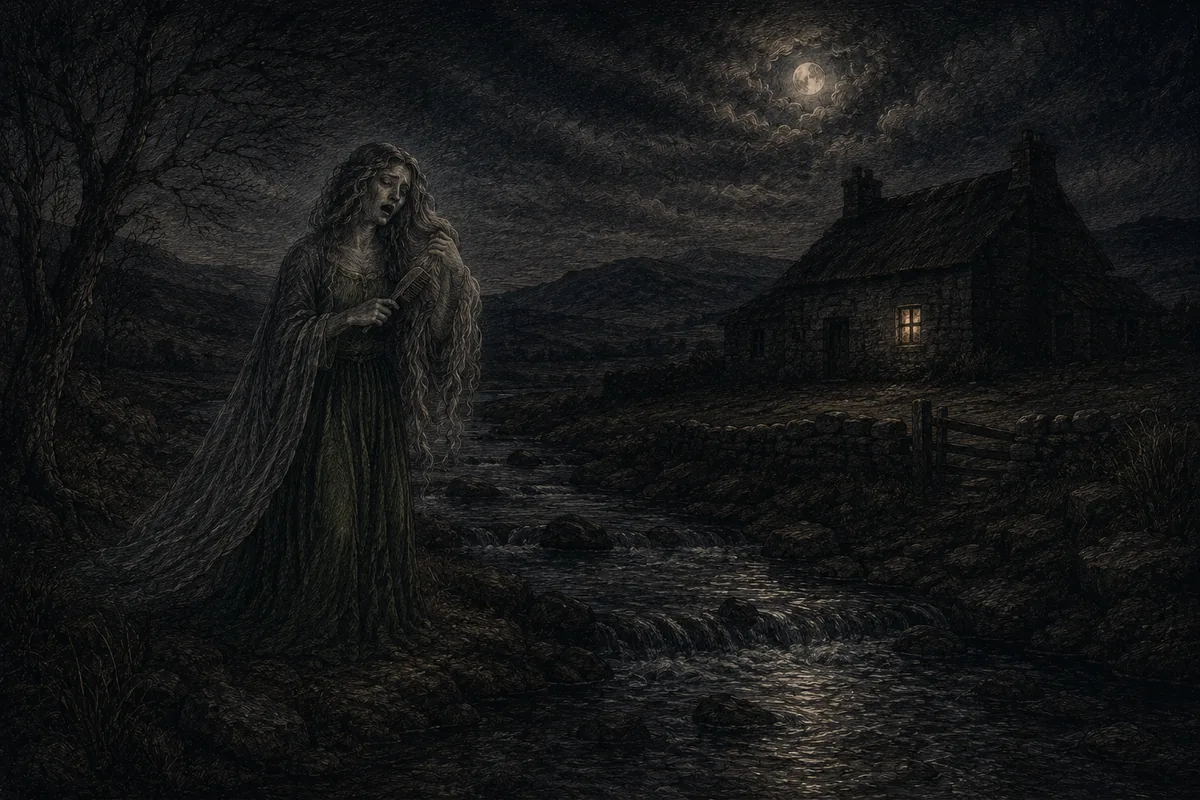
- She does not kill, does not threaten and does not touch: she announces. Her lament, the caoineadh, is heard at night near the house or near a watercourse and foretells the death of a member of a particular family, and it can announce a death that has occurred far away before the news arrives. Her appearance is variable, with long loose hair that she combs, a grey cloak over a green dress or else white garments, sometimes very tall but more often small and old; several banshees together announce the death of a saint or of a great person. She is traditionally attached to families of Gaelic stock with surnames in Ó or Mac, with known exceptions for families gifted in music and song and for the Anglo-Normans more Irish than the Irish.
- What it was forthe author’s reading
- She has a direct link with the real practice of keening, the professional funeral lament performed by the mná caointe, documented down to the twentieth century and opposed by the Catholic hierarchy: the banshee is in a certain sense its supernatural projection. She prepares psychologically for mourning in communities with high mortality and asserts genealogical status, because to have a banshee means to belong to an ancient line.
- Where it is attested
- First attestation in the Cathréim Thoirdhealbhaigh, about 1350-1380, a Middle Irish chronicle of the Ó Briain wars in Thomond, with references also in contemporary Anglo-Norman sources. Patricia Lysaght, The Banshee: A Study in Beliefs and Legends about the Irish Supernatural Death-Messenger, 1985, based on her doctoral thesis and conducted on the materials of the National Folklore Collection of University College Dublin and of the archive of the Irish Folklore Commission, 1935-1971, including the Schools' Collection of 1937-1939. The National Folklore Collection is inscribed in the UNESCO Memory of the World register.
- Caution
- I have not verified in a direct source the details on the specific questionnaires of the Irish Folklore Commission or the maps of the areal distribution of the names, badhbh against bean sí: the differentiated distribution reported here is consistent with the literature but ought to be checked against Lysaght's original. Thomas Crofton Croker, Fairy Legends, 1825-28, and Lady Wilde, Ancient Legends of Ireland, 1887, are historically important but literarily reworked and should be used as grade B sources.
The grade says how well the entry is documented, not how interesting it is. How the grades are assigned.