Santa Compaña
Spain
Galicia, with the greatest density of ethnographic collections on the Costa da Morte; parallel forms in Asturias, León and northern Portugal
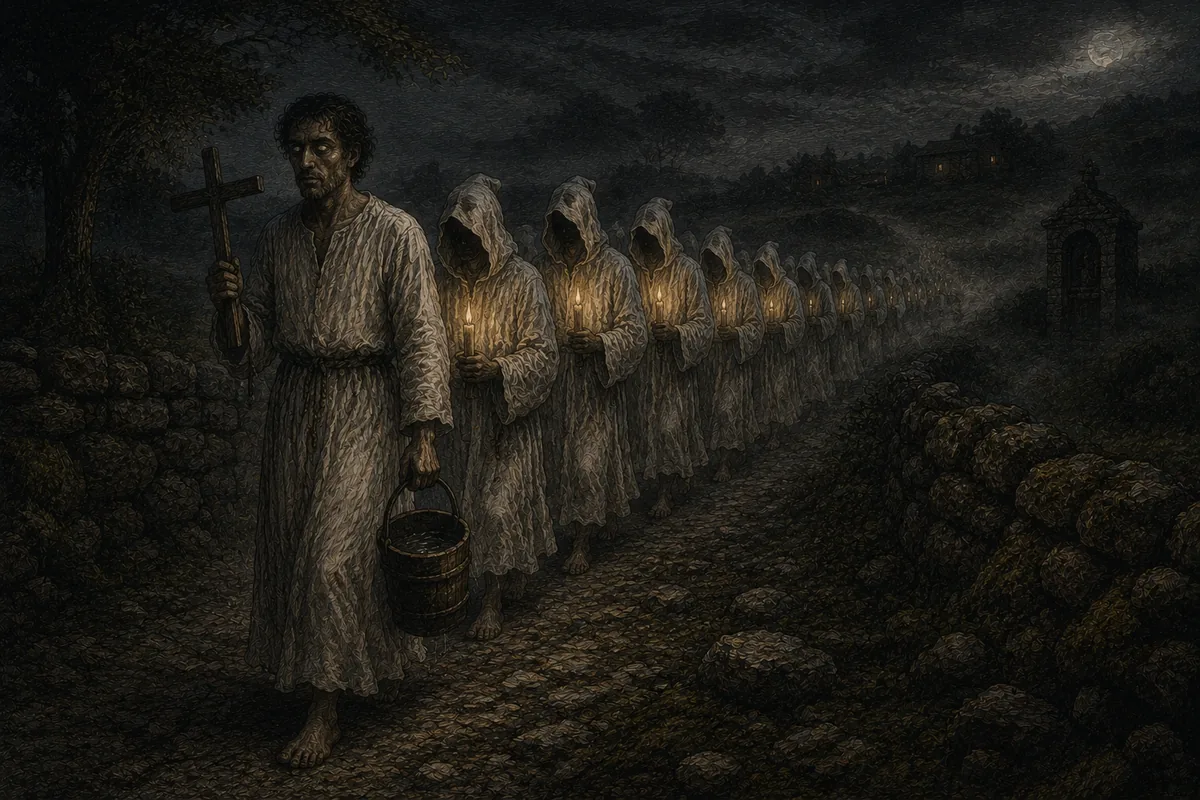
Santa Compaña — a night-time procession of souls from purgatory, hooded, in white, barefoot, with lighted candles, advancing in silence and without the sound of footsteps.
- Variants and names
- Galician Santa Compaña, A Compaña, Estadea, Estantiga, Hoste, Rolda, As da noite, Pantalla; Asturian Güestia, with the euphemism les bones xentes; in the Bierzo and in León Hueste de ánimas; in northern Portugal Companhas and Procissão das Almas. The santa is almost certainly apotropaic, not devotional
- What is told
- A night-time procession of souls from purgatory, hooded, in white, barefoot, with lighted candles, advancing in silence and without the sound of footsteps. Its arrival is announced by the smell of burnt wax, a sudden cold, floating lights, dogs barking at nothing. At its head walks a living person, compelled and without consciousness, carrying the cross and the caldeiro of holy water: on waking he remembers nothing, loses weight, wastes away, often dies. He is freed from it only if someone else accepts the object from his hands — and whoever takes it inherits the sentence. One defends oneself by tracing a circle or Solomon's cross and stepping inside it, by lying face down and feigning death, by running to a cruceiro; and above all by not answering and not accepting anything.
- What it was forthe author’s reading
- In the prevailing anthropological reading it is a device for the collective management of death in rural societies with very high mortality: it codifies the obligation of suffrage for the dead, penalises whoever goes about alone at night, disciplines children and women, and gives a public language to premonitions and to mourning. Not a religious survival, then, but an active social instrument — which nonetheless remains an interpretation.
- Where it is attested
- The founding European testimony is Orderic Vitalis, Historia Ecclesiastica, book VIII: the priest Walchelin of the diocese of Lisieux, returning from a sick man on the night of 1 January 1091, meets an immense procession of the dead in torment, recognises the familia Herlechini, tries to seize a horse, is wounded and keeps on his neck the mark of a spectral hand; Orderic writes around 1130-1135, from direct testimony. In Galicia, by contrast, there is no attestation of the Santa Compaña earlier than the nineteenth century: the first records are lexicographical and ethnographic, beginning with the Diccionario Gallego of Cuveiro Piñol, 1876. The twentieth-century corpus: Vicente Risco in the ethnographic section of the Historia de Galiza directed by Otero Pedrayo, 1962; Taboada Chivite; Elisardo Becoña, 1980; Carmelo Lisón Tolosana, La Santa Compaña, Akal, 1998; Xosé Ramón Mariño Ferro.
- Caution
- Grade B measures one thing only: the oral tradition is documented in exceptional fashion, but only from the 19th century onwards, and its historical depth is inferred by European analogy, not proved on the spot. Before 1800 the European wild hunt and the word estantigua are attested; the specific Galician complex is not — the cross, the cauldron, the passing on of the task, Solomon's circle. On the Celtic origin, which in Galicia is a politically charged subject, what holds for Breton Celticism holds here too: it is a nineteenth-century identity construction projected backwards, and no element of the Santa Compaña can be reconstructed on a Celtic basis — the comparison with the Ankou and the banshee is typological, not genealogical. Other corrections: it is not «the procession of Santiago» nor has it any original connection with the Camino, which is a tourist addition; it is not a unitary myth but a set of parish variants with different rules a few kilometres apart; and the conxuro of the queimada that is recited in bars is a text composed in the 1950s.
The grade says how well the entry is documented, not how interesting it is. How the grades are assigned.