Rusalka
Russia
Eastern Slavia, with a differentiated distribution: Polesia and Ukraine agrarian in character, the Russian North aquatic
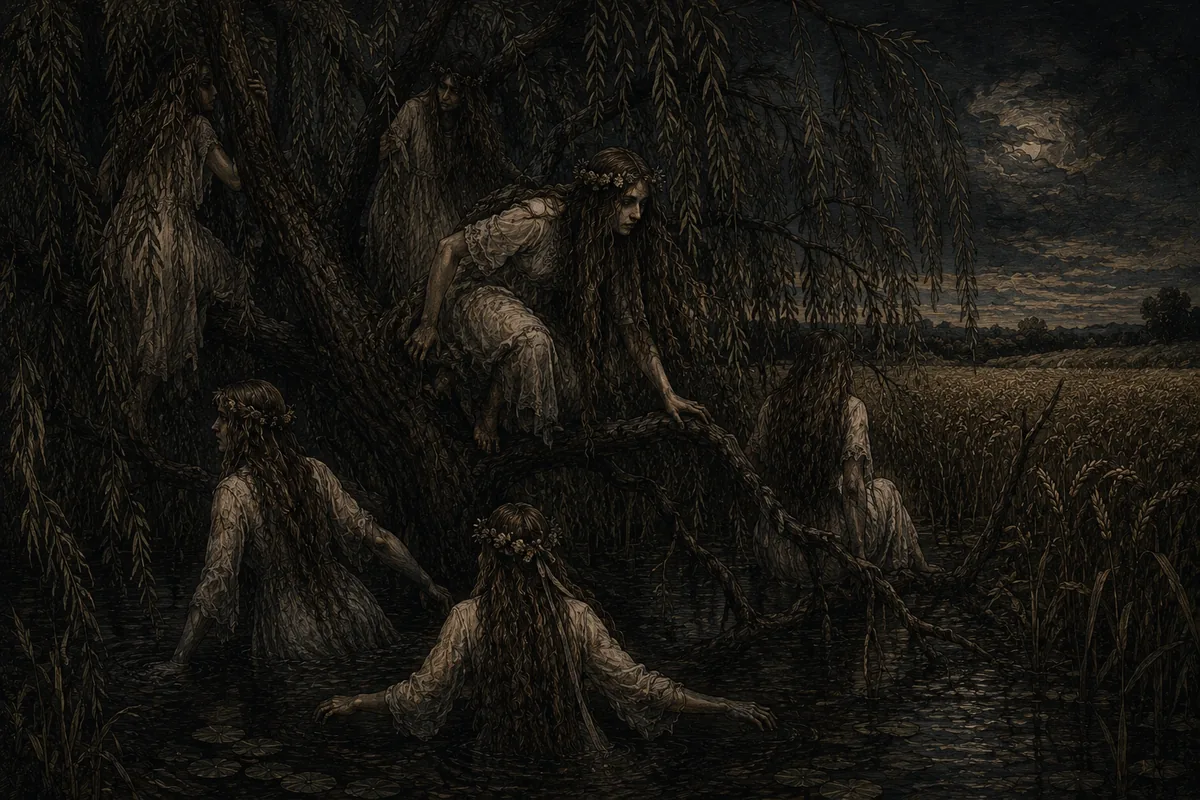
Rusalka — the appearance varies a great deal according to the region: very pale little girls with green hair and long arms, naked young women with light brown hair, in the south girls in white shifts with garlands.
- Variants and names
- rusalka, plural rusalki; in the Russian North vodjanica, kupalka, loskotucha, the tickler; in Ukraine mavka or navka, from nav', the dead; in Belarus and Polesia rusalka and vodjanica
- What is told
- The appearance varies a great deal according to the region: very pale little girls with green hair and long arms, naked young women with light brown hair, in the south girls in white shifts with garlands. One trait is constant, namely the hair, always loose or badly plaited, which in Slavic semiotics signals an unmarried woman and therefore an interrupted biography. They come out of the water in the week dedicated to them, climb the willows and the birches, sing and dance in the rye fields, draw passers-by to them and tickle them to death or drag them to the bottom. In the south, however, they are also bringers of moisture and fertility to the fields, with an ambiguity at once menacing and beneficial.
- What it was forthe author’s reading
- They fall into the category of the unclean dead, the založnye pokojniki: according to Zelenin's classic interpretation they are the girls who have drowned, killed themselves or been murdered, and children who died unbaptised, that is, those who died a wrong death or before their time, and they remain among the living until their natural span has run out. In practical terms they impose the seasonal prohibition on bathing in a period of still cold water and of floods, the prohibition of certain agricultural and women's tasks, and they structure a female rite of passage conducted by unmarried girls.
- Where it is attested
- D. K. Zelenin, Očerki russkoj mifologii: Umeršie neestestvennoju smert'ju i rusalki, Petrograd, 1916, the founding monograph; N. I. Tolstoj and the Moscow ethnolinguistic school, Slavjanskie drevnosti, a dictionary in five volumes, 1995-2012, with areal mapping; ethnographic expeditions to Polesia by the Institute of Slavic Studies of the Russian Academy of Sciences from the 1960s; S. V. Maksimov 1903 and A. N. Afanas'ev 1865-69. The calendrical reference is the Rusal'naja nedelja, the week following Pentecost, with the Semik on the Thursday before Trinity, and the rites of the provody rusalki, the accompanying or funeral of the rusalka.
- Caution
- The name was felt by many peasants until the twentieth century to be bookish and learned, while the terms really in use were the local ones: the «single» rusalka is in part an artefact of literature. The reworkings by Pushkin, Gogol, Lesja Ukrainka and Dvořák are works of art and not ethnographic sources, and the Romantic water-nymph that descends from them has little to do with the peasant rusalka. The provody rusalki are documented down to the mid-twentieth century but today survive above all as re-enactments organised by houses of culture and ensembles, so present-day ritual is of grade B. The popular etymology that links the name to rusyj, ash-blond, or to ruslo, river bed, is false: the term comes from rusalia, from the Latin Rosalia.
The grade says how well the entry is documented, not how interesting it is. How the grades are assigned.