Buda
Ethiopia
Amhara highlands, Gondar; a belief that is above all an accusation
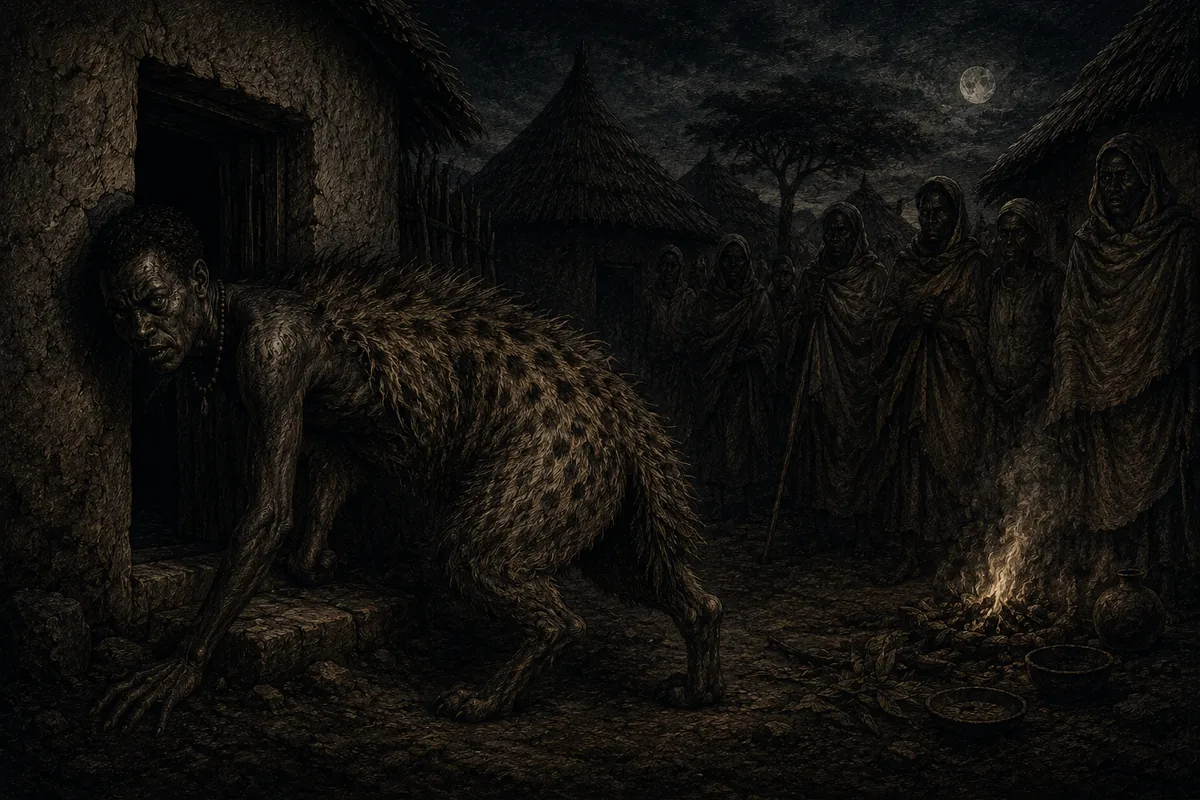
Buda — in Ethiopia not a creature but an accusation: whoever is buda has the evil eye and can turn into a hyena.
- Variants and names
- Amharic ቡዳ buda — the word denotes at once the faculty and the one who possesses it. The synonym that matters is ጠቢብ ṭäbib, «wise, skilled, craftsman»: the same word that says «good with his hands» says «dangerous». Compounds appear with ayn, «eye», for the power to curse, and qalb, the inner desire that would drive the buda to act without his own knowledge. The forms qoraté and wodde qolla circulate online without a source: I have not been able to verify them.
- What is told
- Whoever is buda has the evil eye and can turn into a hyena. In the description collected among the Amhara he rolls in the ashes of the hearth, goes out in the form of a hyena, fixes his gaze on the victim and returns as a man to wait for her to waste away. Evil eye and lycanthropy are not two different beliefs: they are the same complex, documented together. What makes this something more than a tale is that the buda is not just anyone: he is a category of persons. Smiths, potters, tanners, weavers — trades of endogamous castes, landless, in an agrarian society where land is everything. And, above all of them, the Beta Israel, the Jews of Ethiopia, who practised those trades.
- What it was forthe author’s reading
- It is a machine of exclusion with a supernatural cover. It explains illness and misfortune, yes; but above all it keeps a productive group inside an enclosure: one buys from him, one does not eat with him, one does not marry into his family. The symbolic reading — the man who transforms metal in fire exercises an anomalous, and therefore suspect, power — has been proposed and is convincing, but it comes after the social fact, not before.
- Where it is attested
- The standard description is Ronald A. Reminick, «The Evil Eye Belief Among the Amhara of Ethiopia», Ethnology 13, 3 (1974), pp. 279-291, which also records the four procedures of diagnosis and cure of the debtera, the unordained cleric: holy water and the smoke of roots; the silver bracelet heated and applied to the face so that the scar passes to the aggressor; the left thumb bound and the smoke of dung, until the sick person speaks with the voice of the one who struck him; the confrontation with the hair and clothes of the suspect. The central book is Hagar Salamon, The Hyena People: Ethiopian Jews in Christian Ethiopia, University of California Press, 1999, built on more than a hundred interviews. For the amulet scrolls: Marcel Griaule, Le livre de recettes d'un dabtara abyssin, Institut d'ethnologie, 1930, and Jacques Mercier, Ethiopian Magic Scrolls, 1979. On the zar side: Simon D. Messing, 1958, and Joseph Tubiana, «Zar and buda in northern Ethiopia», 1991.
- Caution
- Grade A without reservation on the core: an article in a peer-reviewed anthropology journal, a university monograph, an ethnographic collection of 1930. The reservations lie elsewhere.
I have not been able to confirm that the belief appears in the nineteenth-century travellers to whom it is often attributed — Bruce 1790, Salt, Parkyns 1853, Plowden, Pearce: the books exist, that they contain the buda I have not verified and do not assert. I have not confirmed the term ye-buda zar, which nonetheless circulates. And the idea that evil eye and lycanthropy are two superimposed historical strata — the one Mediterranean, the other African — is an elegant reading that I have not found demonstrated by anyone: I leave it out.
A clarification that here is not a formality. This entry describes a structure of accusation, not a property of the persons accused. Nothing that the belief attributes to the Beta Israel or to Ethiopian craftsmen is reported here as fact. The fact is the accusation.
The grade says how well the entry is documented, not how interesting it is. How the grades are assigned.