Tokoloshe
South Africa
KwaZulu-Natal, Valley of a Thousand Hills; and the Cape townships, where the figure has changed trade
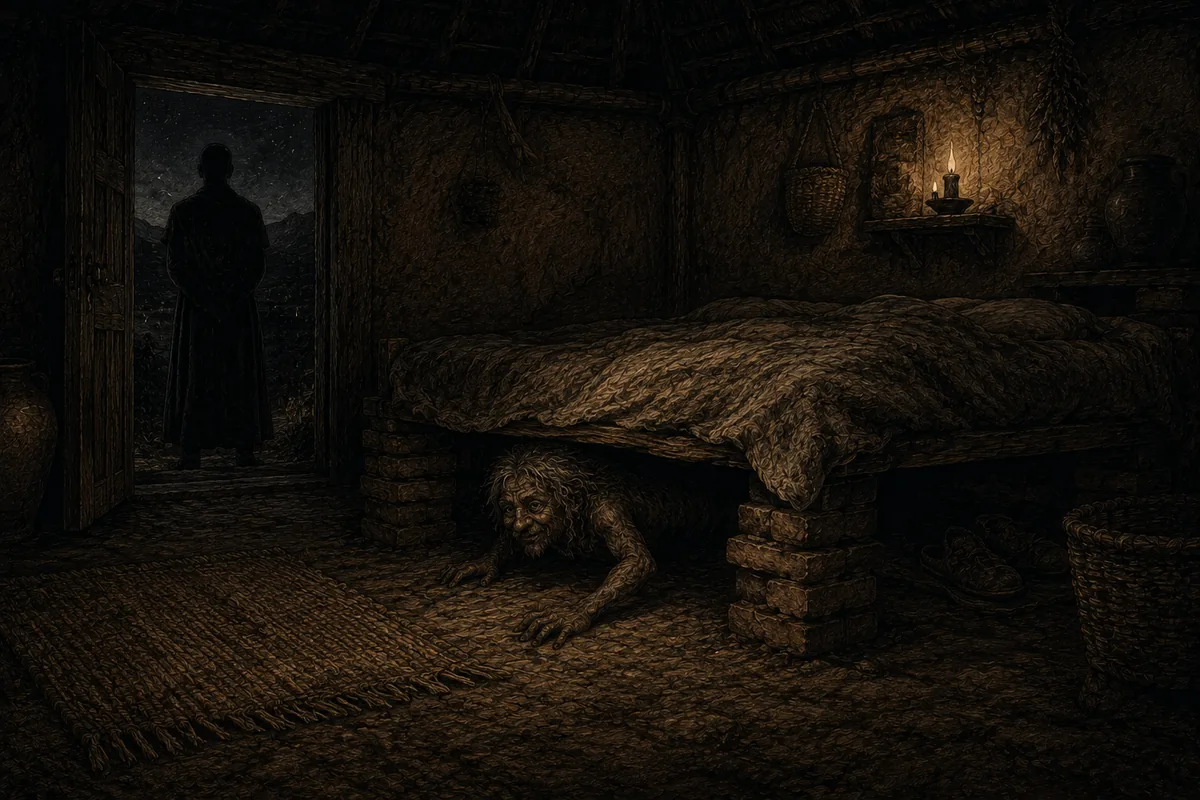
Tokoloshe — a familiar of Zulu and Xhosa folklore: a small hairy being that somebody sends against somebody else, neither a dead person nor a god.
- Variants and names
- isiZulu utokoloshe, isiXhosa uthikoloshe, Sesotho thokolosi. The colonial transcriptions are something of a disaster: tikaloshi, tickelosh, tikolosh, togolosh, tagalash and ten other forms recorded by the Dictionary of South African English — which are variants of European spelling, not of an African language. The same dictionary records the Xhosa synonym hili. In urban slang, from 1972, «tokoloshe» also means «policeman».
- What is told
- A small male being, hairy, shorter than a man. He is not a dead person and he is not a god: he is a familiar, that is a creature that somebody sends. Behind the tokoloshe there is always an umthakathi, one who practises witchcraft against a neighbour; the tokoloshe is the instrument, not the one who sends. He comes and goes at night, enters houses, frightens, steals, assaults those who are asleep. The best known defence is the most prosaic: raising the bed on bricks or on tins, because he is short and cannot reach. His repertoire includes invisibility — obtained, it is said, by swallowing a pebble or drinking from a certain water — and a connection with rivers and pools.
- What it was forthe author’s reading
- It is the name given to the evil that comes into the house from outside and has a human author. It does not explain misfortune in the abstract: it explains who sent it to you. This is why the tokoloshe does not live in the woods but in relations between neighbours, and it is as alive today as it was in the nineteenth century — indeed, in the city it has changed trade, as the box at the foot of the page explains.
- Where it is attested
- The earliest dated attestation I have been able to verify is Stephen Kay, Travels and Researches in Caffraria, 1833, who notes that the tikaloshi is «spoken of far more frequently and familiarly» than other figures — a sign that by 1833 it was already common knowledge. Next come Ernest Glanville, 1894 («an evil spirit that takes the form of a little man») and Ellen Hellmann, 1949, which is the first dated record of the traits «hairy» and «baboon-faced». For the Zulu context, Axel-Ivar Berglund, Zulu Thought-Patterns and Symbolism, 1976 and Harriet Ngubane, Body and Mind in Zulu Medicine, 1977 remain obligatory, ethnography carried out among the Nyuswa of the Valley of a Thousand Hills. And there is one source that here is worth more than an ethnography: the court records.
- Caution
- Grade A for a precise reason: for this figure the existence, the antiquity and the social functioning are documented at the highest level — historical dictionary, attestation of 1833, judgments, peer-reviewed ethnography. What is not documented at that level, as far as my checks go, is the dating of the individual descriptive traits: the pebble of invisibility, the water, the bed on bricks are real and widespread practice and narrative, but I have not found who recorded them first and when. The earliest academic mention of the bed on bricks that I have been able to verify is very late indeed — an article in the South African Medical Journal of 2009, which moreover writes that it «is said to offer some protection».
To be corrected, and it is worth saying so loudly. It circulates everywhere that the tokoloshe was recorded by Henry Callaway in the Religious System of the Amazulu (1868-1870). This is false. I have searched the full text, both in the Unkulunkulu part and in the part on divination: the word is not there. And the fourth part of the work, the one that would have dealt with witchcraft and medical magic, was never published — the preface itself states as much. The same goes for Dudley Kidd, The Essential Kafir, 1904: no occurrence. An authoritative attribution repeated until it seemed true.
The grade says how well the entry is documented, not how interesting it is. How the grades are assigned.