Bunyip
Australia
Murray-Darling basin; the specimen that gave rise to the documentary episode was found near Balranald, in New South Wales
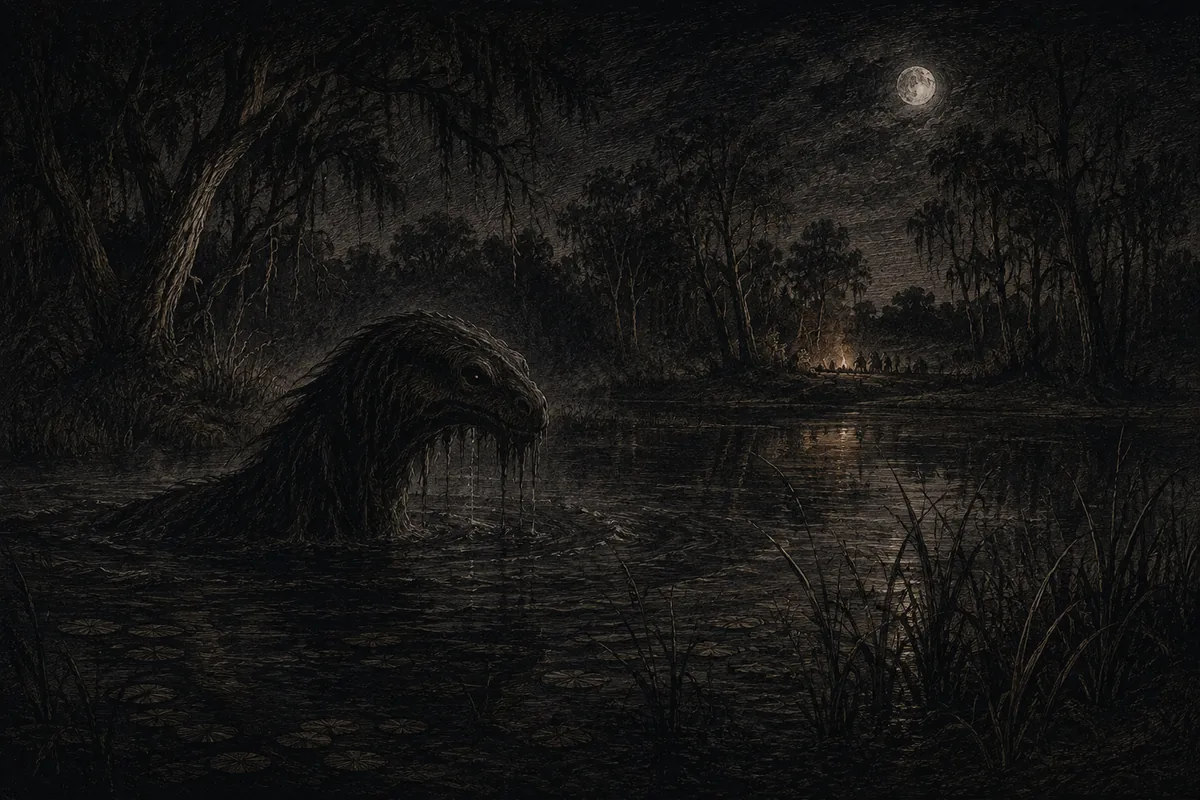
Bunyip — the water-bound spirit being of the Australian Aboriginal languages — watercourses, lagoons, billabongs.
- Variants and names
- banib in Wemba-Wemba, the recognised etymological form; banyib in Wathawurrung, the probable direct route into the English of Victoria; kianpraty, by contrast, is a distinct term. Water beings of other traditions, often wrongly absorbed under the same name: Ngarrindjeri mulyawonk of the lower Murray, worridziam in the Brisbane area. In English: bunyip, and figuratively bunyip aristocracy, from 1853
- What is told
- In the source languages banib denotes a spirit being bound to water — watercourses, lagoons, billabongs — within a frame of reference that the colonial recorders did not share and did not describe. Of that content this entry reports nothing: what can be documented is the history of its collection. Colonial recording carried out a systematic translation into a zoological category, turning a spirit being into an animal not yet discovered, with the attendant descriptions — fur, tusks, nocturnal cry — that fill the Australian press from the 1840s onwards.
- What it was forthe author’s reading
- Among several groups of the Murray basin, water beings function, in the reading of outside observers, as devices for regulating access to water: the marking of dangerous waters, control of the taking of fish, keeping children away from the banks. This is the functionalist reading current in Australian ethnography and must be flagged as such: it is not what the holders of the tradition say, it is what those who look on from outside infer from it.
- Where it is attested
- The founding document of the English entry is the article in the Geelong Advertiser of 2 July 1845, «Wonderful Discovery of a New Animal», which reports fossil bones and a drawing made by an Aboriginal man questioned by the settlers. In January 1846 a squatter found a skull on the Murrumbidgee near Balranald; in January 1847 the specimen was exhibited for two days at the Australian Museum in Sydney, with crowds and a wave of sightings in its train. In July 1847 W. S. Macleay and Richard Owen identified it. On the linguistic side: R. M. W. Dixon, W. S. Ramson and M. Thomas, Australian Aboriginal Words in English, Oxford University Press, 1990; the work of Luise Hercus and Barry Blake; the Oxford English Dictionary, with the etymology revised in 2024. The standard folkloristic analysis is Mo A. Quirk, «From Banib to Bunyip», Folklore 134(1), 2023.
- Caution
- Grade A applies to the documentation — linguistic studies, historical lexicography, a peer-reviewed article — not to the content, which remains colonial and mediated. Of that content this entry describes the context and the history of the extraction, not the narrative: the communities descended from those groups have formal instruments for regulating the circulation of this material, and consent to nineteenth-century collection is not consent to republication. A number of things that circulate everywhere need correcting. There is no «Geelong skull of 1845»: two distinct events have been fused into one — in 1845 there is the article on fossil bones, the skull is of 1846 and comes from the Murrumbidgee. The bunyip is not a pan-Australian legend: it is a word from Victoria, spread by the settlers across the whole continent, and as early as 1891 an observer noted that speakers in the Brisbane area called their own water being worridziam and regarded «bunyip» as an imported name.
The grade says how well the entry is documented, not how interesting it is. How the grades are assigned.