Domovoj
Russia
Russia, with denser documentation in the Russian North (Arkhangelsk, Olonets, Vologda) and in the central regions
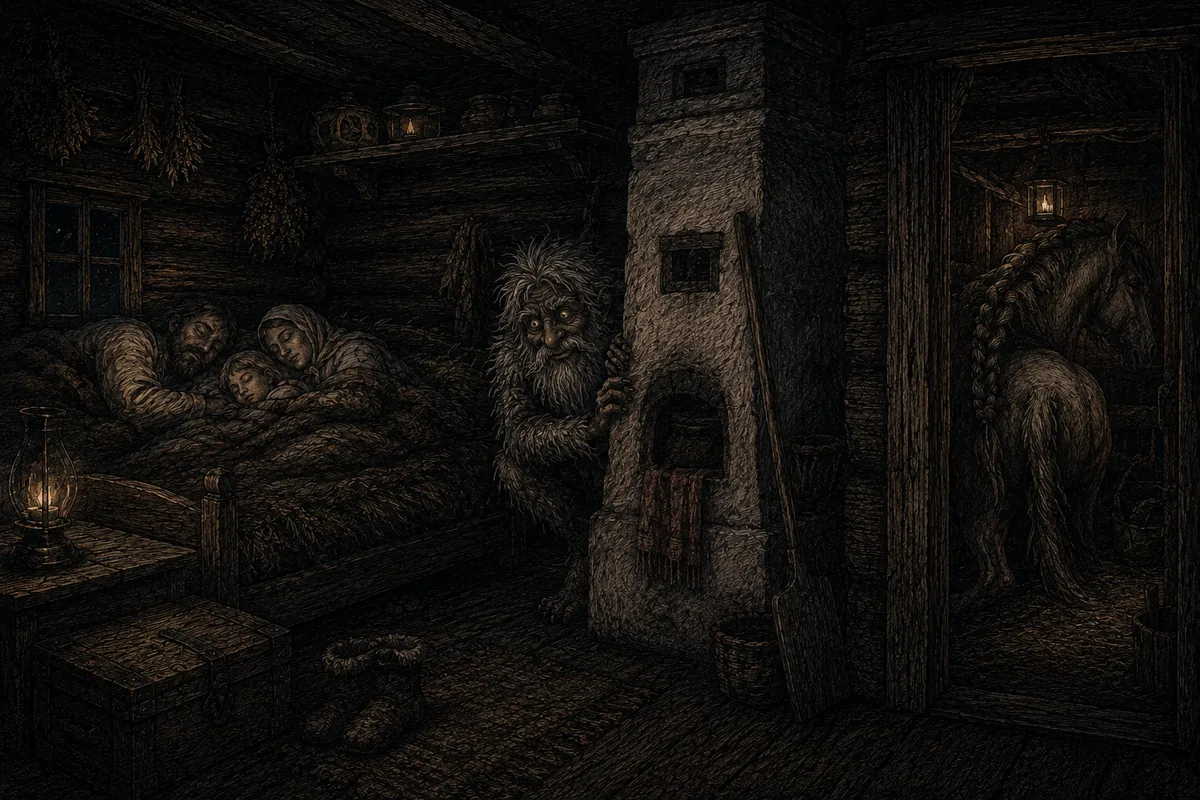
Domovoj — the Slavic spirit of the house and of the family — not of the place: if the family moves, he is taken along.
- Variants and names
- domovoj; the euphemistic names dedushka, that is little grandfather, chozjain, the master of the house, sam, himself, susedko, the neighbour, in the Russian North, dobrochot, the benevolent one; female counterpart domovicha or Domania; kindred spirits dvorovoj, bannik, ovinnik, polevoj, lešij, vodjanoj
- What is told
- Spirit of the house and of the family, not of the locality. He shows himself as a hoary, hairy old man with shining eyes, or as a cat, a dog, a bear or a snake, or in the likeness of a dead member of the family or of the living head of the household, and to see him in one's own form is an omen of death. He lives behind or under the stove, protects the house, the livestock and the children, plaits or tears out the manes of the horses according to whether the animal pleases him, and announces deaths and epidemics with weeping, knocks or night-time caresses, warm if the omen is good and cold if it is bad. If the family behaves badly he grows angry, shows his demonic side and in extreme cases abandons the house, which then falls into ruin.
- What it was forthe author’s reading
- It is the cult of the ancestors domesticated: the folklorist E. G. Kagarov defines him as the personification of the supreme rod in the microcosm of kinship. He makes the house sacred as an economic and moral unit, imposes cleanliness, order and respect between family members and towards the animals on a daily basis, that is, works as a sanctioned domestic ethic, and guarantees the continuity of the family line in the passage from one house to another.
- Where it is attested
- S. V. Maksimov, Nečistaja, nevedomaja i krestnaja sila, St Petersburg, 1903; A. N. Afanas'ev, Poetičeskie vozzrenija slavjan na prirodu, three volumes, 1865-69; D. K. Zelenin, Russische (Ostslavische) Volkskunde, Berlin-Leipzig, 1927; Linda J. Ivanits, Russian Folk Belief, 1989; contemporary research by E. Ansimova on lexicographical and ethnographic aspects in Archaeology, Ethnology and Anthropology of Eurasia. Archives at the Russian Ethnographic Museum in St Petersburg and at the Puškinskij Dom. The removal rite is amply documented, with the domovoj carried in the embers of the old stove and invited with an explicit formula.
- Caution
- The feast of 10 February, the so-called Kudesy, exists in the literature but its contemporary observance is heavily promoted by Russian neo-paganism, rodnoverie, and continuity with historical peasant practice is to be checked case by case: the living ritual of today is in good part of grade B or C. The removal rite, by contrast, is ethnographically very solid indeed. Afanas'ev is to be used with caution on account of his nineteenth-century comparative mythological framework, while remaining irreplaceable as a repertory.
The grade says how well the entry is documented, not how interesting it is. How the grades are assigned.