Południca
Poland
Poland and western Slavia, with a conservative core in Sorbian Lusatia
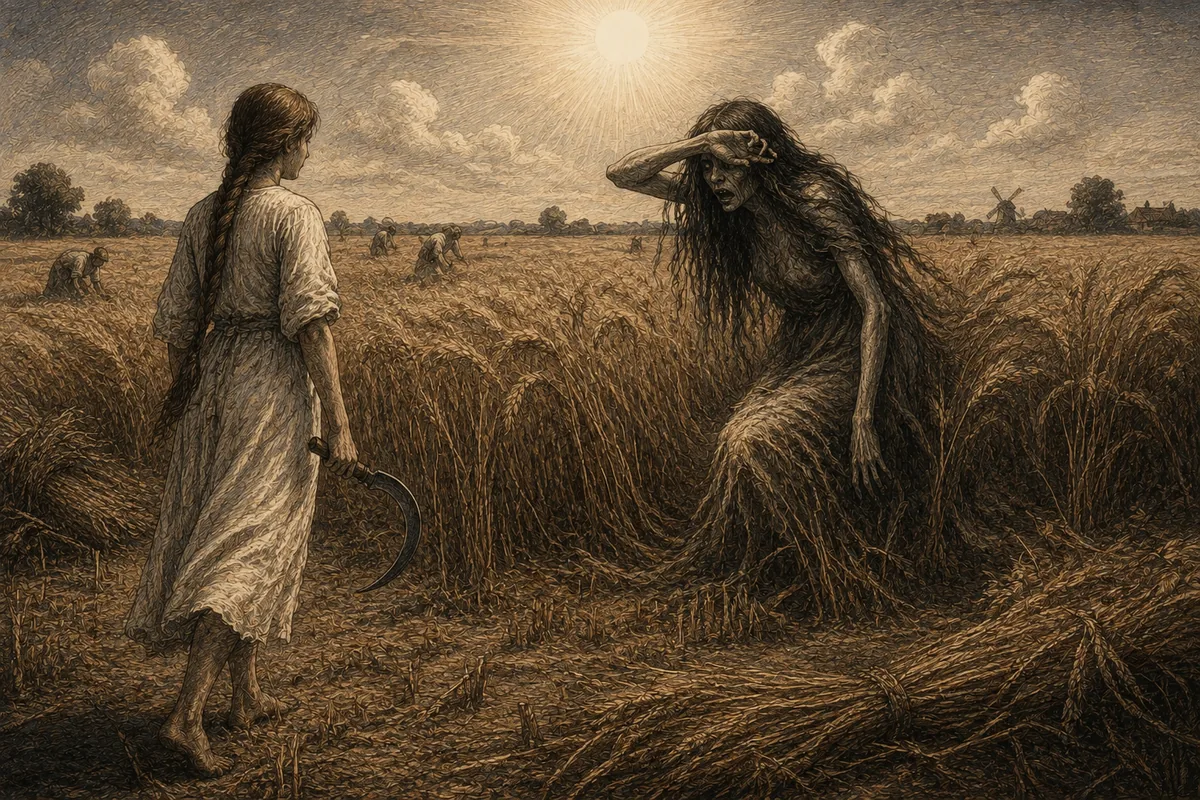
Południca — the Slavic Lady of Midday, who appears at the hottest hour at the edges of the wheat fields during the harvest.
- Variants and names
- Południca in Polish; polednice in Czech; poludnica in Slovak; Připołdnica and Serpolnica in Sorbian; poludnica in Russian, Serbian and Bulgarian; German parallels Roggenmuhme, Kornwief, Mittagsfrau
- What is told
- She appears at exact midday, in the hottest hour, at the edges of the wheat fields during the harvest, typically as a young woman dressed in white walking the boundaries of the fields, but also as an old hag or as a little girl. She carries a sickle or a pair of shears. She stops the reapers and puts difficult questions to them, often demanding to be told about flax, from the sowing to the weaving, for a whole hour: whoever falls silent, makes a mistake or breaks off is beheaded or struck with illness. She causes heatstroke, migraines and sudden paralysis and can carry off children left alone among the ears of wheat: she is explicitly the personification of sunstroke.
- What it was forthe author’s reading
- She imposes the midday break on peasants in the middle of the harvest, preventing heatstroke in a society in which the peak of work coincides with the peak of temperature, and she keeps children out of the ripe fields. She further supplies an aetiology for a real and sudden medical event and makes midday sacred as a liminal hour, the mirror of midnight, in continuity with the daemon meridianus of Psalm 91 in the Vulgate.
- Where it is attested
- Oskar Kolberg, Lud. Jego zwyczaje, sposób życia, mowa, podania, przysłowia, obrzędy, gusła, zabawy, pieśni, muzyka i tańce, 33 volumes published in his lifetime between 1857 and 1890 and more than 80 in the complete edition Dzieła wszystkie edited by the Instytut im. Oskara Kolberga of Poznań: the greatest European ethnographic undertaking of the nineteenth century. Sorbian-Lusatian ethnography on the Serpolnica at the Serbski institut in Bautzen; Kazimierz Moszyński, Kultura ludowa Słowian, 1929-39; Karel Jaromír Erben, the ballad Polednice in Kytice z pověstí národních, 1853; Władysław Reymont, Chłopi, 1904-09, Nobel Prize 1924.
- Caution
- The figure is extinct as an operative belief and survives as a school and literary narrative repertoire in Poland and Czechia, where Erben's ballad is a canonical text, as Dvořák's symphonic poem, op. 108 of 1896, and as a minority identity marker in Lusatia. Erben is at once literature and a second-hand document: he was a folklorist and a professional archivist and worked on material that had genuinely been collected, but the text is a poetic reworking. The revival in Polish fantasy and video games is transmission of grade C.
The grade says how well the entry is documented, not how interesting it is. How the grades are assigned.