Huli jing
China
Northern and eastern China; domestic cult documented in the Beijing plain and in the North-East, literary corpus in Shandong
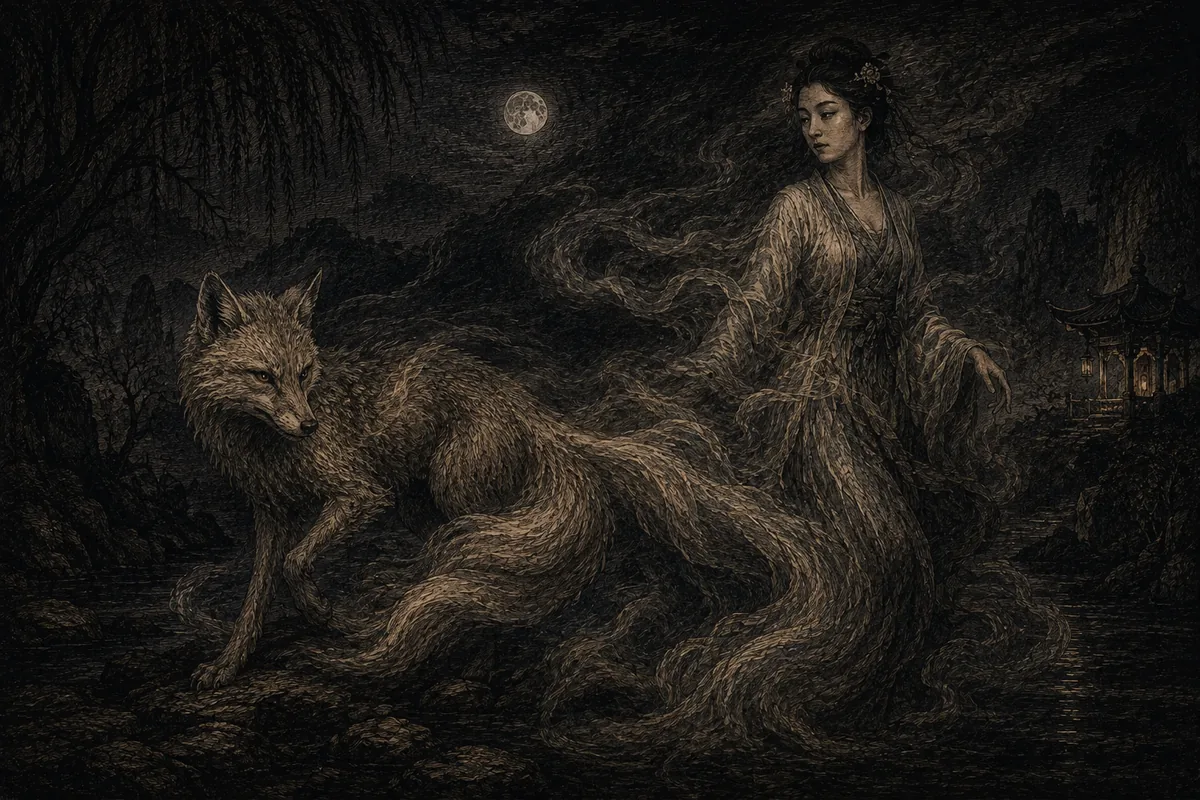
Huli jing — a fox that acquires powers with age: at fifty she can change into a woman, at a hundred she is a beautiful woman or a shamaness, at a thousand she communicates with heaven.
- Variants and names
- Chinese 狐狸精 húlijīng, «fox spirit»; short forms hújīng, húmèi; the respectful cultic form 狐仙 húxiān, «fox immortal». Mythical species: jiǔwěihú, the nine-tailed fox, and tiānhú, the celestial fox. In the North-East she is the first of the bǎojiā xiān, the immortals who protect the house; in the Beijing plain she is one of the 四大门, the «four great gates» — fox, weasel, hedgehog, snake
- What is told
- A fox that acquires powers with age: at fifty she can change into a woman, at a hundred she is a beautiful woman or a shamaness, at a thousand she communicates with heaven. In the familiar form she seduces, drains a man's vital energy, insinuates herself into houses. But this is only one of the three traditions that converged in the term, and not the oldest: the nine-tailed fox is originally an auspicious animal, bound to dynastic myth; and alongside the seductress there exists, living and practised, the fox as household deity, who protects the house, punishes discourtesy and speaks through the mouth of a medium.
- What it was forthe author’s reading
- The fox is the alien par excellence, and serves to mark the most jealously guarded boundaries: between species, between genders, between the living and the dead. She is at once succubus and good wife, trickster and Confucian model — the ambivalence is the function, not a defect of the tradition. On the cultic side she is instead a deity of proximity, concerned with the house and not with the cosmos.
- Where it is attested
- The canonical formula of transformation by age is in the Xuanzhongji, attributed to Guo Pu (276-324). The Soushenji of Gan Bao, first half of the 4th century, gathers in the eighteenth juan the Azi cycle — with the philological caveat that the text we read is a late reconstruction from encyclopaedic citations. The attestation of a real cult is in Zhang Zhuo, Chaoye qianzai, beginning of the 8th century: «Since the beginning of the Tang the people greatly venerate the fox deities… there ran then the saying: without a bewitching fox there is no village». The Taiping guangji, 978, devotes nine juan to foxes. The literary summit is Pu Songling, Liaozhai zhiyi — preface of 1679, composition spread over forty years, first printing 1766 — where many foxes are loyal and morally superior to humans. Ethnography: Li Wei-tsu on the cult of the four sacred animals in the environs of Beijing, Folklore Studies 7, 1948.
- Caution
- Three things to correct, and the third is the most interesting. The nine-tailed fox is not originally a demonic figure: in the Shanhaijing she is auspicious. Daji, the concubine said to have ruined the Shang dynasty, is not a fox in the early sources: the identification is late and is fixed in the Fengshen yanyi, late Ming, that is, two thousand years after the events. And the use of huli jing as an insult directed at a flesh-and-blood woman is not modern slang: it is in chapter 77 of the Dream of the Red Chamber, where a lady dismisses a young actress by saying that «girls who act are naturally fox-demons». The insult is about two hundred and fifty years old; what is genuinely twentieth-century is the further restriction to the sense of mistress or the other woman.
The grade says how well the entry is documented, not how interesting it is. How the grades are assigned.