Zashiki-warashi
Japan
Iwate Prefecture, Tōno area, Tōhoku; minor attestations in Aomori, Miyagi and Akita
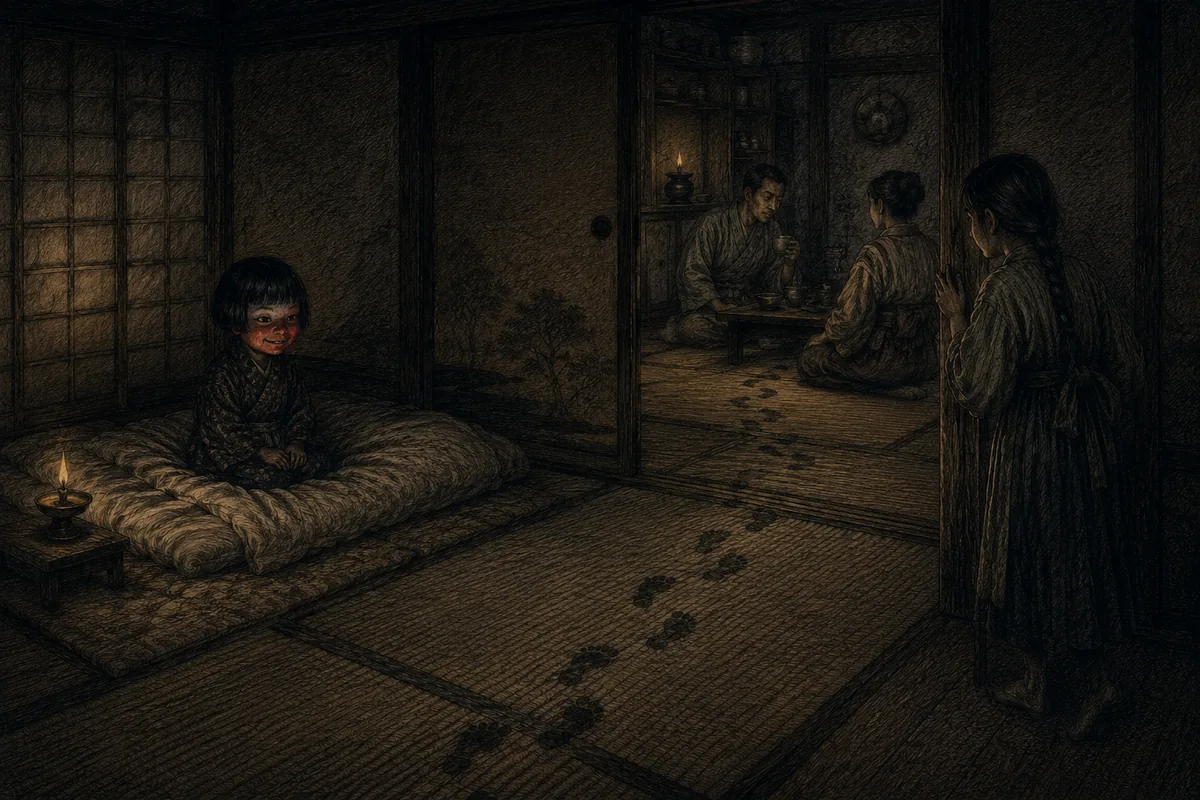
Zashiki-warashi — a boy or girl of three to fifteen, red face, bobbed hair, traditional dress, who lives in the zashiki, the tatami reception room, or in the storehouse of large, old houses.
- Variants and names
- zashiki-warashi, the child of the zashiki; local variants zashiki-bokko, kura-bokko, that is of the storehouse, makura-gaeshi, the pillow-turner, notabariko, usutsuki-warashi
- What is told
- A boy or girl of three to fifteen, red face, bobbed hair, traditional dress, who lives in the zashiki, the tatami reception room, or in the storehouse of large, old houses. It plays harmless tricks: ash footprints on the floor, the sound of a spinning wheel in the empty room, it sits on the futon, turns the pillows over, and is often visible only to small children and not to adults. The principle is clear-cut: the house it lives in prospers, and the day it leaves the family is ruined.
- What it was forthe author’s reading
- Explains the rise and decline of notable houses in a strongly stratified rural society, establishing that fortune depends not only on what one does but on a presence that must be earned and kept. The implicit sanction is that the child is kept by treating it well, that is by keeping the house open, orderly and generous; it also works as a regional identity marker of the Tōhoku.
- Where it is attested
- Yanagita Kunio, Tōno Monogatari, 1910, episodes 17 and 18, the text that introduces the zashiki-warashi into Japanese national culture and that with it founds the discipline of folklore in Japan; the material was collected from the informant Sasaki Kizen, a native of Tōno, later a folklorist himself and the author of local collections. Komatsu Kazuhiko at Nichibunken; Michael Dylan Foster, The Book of Yōkai, 2015. Dedicated institutions: the Tōno Municipal Museum and the Tōno Monogatari-kan, with an active network of kataribe, professional storytellers. The etymology is transparent: zashiki plus warashi, an archaic north-eastern dialect form for child, which confirms the regional origin.
- Caution
- The interpretation according to which the figure would preserve the suppressed memory of mabiki, that is of the infanticide practised in the Tōhoku during famines, with the children buried under the floor of the house, is ethnographically supported but not demonstrated and should be presented as a hypothesis. The tradition today lives in a form at once devotional and commercial, as in the case of the Ryokufūsō ryokan at Kindaichi Onsen, famous for its resident zashiki-warashi and with a waiting list of several years: this is institutionalised living folklore, and it should be distinguished from spontaneous transmission.
The grade says how well the entry is documented, not how interesting it is. How the grades are assigned.