Donni di fora
Sicily · The islands
Sicily; trials documented at Palermo, Monreale, Sciacca, Cammarata, Agrigento, Messina
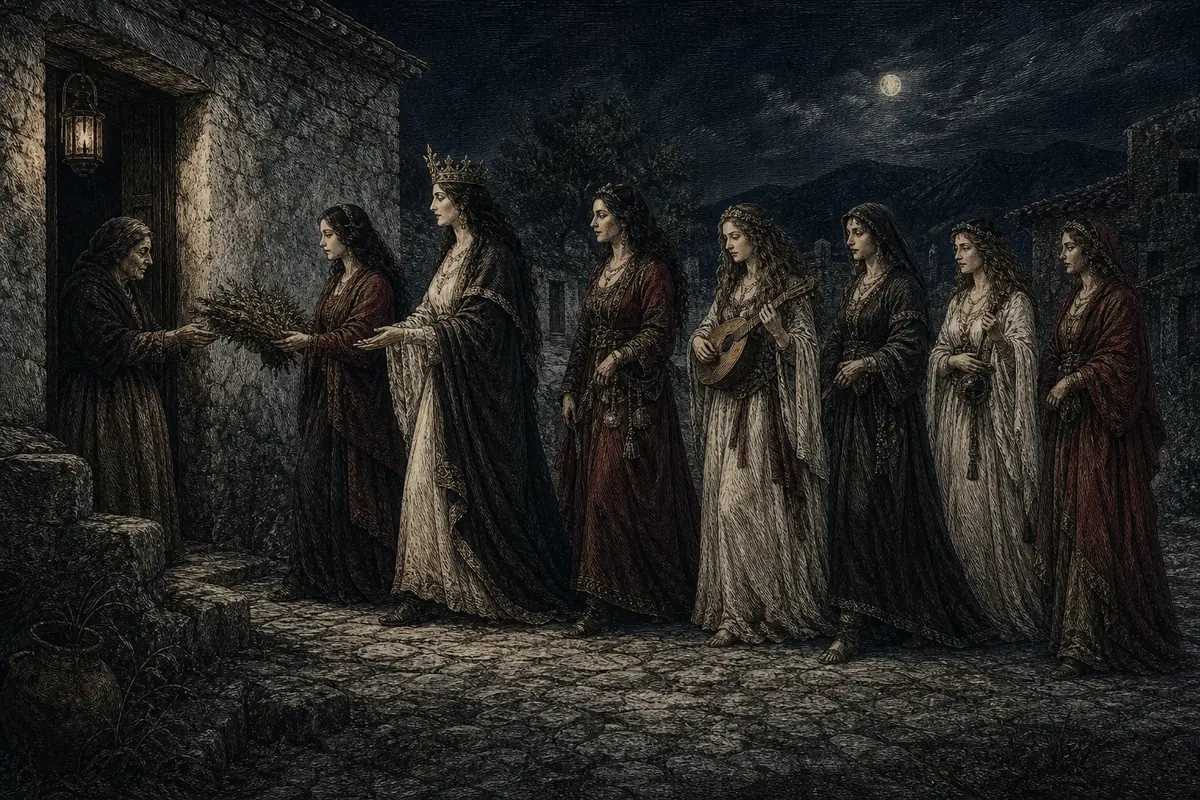
Donni di fora — supernatural female beings, beautiful, dressed in white, red or black, with anomalies in the feet — cat's paws or hooves.
- Variants and dialect names
- Donni di fora, donne di fuora, donas de fuera in the Spanish records; magare in other areas; patroneddri di casa, donni di locu
- What is told
- Supernatural female beings, beautiful, dressed in white, red or black, with anomalies in the feet — cat's paws or hooves. They move in groups of five or seven, with a queen and a lute player. They seek out people with «sweet blood», typically poor women, and transmit to them therapeutic and divinatory abilities.
- What it was forthe author’s reading
- A therapeutic and legitimising function: the human donne di fuora were healers who operated in competition with and in parallel to the clergy. In a case of 1630 a mother turns at the same time to a Capuchin and to a healer, recognising them as of equal authority.
- Where it is attested
- Records of the Spanish Inquisition in Sicily, active from 1516 to 1782. Gustav Henningsen, The Ladies from Outside, 1990. Giuseppe Pitrè, between 1870 and 1890, surveyed a sample of 172 Sicilian municipalities to check whether the belief was still alive; the material went into vol. IV of Usi e costumi, credenze e pregiudizi del popolo siciliano, Palermo 1889. The intact trial record of Diana La Viscusa, Monreale 1639, thirty-one pages.
- Caution
- The 172 municipalities are the sample surveyed by Pitrè, not the number of municipalities in which the belief turned out to be attested: the difference is substantial and is always confused. The trial figures are not interchangeable either — 65 persons between 1579 and 1651 according to one reconstruction, 193 identifications attributed to Henningsen and 77 to Messana according to Geremia's study of 2024: they depend on the counting criteria and are not to be merged. On the abolition of the tribunal: it was decreed by Ferdinand IV on 16 March 1782, and the viceroy Caracciolo was its executor on 27 March; the burning of the trial papers, however, took place on 27 June 1783, and the accounting documentation and the reports sent to Madrid survived.
The grade says how well the entry is documented, not how interesting it is. How the grades are assigned.