Benandanti
Friuli-Venezia Giulia · The Alpine arc
Central and eastern Friuli: Cividale del Friuli, Iassico and Brazzano near Cormòns, Udine, Aquileia, Monfalcone, Latisana
Benandanti — whoever is born wrapped in the amniotic sac is a benandante.
- Variants and dialect names
- benandante, benandanti («those who go well»); Friulian benandant. In the same trial records their counterpart are the malandanti, that is the witches. Recurrent self-definition: «born with the caul»
- What is told
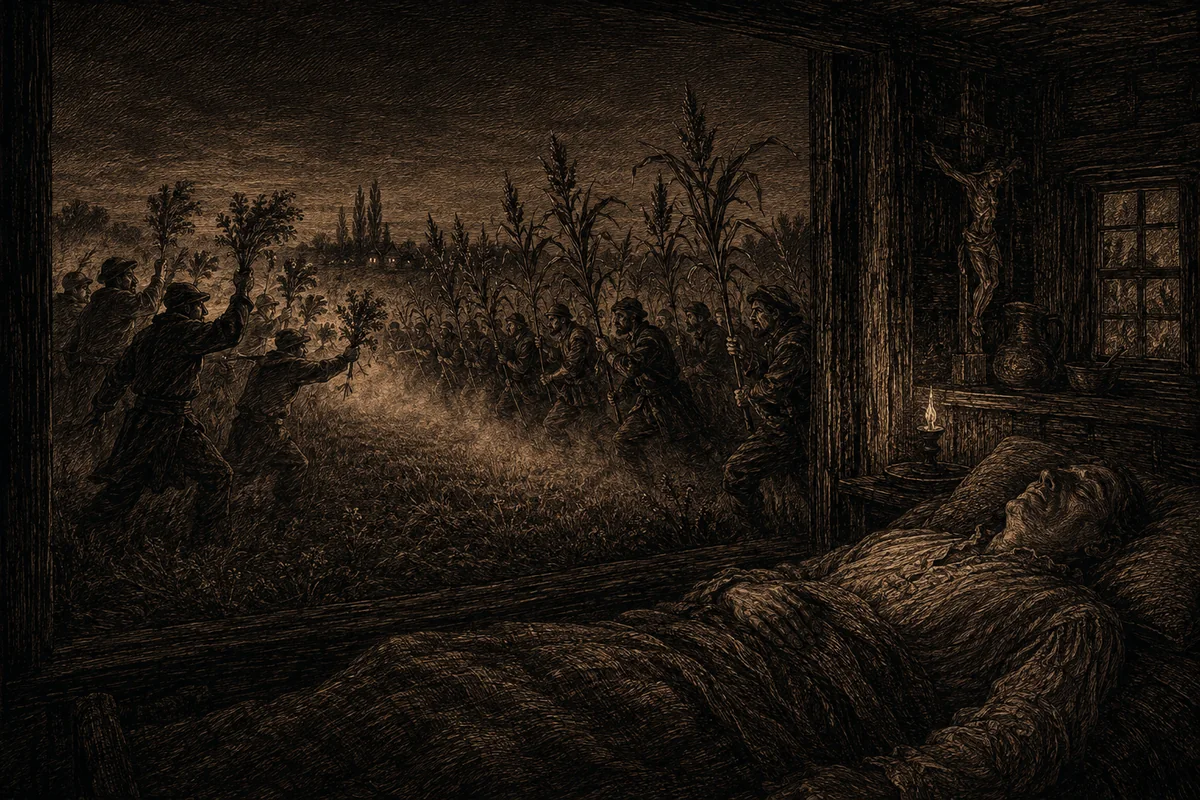
- Whoever is born wrapped in the amniotic sac is a benandante. The midwife keeps the membrane, which is often worn round the neck. Four times a year, on the Thursday of the Ember Days, the benandante goes out in spirit, leaving the body inert, and goes to fight the witches: the benandanti armed with bunches of fennel, the witches with sorghum stalks. If the former win the harvest will be abundant, if the latter win there will be famine. A second line of testimony, predominantly female, concerns instead the procession of the dead: benandanti who see the departed and speak with them, and who in the village act as mediators and healers. Before the judge their claim is constant: they are not witches, they are the witches' enemies.
- What it was forthe author’s reading
- It is the clearest document there is of how an inquisition manufactures its own object. The inquisitors do not understand what a benandante is, having no model to hand but the sabbath; and over the course of two generations, from interrogation to interrogation, they bring the account back to the diabolical scheme until some of the accused confess to the pact with the devil. By the end of the seventeenth century, in Friuli, «benandante» is by now a synonym for sorcerer. The content has not changed: the question has changed.
- Where it is attested
- Archivio storico dell'Arcidiocesi di Udine, Sant'Officio collection: 98 boxes, trial series 1557-1823. First deposition taken on 21 June 1575 by the parish priest Bartolomeo Sgabarizza at Cividale; interrogations of Paolo Gasparutto and of Battista Moduco, public crier, in June and September 1580; sentence on 26 November 1581. Foundational study: Carlo Ginzburg, I benandanti. Ricerche sulla stregoneria e sui culti agrari tra Cinquecento e Seicento, Torino, Einaudi, 1966. Archival revision: Franco Nardon, Benandanti e inquisitori nel Friuli del Seicento, Trieste, EUT, 1999, available in open access.
- Caution
- The calendar is that of the Ember Days, that is Catholic liturgical, and the weapon is fennel, a garden plant: whoever presents the benandanti as surviving pagans is reading the opposite of what the records say. Ginzburg does not confirm Margaret Murray: he grants her «a kernel of truth» and demolishes her method, and in the 1982 preface to the English edition he rejects the idea that sabbaths were actually held. No benandante ended at the stake: the penalties are months of imprisonment and penances, and Perry Anderson used precisely this mildness as an argument against the thesis of Storia notturna (1989), which connects the sabbath to a shamanic substratum. Nardon documents in addition thirty-five trials after 1650 in which the benandante is still perceived as a healer: his replacement by the sorcerer was slower and less complete than it has been told. The known trials are about fifty for Ginzburg, about sixty in Nardon's census.
The grade says how well the entry is documented, not how interesting it is. How the grades are assigned.