Gl’ Cierv, il Cervo di Castelnuovo
Molise · Central Apennines and the Adriatic
Castelnuovo al Volturno, a hamlet of Rocchetta a Volturno (province of Isernia), at the foot of the Mainarde
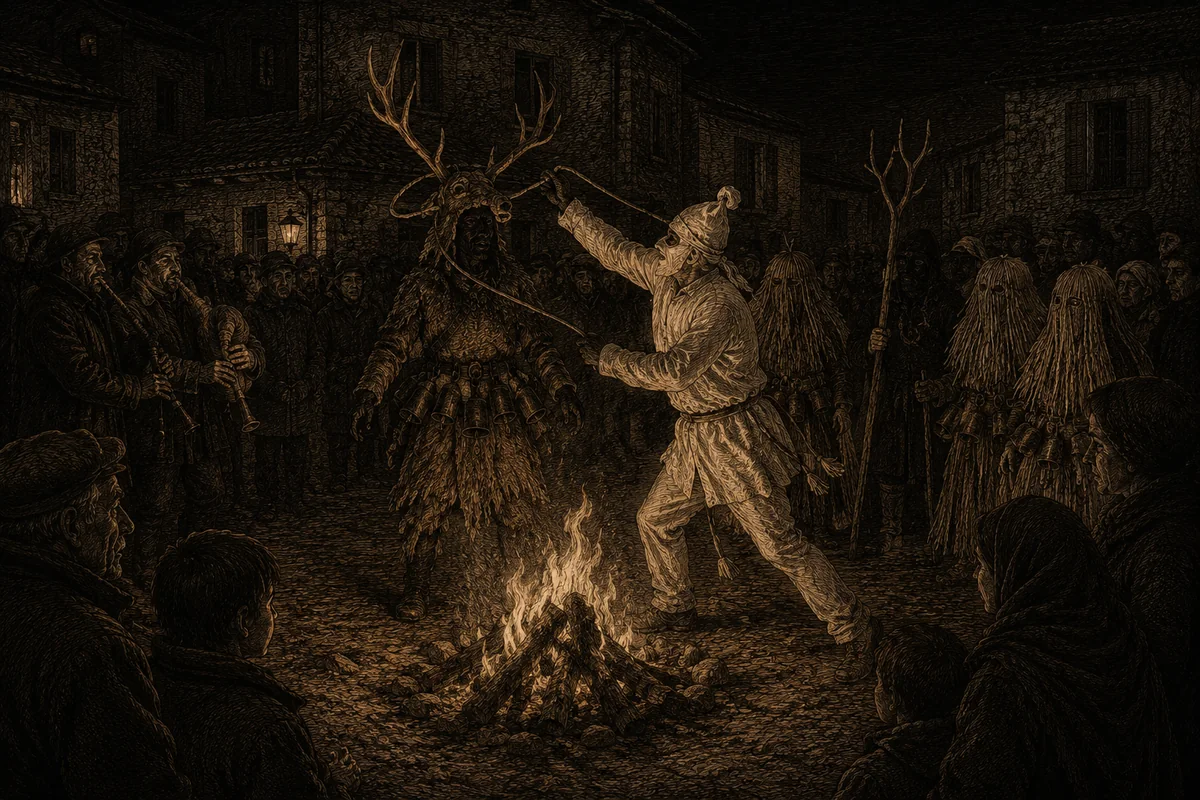
Gl’ Cierv, il Cervo di Castelnuovo — on the last Sunday of Carnival, the square of Castelnuovo becomes the stage of a pantomime.
- Variants and dialect names
- Gl’ Cierv in the local speech, «the Stag». The other figures: the Doe, Martino, the Hunter, the Maone, the janare, the village women, the zampogna players. Note for the atlas: the janare appear here as figures in a pantomime, distinct from the Benevento janara — same name, different tradition.
- What is told
- On the last Sunday of Carnival, the square of Castelnuovo becomes the stage of a pantomime. The zampogna players announce the arrival. The Maone, a sorcerer figure in long goatskins, hairy mask and a staff adorned with deer antlers, leads the janare — girls in black fur, straw wigs and cowbells — in a dance around a bonfire. The Stag Man bursts in: face and hands painted black, goatskins, cowbells, real stag antlers on his head. He howls and destroys. Then he dances with the Doe, whose black face has white areas around the eyes and who is played by a woman — a rare thing in Italian carnivals. Martino, a white figure, catches them with rope and staff; the villagers accuse the Stag of every ill, one of the village women intervenes, the Stag frees himself. Only the Hunter stops him, by shooting him. Then he brings him back to life by blowing into his ears. The creatures wake up docile and take the road to the woods.
- What it was forthe author’s reading
- What can be said without interpreting is that this is a pantomime of capture, killing and resurrection of the wild animal, ending in domestication: the beast is not eliminated, it is pacified and given back to the wood. The scheme is that of carnival reversal and of symbolic control of the wild. The second function belongs to the present and can be verified: Castelnuovo has lost about 80% of its inhabitants, from seven hundred and fifty to a hundred and fifty, between wartime destruction and emigration. The rite is the chief mechanism of attraction and of collective identity left to a village that has emptied out.
- Where it is attested
- It is, among Apennine rites, one of the best served by academic scholarship, and that is owed to a single scholar. Alessandro Testa, Il carnevale dell’uomo-animale. Le dimensioni storiche e socio-culturali di una festa appenninica, Napoli, Loffredo, 2014 — a monograph devoted to it, reviewed in Asdiwal. Revue genevoise d’anthropologie et d’histoire des religions, 9 (2014), pp. 181-184. By the same author: «La maschera del Cervo di Castelnuovo al Volturno. Breve introduzione alla storia ed alle interpretazioni di una pantomima tradizionale», in ArcheoMolise, II (2009), pp. 48-61; and «Mascheramenti zoomorfi. Comparazioni e interpretazioni a partire da fonti tardo-antiche e alto-medievali», in Studi Medievali, s. III, LIV/1, 2013, pp. 64-93, which discusses the cervulus of the late antique sources. Institutional sources: the official website of the Comune of Rocchetta a Volturno (which is the most reliable of the non-academic ones because it cites Testa), the Fondazione Molise Cultura, and the exhibition Tradizioni popolari del Molise in musica e canto of the Soprintendenza archivistica on the Ministry's MOVIO platform — this last would not open for me: I note its existence, I do not cite its text. To be consulted in a library, and not consulted here: Alberto Mario Cirese, Gli studi di tradizioni popolari nel Molise, Roma, De Luca, 1955.
- Caution
- Grade A holds for the rite as it is now. The origins are grade C, and the documented chronology contradicts the rhetoric of the «very ancient unbroken rite». The sequence is this: the first written documentation is from the 1960s; in the 1970s and 1980s the ethnographic investigations arrive and the festival undergoes significant transformations; in 1993 the Associazione culturale «Il Cervo» is founded; between the 1990s and the 2000s substantial modifications are recorded — added figures, choreography, spectacular elements. The dates of revival that circulate contradict one another: 1985 according to some popularising sources, 1993 according to others. The «Samnite origins» and the «Dionysiac» reading have no documentary support whatever. As for descent from the late antique cervulus, which really is attested from the 4th century: the attestation of an ancient practice does not demonstrate the descent of a modern one. Testa himself rejects both continuist essentialism and radical deconstruction, observing that not all traditions are susceptible of being invented and that nothing is invented ex nihilo: this is the formulation to report, not the short cut. Testa warns in addition that many Apennine masks are called indiscriminately «stag», «wild beast» or «devil», and that comparisons must be made with caution.
Why the rite was broken off. On 17 June 1944, after the fall of Rome, the village was destroyed so that the operators of the United States army's propaganda section could shoot a war documentary; the inhabitants had to rebuild their houses. It is the episode that explains both the interruption and the depopulation.
The grade says how well the entry is documented, not how interesting it is. How the grades are assigned.