La Sibilla appenninica
the Marche · Umbria · Central Apennines and the Adriatic
Monti Sibillini, Marche side, comune of Montemonaco (province of Ascoli Piceno): Monte Sibilla (2,173 m) and Lago di Pilato
La Sibilla appenninica — a cave that opens near the summit ridge at about 2,150 metres, and inside it a kingdom.
- Variants and dialect names
- Regina Sibilla in fifteenth-century texts, la royne Sibille in French; Sibilla di Norcia; Sibilla Picena. In local oral tradition, le fate or fate sibilline. In the censored editions of the Guerrino the name is replaced with Alcina, Fata, Incantatrice
- What is told
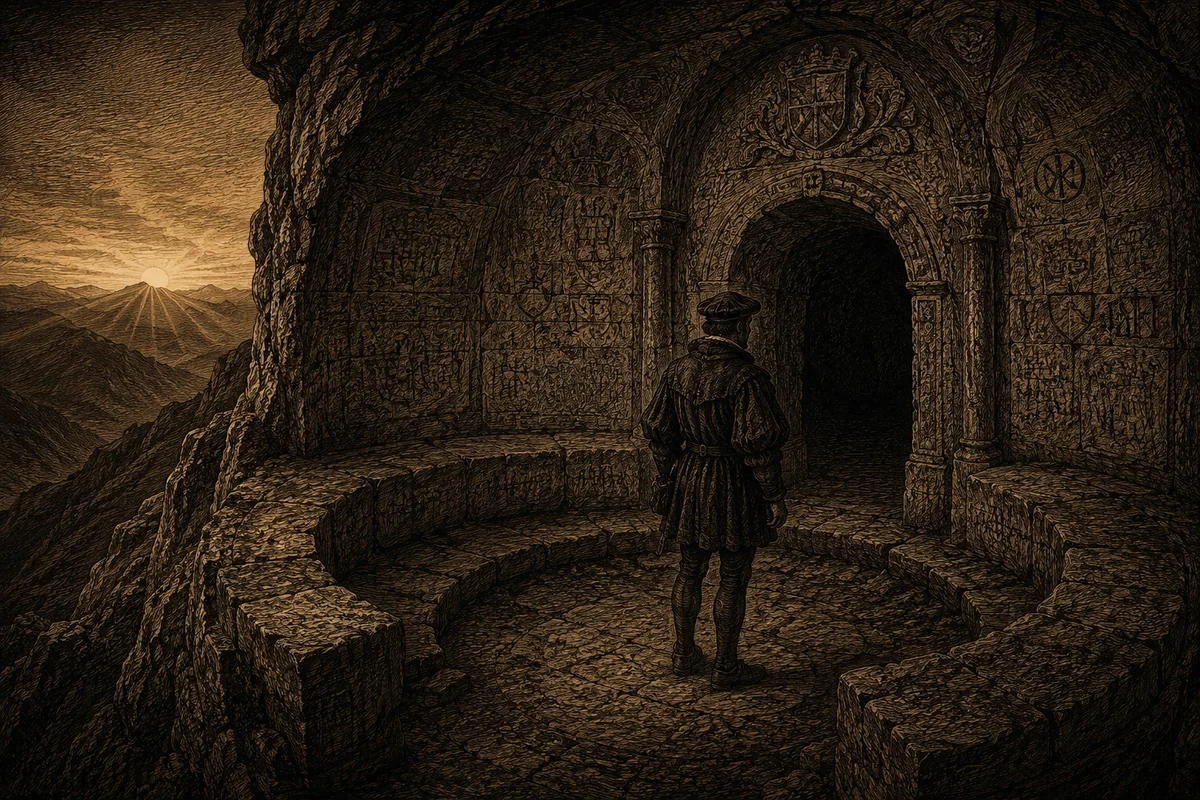
- A cave that opens near the summit ridge at about 2,150 metres, and inside it a kingdom. Antoine de la Sale, who climbs up to it on 18 May 1420, does not go in: he describes the vestibule, «a wide circular space, with stone seats cut all around in the rock», and reads there the incised signatures of the European knights who had preceded him. The villagers of Montemonaco tell him the rest. Whoever dwells in there learns all languages in nine days; he may come out on the eighth day, on the thirtieth or on the three hundred and thirtieth; once the year is past, the confinement is eternal and damnation certain. Every Friday, from midnight to midnight, the Sibyl and her ladies turn into serpents. In the oral tradition collected in the twentieth century the fairies come down to dance in the villages at the full moon, wash their feet in the Lago di Pilato and must be back before dawn: they have goat's feet hidden by their skirts.
- What it was forthe author’s reading
- A pagan otherworld kept standing inside a Christian Europe, and reachable on foot. The cave works as a temptation with a geographical location: not a metaphor, an address. The Lago di Pilato below the Vettore was meanwhile the destination of necromancers who went there to consecrate their magical books, and the authorities imposed safe-conducts and penalties on intruders.
- Where it is attested
- Andrea da Barberino, Il Guerrin Meschino, composed around 1410, editio princeps Padova 1473. Antoine de la Sale, Le Paradis de la reine Sibylle, written between 1437 and 1444 and incorporated into the Salade, critical edition by Fernand Desonay, Paris, Droz, 1930; Italian translation by Patrizia Romagnoli, Verbania, Tararà, 2001. Felix Hemmerlin, De nobilitate et rusticitate dialogus, 1444-1450. Arnold von Harff, travel account, 1497, whose reliability was contested already by Alfred von Reumont. Arturo Graf, Un monte di Pilato in Italia, 1889; Luigi Paolucci, La Sibilla Appenninica, Firenze, Olschki, 1967.
- Caution
- Two errors of chronology, and both overturn the sense. 1420 is the date of the journey of Antoine de la Sale, not of the text, which is some twenty years later: it is not a diary, it is a memory constructed as literature. And the Guerrin Meschino does not derive from the French account, it precedes it by thirty years. Nor does there exist a single source connecting the medieval Sibyl to a pre-Roman oracle: between antiquity and the fourteenth century there is a documentary void, and the name «Sibilla Appennina» is itself a coinage of 1938. In the fifteenth-century sources the Sibyl is not the benevolent fairy queen of the tourist vulgate: she is a demonic seductress from whom one gets out only with papal absolution — so much so that the Venetian edition of the Guerrino of 1785 expunges her and suppresses her name. The Lago di Pilato, finally, is called lacus Sibyllae in the fifteenth-century documents. The cave cannot be visited: the vestibule collapsed between 1953 and 1968, partly because of dynamite charges set off by improvised explorers, and no one has entered the inner chambers since. The document of 1452 on the necromancers absolved at Montemonaco and manuscript no. 40 of the municipal archive I have not been able to verify directly: I report them as attested by the literature.
The grade says how well the entry is documented, not how interesting it is. How the grades are assigned.