I vattienti di Nocera Terinese
Calabria · The Mezzogiorno
Nocera Terinese (province of Catanzaro), Tyrrhenian Calabria; related flagellation rites are attested elsewhere in the region, for example at Verbicaro (province of Cosenza)
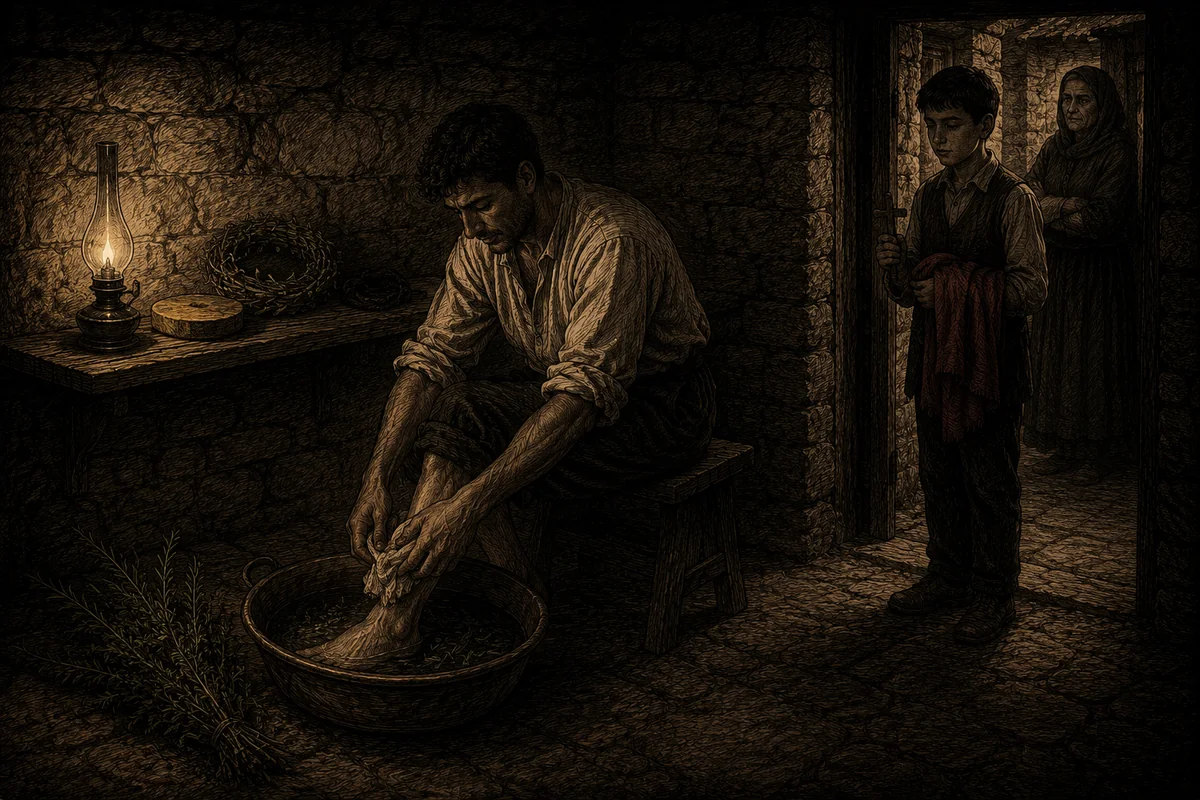
I vattienti di Nocera Terinese — the vattiente prepares in private, in the catuojo, bathing his legs with a decoction of boiled rosemary.
- Variants and dialect names
- vattiente (pl. vattienti), from the dialect vattìri «to beat»; also battienti. The other figures of the rite have names of their own: the acciomu (< Ecce Homo), the boy tied to the flagellant; the wine bearer; the catuojo, the storeroom where the preparation takes place.
- What is told
- The vattiente prepares in private, in the catuojo, bathing his legs with a decoction of boiled rosemary. He uses two instruments: the rosa, a smooth cork disc with which he strikes thighs and calves to bring the blood to the surface, and the cardo, a cork disc of some ten centimetres in which thirteen splinters of glass are fixed with beeswax, arranged in two concentric circles of eight and four, plus one — the local reading: Christ and the twelve apostles. It is the cardo that cuts. Then he goes out, tied by a black rope to the acciomu, who carries a red cloth, a crown of Christ's thorn and a cross. Each vattiente follows an itinerary of his own: he passes in front of houses, churches and family property and leaves marks of blood on them, on the doors, on the walls, on the façade of the church of the Annunziata. The itinerary closes before the statue of the Addolorata. The red traces remain on the streets until it rains.
- What it was forthe author’s reading
- The rite is a personal vow, almost always tied to a precise family event — an illness, an accident, a bereavement: not an assigned role, but a promise being discharged. It is handed down from father to son. But the function best argued in the literature is another, and it is the reason this entry exists: the marks of blood left on doors, churches and property physically trace the map of the vattiente's relationships — kinship, belonging, debt. The route is not a devotional itinerary the same for everyone; it is one's own social network written on the village, once a year, in one's own blood. To this is added the annual return of second- and third-generation emigrants, for whom the rite is the way of repossessing the places they came from.
- Where it is attested
- Best source, peer-reviewed and in open access: Simona Loi, «De-orientalising Ritual Blood. Calabria’s Vattienti, a Case Study», in Annali di Ca’ Foscari. Serie orientale, vol. 54 supplement, 2018, pp. 461-490, DOI 10.30687/AnnOr/2385-3042/2018/01/022, with direct observation in 2017. Nineteenth-century attestation: Luigi Borrello, Reliquie del dramma sacro in Calabria, 1889, which describes men striking their thighs with wood and glass — it is the oldest written testimony identified by Loi. Ethnographic monograph: Franco Ferlaino, Vattienti. Osservazione e riplasmazione di una ritualità tradizionale, Vibo Valentia, Qualecultura – Jaca Book, 1991. In addition: Antonino Basile, «Il rito del sangue del giovedì Santo a Nocera Terinese», in Folklore della Calabria, IV/1, 1959; Ernesto Pontieri, Sopravvivenze pseudo-ascetiche medioevali. I Battienti di Nocera Terinese, Napoli 1967; Francesco Faeta, Il santo e l’aquilone, Sellerio 2000; Luigi M. Lombardi Satriani, Il ponte di San Giacomo, Rizzoli 1989. Ritual detail in Simone Lamanna, «I Vattienti» di Nocera Terinese tra memoria ed identità, degree thesis, University of Perugia, 2007, hosted by the ICSAIC — it is a thesis, not a peer-reviewed text: here it is used for the description, not as interpretative authority. There is a record in the Catalogo generale dei Beni Culturali (ICCD), demo-ethno-anthropological heritage: I note its existence, I do not cite its text, because I was unable to open it.
- Caution
- Two explanations circulate about the origins, and both are rejected by recent scholarship. The first, «Dionysiac rite, cult of Adonis and Attis», goes back to Antonino Basile (1959) and Loi (2018) rejects it explicitly as a reductive reading. The second, «survival of the medieval flagellants of Raniero Fasani», is rejected as well; Pontieri as early as 1967 qualified it as a pseudo-ascetic survival. The formula «thousand-year-old tradition», which recurs on tourist sites, is not documented: the oldest written testimony is of 1889. What is documented, on the other hand, are the prohibitions, and they must be stated: in 1956 the parish priest forbids the procession of the Addolorata in order to prevent the rite, and the people carry it in procession by night all the same; in May 1958 the bulletin of the diocese of Nicotera and Tropea describes the flagellation as among the most «barbarous and uncivilised» spectacles; between 1958 and 1960 the prohibitions are enforced with the intervention of the police. Until 1956 the rite occupied Thursday and Friday; today Friday and Holy Saturday. The participants today number between ninety and a hundred a year.
The grade says how well the entry is documented, not how interesting it is. How the grades are assigned.