La focarazza di Santa Caterina
Tuscany · The Po plain and the northern Apennines
Santa Caterina, a hamlet of Roccalbegna (province of Grosseto), south-western slopes of Monte Amiata, the Grosseto hinterland
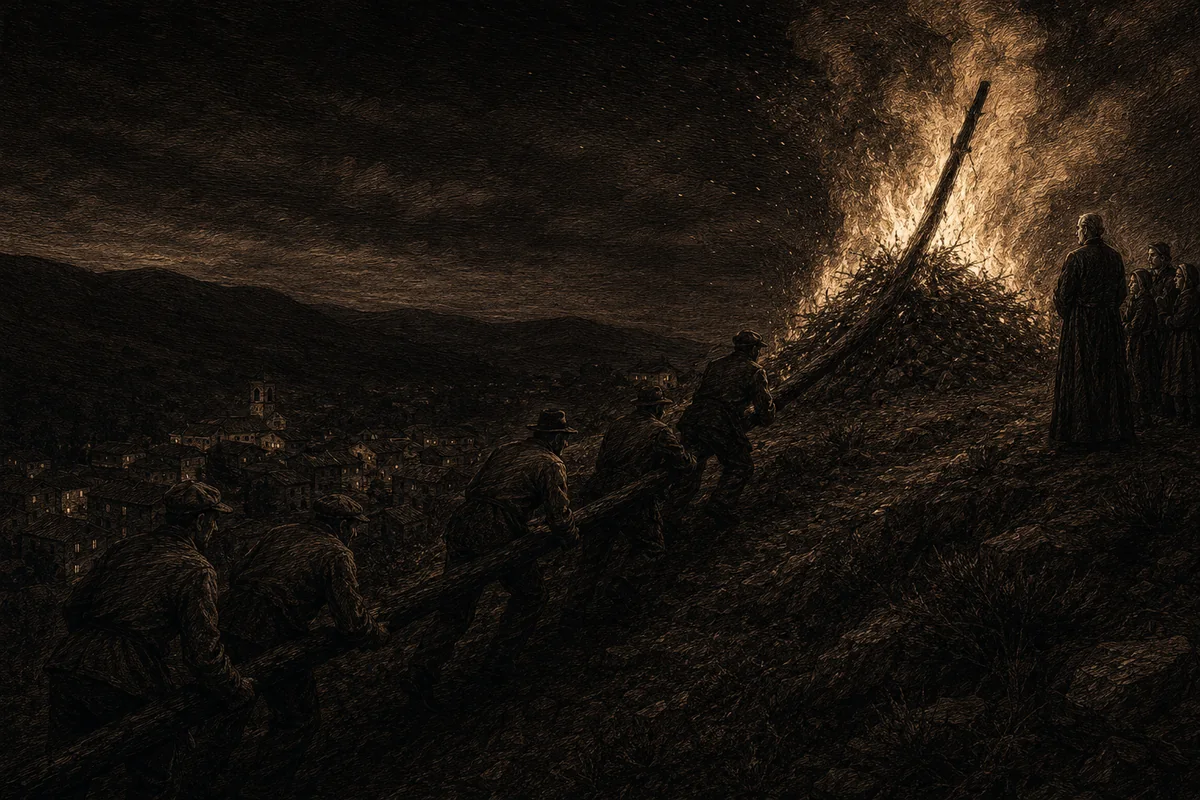
La focarazza di Santa Caterina — the evening of 24 November, the eve of Saint Catherine of Alexandria.
- Variants and dialect names
- focarazza, augmentative of focara; the central element is the stollo, the long Turkey-oak pole driven into the pile. The name «Palio dello Stollo», which appears on events websites, is not a traditional name and does not figure in the ethnographic sources.
- What is told
- The evening of 24 November, the eve of Saint Catherine of Alexandria. Early in the morning the men go up into the wood and cut the chosen tree. In the evening the parish priest goes up in procession to the knoll above the village and blesses the pile of faggots, at the centre of which the stollo is planted. The fire is set. From that moment every participant braves heat and smoke in order to take possession of the pole and drag it into his own quarter: dozens of contenders haul the blackened wood across the countryside in the dark, jumping ditches and low walls. The trunk is then shared out. Each piece is burnt in its owner's own hearth, and the ashes are scattered on the fields and in the vegetable gardens.
- What it was forthe author’s reading
- The two functions are both in the documentation, and they need no hypotheses. The first is agrarian, and it is stated by the participants themselves: the ash on the fields is the final use of the wood, not an observer's interpretation. The second is competitive and to do with identity: the contest between quarters makes the focarazza the moment in which the whole community counts itself and divides itself, and then puts itself back together by sharing out the same trunk. It is the rare case in which a fire rite closes the circle in material terms — the tree cut in the morning ends up, that same night, as ash on the fields of those who fought over it.
- Where it is attested
- Decisive source: Roberto Ferretti (ed.), La focarazza di Santa Caterina: indagine su un rito del fuoco nell’entroterra grossetano, Grosseto, Amministrazione comunale, 1984 — fieldwork carried out in 1982, at that time within a collaboration with the University of Siena. The circumstance is independently attested by Fabio Mugnaini, «Dietro le quinte. L’eredità del mondo mezzadrile…», in Visual Ethnography, vol. 10 no. 2, 2021, note 7. Bibliographic entry verified in the bibliography In terra di Maremma of the Biblioteca del Consiglio regionale della Toscana (2020). The documentary material is in the Archivio delle tradizioni popolari della Maremma grossetana, founded by Ferretti in 1979 and since 1993 a section of the Biblioteca comunale Chelliana. Institutional sources on the museum: entries of the Ministero della cultura, of the Musei Amiata system and of Musei di Maremma. Local printed source: AA.VV., Il mio paese. Roccalbegna, Cana, Santa Caterina, Triana, Vallerona, Amministrazione comunale, 1997, pp. 158-160.
- Caution
- Grade A covers the conduct and the function of the rite, not its origins. Four current assertions have no documentation. «Ancestral purifying rite», pagan or Etruscan origins: it is an interpretative formula that came into circulation from a popularising entry and was then repeated everywhere; no source supports it. «Sixteenth-century tradition»: no archival document attests the rite before the twentieth-century investigations. The aetiology of 1555 — the men of Roccalbegna who on 25 November drive back the French army allied with Siena, and the chapel raised in thanksgiving — is the foundation legend of the chapel, not the date of birth of the focarazza: the two things are regularly confused. I have not consulted Ferretti's 1984 volume in the original: this entry rests on the institutional bibliography that records it and on Mugnaini's confirmation of 2021.
The grade says how well the entry is documented, not how interesting it is. How the grades are assigned.