I vampiri di Serbia, 1725-1732
Serbia
Kisiljevo (Braničevo district) and Medveđa (Trstenik), then the Habsburg Kingdom of Serbia, the military frontier with the Ottoman Empire
I vampiri di Serbia, 1725-1732 — this is not a legend collected by an ethnographer: these are Habsburg administrative records.
- Variants and names
- In the German documents of 1725: Peter Plogojoviz / Plogojowitz, for the Serbian Petar Blagojević; the village is written Kisilova, Kisolova. In the manuscript of 1732 the name is «Arnont Paole»: the form Arnold Paole, under which the affair is known everywhere, is an eighteenth-century typographical normalisation. The readings Arnaut Pavle and Arnaud Paul have also been proposed — the ambiguity is one of German cursive script. The village appears as Medvegya, Medwegya, Metwett.
- What is told
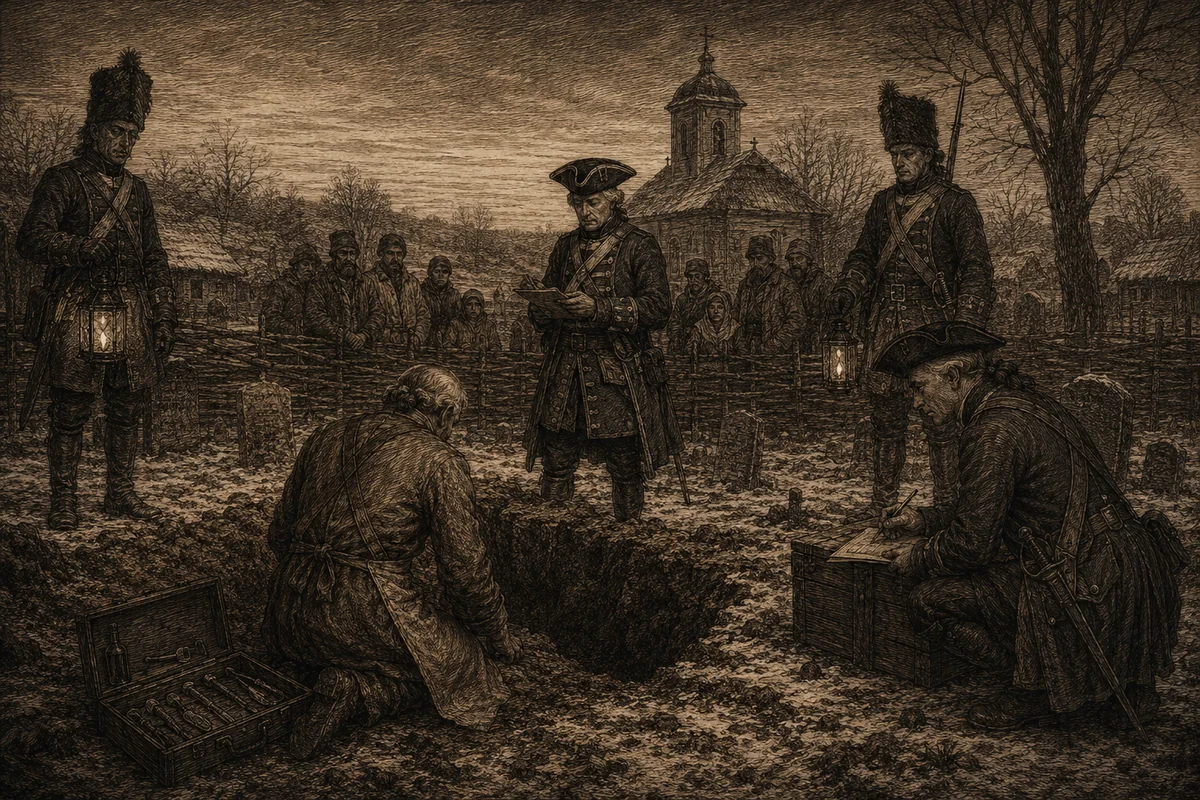
- This is not a legend collected by an ethnographer: these are Habsburg administrative records. 1725. In the district of Gradisca the chamber provisor Frombald reports that, after the death of Petar Blagojević, nine inhabitants of the village died within eight days, each declaring on his deathbed that he had been attacked in his sleep by the dead man. The body, exhumed after about ten weeks, appears undecomposed, with hair, beard and nails regrown, new skin and blood in the mouth; when pierced it gives out «entirely fresh» blood. The report appears in the Wienerisches Diarium of 21 July 1725. 1731-32. At Medvegya the quarantine physician Glaser reports an epidemic on 12 December 1731; on 7 January 1732 a military commission exhumes fifteen bodies and declares ten of them «im Vampirstande», in the vampire state. On 26 January 1732, at Belgrade, five military men sign the Visum et Repertum: the regimental surgeon Johann Flückinger, his colleague Johann Friedrich Baumgarten, the field surgeon Siegel, Lieutenant Büttner and Ensign J. H. von Lindenfels. The bodies are beheaded and burned, and the ashes scattered in the Morava.
- What it was forthe author’s reading
- The work these episodes did is threefold, and all of it is documentable. On the spot, the exhumation and the destruction of the body work as a public act closing an epidemic: they identify a culprit, give the community a procedure that can be carried out, restore control — and it is not by chance that those singled out are the recent and irregular dead, a man who fell from a cart, a fifteen-day-old baby. For the Habsburg administration, as Bräunlein argues, the vampire is a phenomenon of occupation: it appears exclusively in the geography of the newly conquered military frontier, and Flückinger's report is not folklore collected, it is military medicine producing an administrative object — something over which the state can exercise technical competence. For educated Europe, finally, it is a genuine epistemological crisis: not «superstition against science», but different expert cultures — military, medical, theological — contending for competence over a phenomenon. It is this contest that allows Maria Theresa and van Swieten to reclassify a whole domain of phenomena, shifting it from ecclesiastical jurisdiction to medical and state jurisdiction. The Serbian vampire is a tool for building the modern state.
- Where it is attested
- Document: Österreichisches Staatsarchiv, Finanz- und Hofkammerarchiv, AT-OeStA/FHKA SUS Kur 01.1, ff. 1131-1143, «Visum et Repertum über die sogenannten Vampyrs oder Blutaussaugers so zu Medvegia in Servien an der Türkhischen Gräniz am 7. Jänner 1732 geschehen», 29 February 1732 — I have consulted the catalogue description, not the text of the document. The Sammlung Vampirakten der k.k. Hofkammer has been inscribed in the Memory of Austria register of the Austrian UNESCO commission since 2022. Historiography: Peter J. Bräunlein, «The frightening borderlands of Enlightenment: The vampire problem», in Studies in History and Philosophy of Biological and Biomedical Sciences, 43/3, 2012, pp. 710-719, DOI 10.1016/j.shpsc.2012.02.007; Ádám Mézes, Doubt and Diagnosis. Medical Experts and the Returning Dead of the Southern Habsburg Borderland (1718-1766), doctoral thesis, Central European University, 2019, DOI 10.14754/CEU.2020.05. I note, without citing their text because I have not opened them: Klaus Hamberger, Mortuus non mordet. Kommentierte Dokumente zum Vampirismus 1689-1791, Wien, Turia und Kant, 1992; Gábor Klaniczay, «Decline of witches and rise of vampires in 18th century Habsburg monarchy», in Ethnologia Europaea 17, 1987; Paul Barber, Vampires, Burial, and Death. Folklore and Reality, Yale University Press, 1988, which is the text that established the taphonomic explanation of the vampiric signs; Nick Groom, The Vampire. A New History, Yale University Press, 2018; Thomas M. Bohn, The Vampire. Origins of a European Myth, Berghahn, 2019. Printed reception: Michael Ranft, De masticatione mortuorum in tumulis, Leipzig, 1728; Augustin Calmet, Dissertations sur les apparitions… et sur les revenants et vampires de Hongrie, de Bohême, de Moravie et de Silésie, 1746, reissued in enlarged form in 1751 as Traité sur les apparitions des esprits et sur les vampires. Habsburg reaction: Gerard van Swieten, Vampyrismus (memorandum of 1755, printed German translation Augsburg 1768 — the electronic edition consulted); rescript of Maria Theresa of 1 March 1755; Lex caesareo-regia ad extirpandam superstitionem of 1 March 1766; inquiry by Georg Tallar of 1756, published in 1784.
- Caution
- It is not the first case of vampirism: it is the first linguistic loan. Exhumations and destructions of corpses for magia posthuma are documented in Silesia, Moravia and Bohemia from at least the seventeenth century — the literature on which Ranft and Calmet work is earlier. What happens in 1725 is that an imperial official uses the Serbian word in an administrative record that is then printed: it is a bureaucratic and lexical first, not a phenomenological one. And the priority is verifiable: the first known English attestation is in the Grub-Street Journal of 16 March 1731/32, in a news item datelined «Medreyga in Hungary, Jan. 7, 1732» which contains the phrase «certain dead Bodies (called here Vampyres)»; the Craftsman of 20 May 1732 reprints it and already uses the term in a figurative sense. The Paole case is literally the vehicle by which the word enters English.
Five clarifications. Blagojević was already dead of natural causes: the rite concerns the corpse, not the killing of a living person — it is the commonest error in popularisations. Frombald's Christian name is uncertain: Ernst according to some sources, Johann according to others; I have found archival confirmation of neither. Paole's date of death fluctuates between 1726, 1727 and 1728, because the report indicates only a five-year interval. The identification of Medvegya with Medveđa near Trstenik is the most widespread one, not a documentary certainty; in 2021 Aleksandar Ristić proposed the hill Vampirlija at Mijajlovac as a candidate archaeological site, and puts it forward as a hypothesis for excavation. «Maria Theresa forbade vampire hunting» is badly put: the rescript of 1755 does not forbid a subject, it transfers competence over supernatural phenomena from ecclesiastical to secular authority, subordinating it to medical expertise. The practical effect was the end of authorised exhumations — and the disappearance of the word «Vampir» from administrative language.
Finally, two explanations that circulate as «scientific»: porphyria and rabies. Neither is necessary and neither is attested in the documents: the signs recorded in the reports — swelling, purplish fluid mistaken for fresh blood, retraction of the skin simulating the growth of nails and beard, the «groan» as the gases are expelled under the stake — are normal taphonomy.
The grade says how well the entry is documented, not how interesting it is. How the grades are assigned.