Vrykolakas
Greece
Cyclades: the case documented at first hand took place on Míkonos; the belief is pan-Hellenic, with forms of its own in Crete
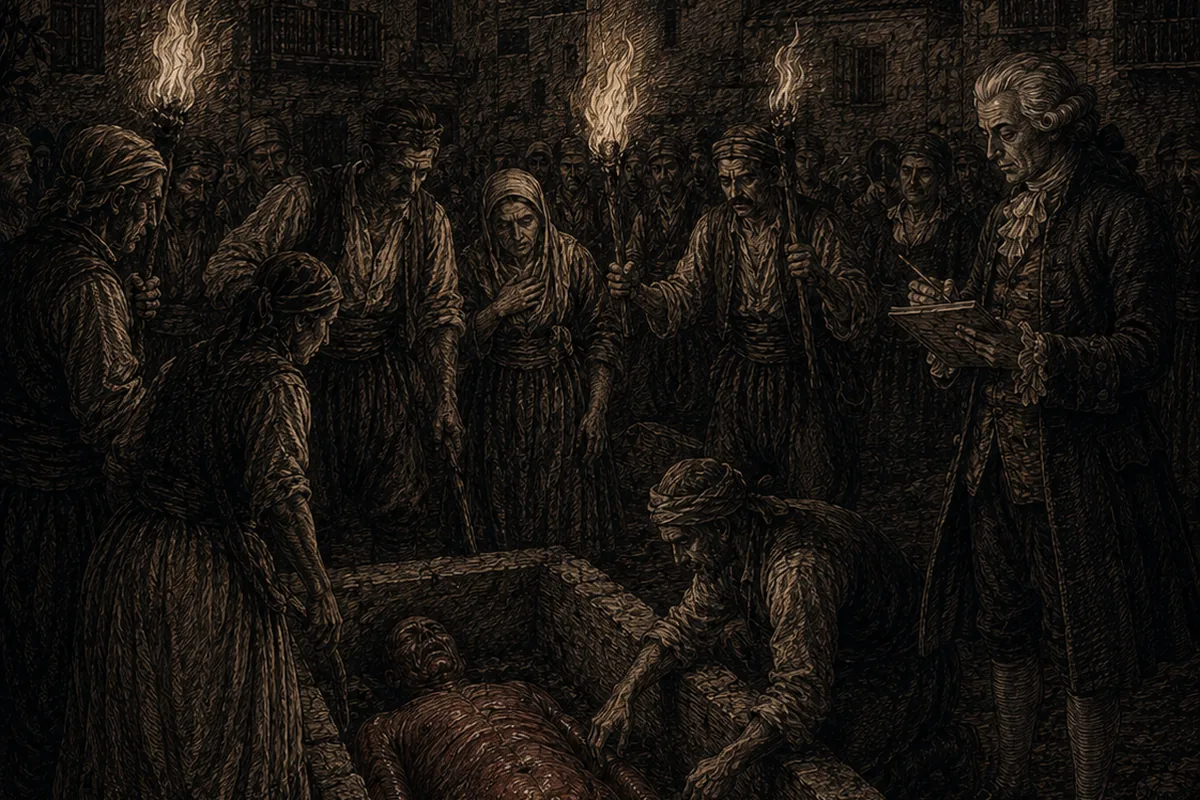
Vrykolakas — a dead man who does not decompose: swollen, reddish, the skin taut as a drum, «fresh and full of new blood».
- Variants and names
- Greek βρυκόλακας, also βρικόλακας and βουρκόλακας; variants vourvoulakas, vourdoulakas; in Crete katakhanas. The earlier and native Greek ecclesiastical term is τυμπανιαίος, «drum-shaped». The current name is instead a Slavic loan — Bulgarian vǎrkolak, Serbian vukodlak, a compound of «wolf» and «hair» — which in the source language means werewolf
- What is told
- A dead man who does not decompose: swollen, reddish, the skin taut as a drum, «fresh and full of new blood». At night he knocks at doors, puts out the lamps, crushes and suffocates sleepers, and infects them. One becomes one through excommunication, through burial in unconsecrated ground, through violent death or death without burial, through a sacrilegious life, through having eaten the flesh of a sheep savaged by a wolf, or if an animal steps over the corpse. The decisive countermeasure is not the stake: it is the priest. Absolution loosens the bond and allows the body to dissolve; where that is not enough one proceeds to exhumation, to the extraction and burning of the heart, to dismemberment, and in Crete to cremation. It is done on a Saturday, the only day on which the vrykolakas rests in the grave.
- What it was forthe author’s reading
- The current readings are three, and all are interpretative: a device of social control that sanctions unresolved quarrels, excommunications and irregular burials; an instrument of ecclesiastical power, given that the priest's absolution is the only key; and a collective management of anomalous deaths and of epidemic fear.
- Where it is attested
- The first systematic Western treatment is Leone Allacci, De Graecorum hodie quorundam opinationibus, Cologne 1645, which sets out the belief concerning the body of the excommunicate, drawing on the Nomocanon. Then comes François Richard, Relation… à Sant-Erini, Paris 1657, on the exhumations at Santorini. The documentary core, however, is Joseph Pitton de Tournefort, botanist to the king of France, who during the voyage of 1700-1702 witnessed the whole Míkonos affair in person and published it in the Relation d'un voyage du Levant, Paris, Imprimerie Royale, 1717 — posthumously, since he had died in 1708; the English translation is of 1718. The modern collections: N. Politis, Παραδόσεις, 1904, with forty-five texts; J. C. Lawson, Modern Greek Folklore and Ancient Greek Religion, Cambridge 1910, chapter IV.
- Caution
- Tournefort's account deserves to be read in full, because it is one of the very few first-hand descriptions of a case of European «vampirism» written by a scientist while it was happening — and by a sceptical scientist. A quarrelsome peasant is killed in the fields; nine days are allowed to pass; on the tenth, after mass, the body is opened, and the butcher, old and clumsy, opens the belly instead of the chest; the heart is burned on the shore; the incense, mixed with the vapours of the corpse, makes the stench worse instead of covering it. The disturbances continue, and the body is burned on 1 January 1701. Tournefort puts it all down to an «epidemic disease of the brain, as dangerous and contagious as the madness of dogs», and traces the heat and the redness back to putrefaction. To be corrected: the vrykolakas does not drink blood — he suffocates, and if anything devours organs — and has nothing of the literary vampire, neither canines nor cloak nor garlic; the etymology from «mud» and «pit» is popular false etymology; and Lawson's thesis of a direct descent from the ancient lamiae is now scaled down. On the Slavic loan, finally, one fine point should be made: the word is Slavic, but as early as the nineteenth century Robert Pashley observed that the Cretan katakhanas is not, and that the belief might therefore be Greek and only the name borrowed.
The grade says how well the entry is documented, not how interesting it is. How the grades are assigned.