New England vampire panic
the United States
Vermont and rural New England (Manchester, South Woodstock; with Rhode Island and Connecticut)
New England vampire panic — not a monster but a ritual practice of nineteenth-century New England: exhuming a relative who has died of consumption and burning the heart to stop the contagion.
- Variants and names
- New England vampire panic is a label of scholars and newspapers, not of the communities involved, who spoke of consumption, that is phthisis
- What is told
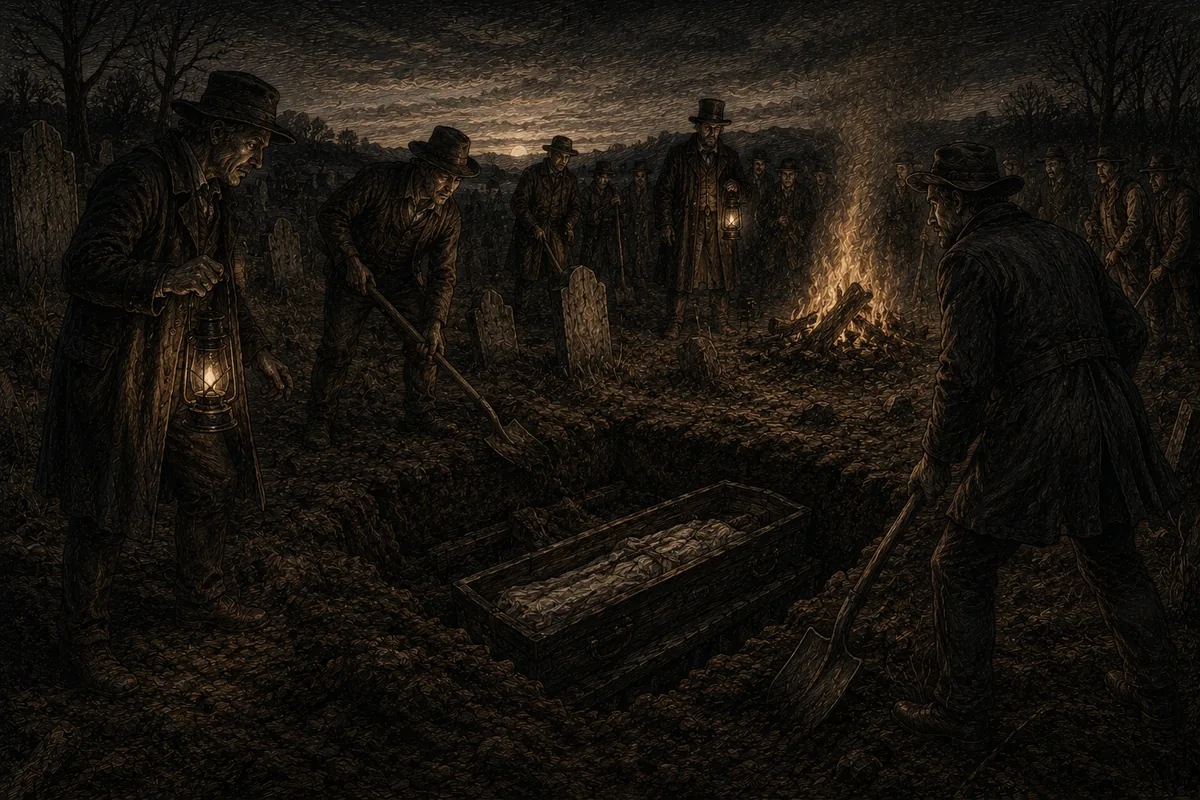
- There is no monster, there is a ritual practice: when several members of the same family died of consumption in sequence, the most recently deceased was exhumed. If the heart or the organs still contained liquid blood, a sign read as proof that the dead person was feeding on the living, the organ was burned and sometimes the ashes were administered to the sick person. In some cases the skeleton was rearranged, as in the JB55 burial at Griswold in Connecticut, with the femurs crossed over the chest.
- What it was forthe author’s reading
- A ritual response to an incomprehensible epidemic: before Koch's identification of the bacillus in 1882, tuberculosis presented itself as an invisible family contagion with a very high fatality rate, and exhumation gave the community a procedure, a culprit and a possible action. Michael Bell interprets it as an attempt to resolve the ambiguity of death, that is to establish who is really dead and when.
- Where it is attested
- Documented Vermont cases: Manchester 1793, with deacon Isaac Burton having his first wife Rachel Harris exhumed in order to save the second; South Woodstock 1817, with Frederick Ransom, a student at Dartmouth College, who died on 14 February and whose heart was burned on a blacksmith's forge. Best documented case in the area: Mercy Lena Brown, Exeter, Rhode Island, 1892, with contemporary newspaper coverage. Direct archaeological evidence in the Walton cemetery at Griswold. Standard study: Michael E. Bell, Food for the Dead: On the Trail of New England's Vampires, 2001, expanded edition Wesleyan University Press 2011, with over eighty reconstructed cases.
- Caution
- The practice as a whole is grade A, but the most frequently retold Vermont case, that is the Woodstock Corwin of 1830 with the heart boiled and buried under a granite slab, is almost certainly false or gravely embellished: it appears for the first time in the Vermont Standard in the autumn of 1890, sixty years later, in the words of an informant reported at third hand; there is no burial record of any Corwin at the Cushing Cemetery and the Woodstock Observer of 1830 reports nothing. Since it is this case that identifies the entry in its current circulation, the precautionary grade is C. Bell further stresses that no credible account describes a corpse coming out of the grave, and that the word vampire was used by the newspapers and by outside observers, not by the communities.
The grade says how well the entry is documented, not how interesting it is. How the grades are assigned.