Strigoi
Romania
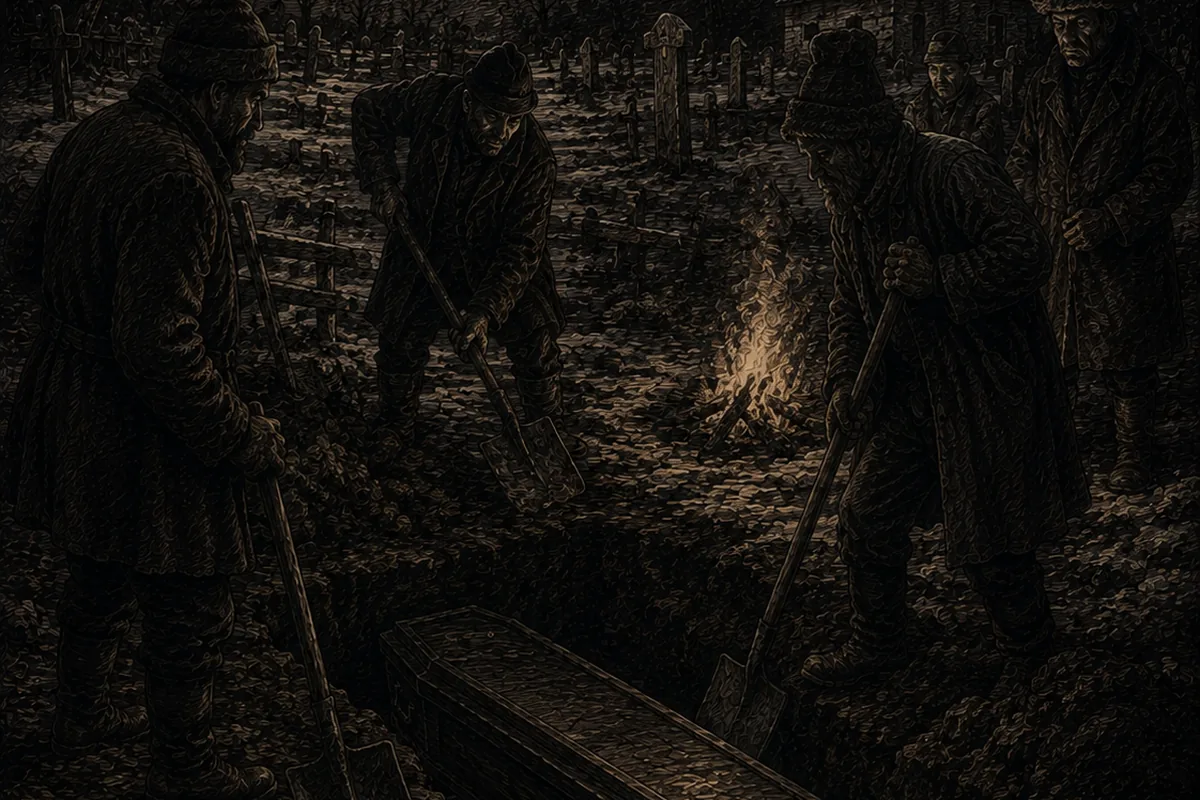
Oltenia; Marotinu de Sus, where the rite was carried out in January 2004
Strigoi — the Romanian revenant, in two forms: the strigoi viu, a living person whose soul goes out at night, and the strigoi mort, the corpse that returns.
- Variants and names
- Romanian strigoi, feminine strigoaică, from Latin striga — the same root as Italian «strega» — with the augmentative suffix -oi, and a popular contamination with a striga, «to shout». Close but distinct: the moroi, which is a regional rather than a functional variant; the pricolici, the dead man who returns in the form of a wolf; the vârcolac, which in tradition devours the moon during eclipses and only by rebound has become a lycanthrope. They are not synonyms, whatever the internet says.
- What is told
- There are two strigoi. The strigoi viu is a living person whose soul goes out at night; the strigoi mort is the corpse that returns. The peasant holds them together, and he has his reasons. One becomes a strigoi by birth — born with the caul, căiță; the seventh child of the same sex — or by accident: a cat that jumps over the coffin, a man who steps across the dead body, a shadow that falls on it, death without confession, suicide. The living one takes away the mana, the virtue, from the milk, the grain, the bread, the bees. The dead one does something worse: he consumes his relatives, one after another. On the grave the earth is disturbed; when the coffin is opened, the body is red in the face, huddled in a corner, with blood at its mouth.
- What it was forthe author’s reading
- It is the only possible answer to an unbearable question: why is it that in this house everyone dies, and in the house next door no one does. The rite that follows is not an act of cruelty towards the deceased but a therapy for the living, and it is organised as such: the heart, the fire, the ash, the water, the sick person who drinks.
- Where it is attested
- The founding collections are Romanian: Simion Florea Marian, Înmormântarea la români. Studiu etnografic, 1892; Elena Niculiță-Voronca, Datinile și credințele poporului român, Cernăuți 1903; Artur Gorovei, Credinți și superstiții ale poporului român, 1915; Tudor Pamfile, Mitologie românească I: Dușmani și prieteni ai omului, Academia Română, 1916. In English the source that carries everything is Agnes Murgoci, «The Vampire in Roumania», Folklore 37, 4 (31 December 1926), pp. 320-349, which lists the regional variants with the names of the villages: needles in the heart at Vâlcea, iron pitchforks and reburial face down at Zărnești, named cases at Cușmir and Văguilești in Mehedinți and at Afumați in Dolj. Before her, Emily Gerard, «Transylvanian Superstitions», The Nineteenth Century, 1885, later incorporated into The Land Beyond the Forest, 1888: it is the text that Bram Stoker read.
- Caution
- Grade A, and with a rare documentary density: four ethnographic collections between 1892 and 1916, an article in Folklore of 1926, and — something no other entry in this atlas has — a court file of 2004.
To be corrected: «nosferatu» is not Romanian. It does not exist in any documented phase of the language. The etymologies proposed — from Greek nosophoros, «plague-bearer», or from Romanian necurat, «the unclean one», or from nesuferit — are all conjectural, and the Greek one has been contested as having no lexicographical basis. It is in all probability a transcription error by Emily Gerard, or an oral source misunderstood, which Stoker canonised. Anyone who sells it to you as an ancient word has not checked.
Two minor points. The author of 1892 is Simion Florea Marian, not Simeon. And the village of Marotinu de Sus belongs to the commune of Celaru, not to Amărăștii de Jos, as one reads here and there.
The grade says how well the entry is documented, not how interesting it is. How the grades are assigned.