Nachzehrer
Germany
Northern Germany, from Lower Saxony to Pomerania; archaeological findings in the district of Stade
Nachzehrer — the dead man stays in the grave — and it is this that distinguishes him from the revenant who walks.
- Variants and names
- Nachzehrer, «he who consumes afterwards» (nach «after» + zehren «to wear away, to consume»): not «bloodsucker», but the one who causes wasting at a distance. Regional variants recorded by the German folklore atlas: Doppelsauger in the Kassel area and in Mecklenburg, Gierhals and Nimmersatt in West Prussia, Neuntöter, Blutsauger in Bavaria; Kashubian wieszczy. In the learned Latin lexicon: mortuus manducans, and in German der schmatzende Tote, «the smacking dead man»
- What is told
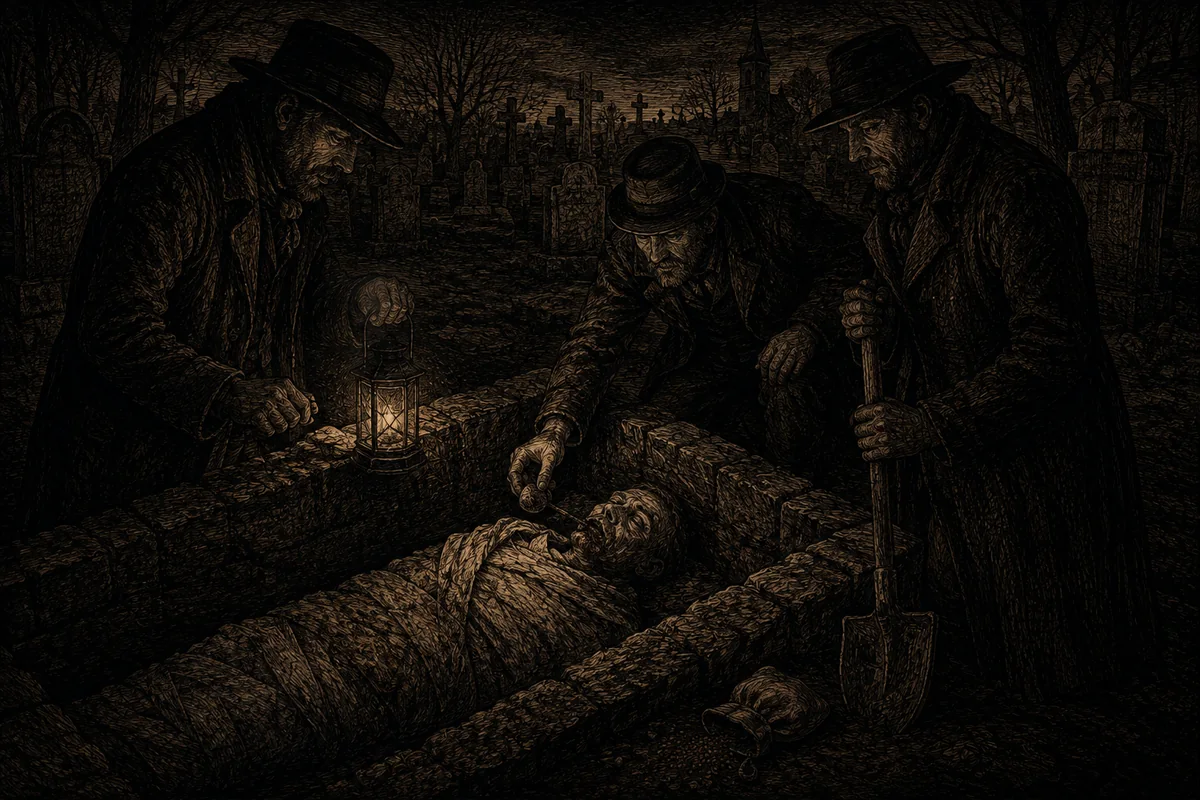
- The dead man stays in the grave — and it is this that distinguishes him from the revenant who walks. He chews the shroud, his own fingers, his limbs, with a sound compared by the sources to that of a pig eating; and as long as he chews, his kin waste away and die one after another. The grave is reopened: mouth bloodied, shroud gnawed, a body that seems fresh. The remedies are material and precise: decapitation, a stone or a sod of peat or a coin in the mouth, the turning over of the corpse, or else impossible tasks — net knots to be untied, poppy seeds to be counted.
- What it was forthe author’s reading
- It probably explained clustered mortality within a single family during epidemics — what today is called household contagion — by attributing it to a dead person rather than to a living one; it gave gravediggers and the community an operational procedure in an otherwise unmanageable crisis; and it disciplined the funeral rite upstream, requiring the eyes and mouth to be closed and no personal objects to be left with the dead.
- Where it is attested
- The oldest narrative core is Bohemian, not German: Jan Neplach, abbot of Opatovice, Summula chronicae tam Romanae quam Bohemicae, around 1360, records the shepherd of Blov in 1336 and the woman of Levín in 1344, found with half her shroud devoured. The explicit link between chewing and plague is fixed around 1600 with Martin Böhm, 1601. The treatises: Philipp Rohr, Dissertatio historico-philosophica de masticatione mortuorum, Leipzig 1679; and Michael Ranft, in three redactions — Dissertatio historico-critica de masticatione mortuorum in tumulis, Leipzig 1725; De masticatione mortuorum in tumulis, oder von dem Kauen und Schmatzen der Todten in Gräbern, Leipzig 1728; and the Tractat of 1734, which discusses the Hungarian «Vampyrs». Archaeology: the Lazzaretto Nuovo in Venice, excavation of 2006, and the German cases of Kloster Harsefeld and Kloster Heiligengrabe, and the Polish ones of Drawsko, Kamień Pomorski and Pień.
- Caution
- Grade B is for a lexical reason: the complex of beliefs and the remedies are attested by independent primary sources — a fourteenth-century chronicle, a sermon of 1601, university dissertations, the ground — but the name «Nachzehrer» is late, and the ordering of the figure is the work of the treatise writers and then of the nineteenth-century folklorists: no medieval source uses that term. Three corrections. Rohr, 1679, is not «the first treatise on vampires»: the word vampire enters German only in 1732, after the Serbian cases, and the chewing dead are a distinct category. Ranft, above all, did not believe in the chewing dead: his book is an operation of dismantling, and it explains the sounds by underground gases, the collapse of the coffin and animals shifting the shroud. And it is not an imported Slavic belief: the folklore atlas documents it as far as the Rhineland.
The grade says how well the entry is documented, not how interesting it is. How the grades are assigned.