Il latte del Rutor
the Aosta Valley · The Alpine arc
Rutor glacier and lakes, La Thuile (province of Aosta); the ice-dammed lake known as Santa Margherita, now gone
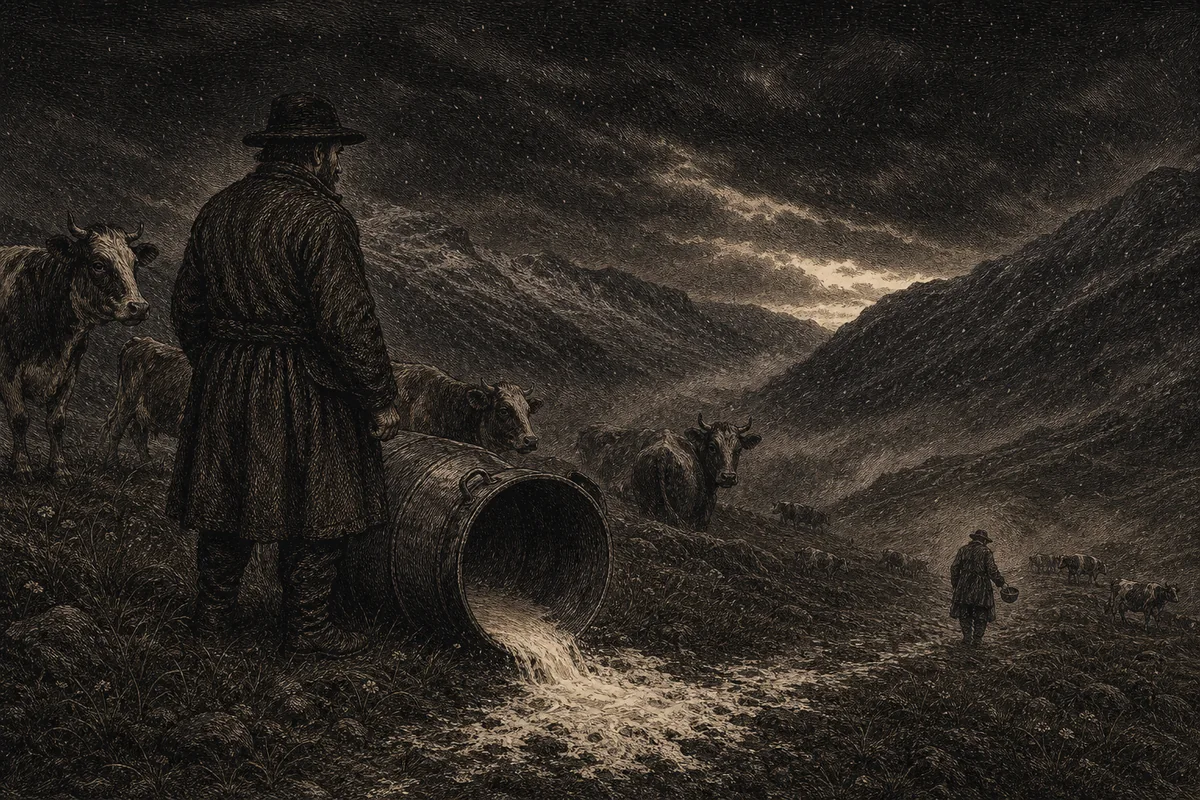
Il latte del Rutor — where today there is the glacier there was a rich alp, with fat pastures and many cows.
- Variants and dialect names
- Rutor, Ruitor; Lac de Santa Margherita, Lac des Glaciers, Lac du Rutor for the ephemeral lake that the glacier formed and released.
- What is told
- Where today there is the glacier there was a rich alp, with fat pastures and many cows. A starving beggar asks for a bowl of milk. The master not only refuses: out of contempt he has the milk of the milking poured on the ground, and it spreads over the meadows and whitens them. It then begins to snow, in high summer, and the snow never goes away again: the meadows stay white for ever. In one version the beggar is Christ and the inhabitants too end up under the ice; in another he is an ordinary poor man who merely speaks the words: «since the meadows have turned white, white they shall stay».
- What it was forthe author’s reading
- It is an aetiological legend of pan-Alpine type: the same story — milk refused, milk poured out, punishment by eternal snow — is found for the Aletsch and for the Morteratsch. It gives a moral explanation of something that really happened: during the Little Ice Age the glaciers advanced and did indeed bury high-altitude pastures. Palynological studies on the Rutor proglacial area document a higher tree line in the Holocene: that there were meadows where today there is ice is true. The legend is not the historical memory of it: it is its moral explanation.
- Where it is attested
- For the legend: no printed attestation earlier than the end of the twentieth century has been found, no collector, no informant, no date of collection. The portal of the BREL — the Valle d'Aosta regional office for ethnology and linguistics — does not contain it. For the documented history, which is of quite another solidity: Regione autonoma Valle d'Aosta, Storia degli eventi idrogeologici dall’800 al 2002, from L. Mercalli et al., Atlante climatico della Valle d’Aosta, SMS, Torino 2003; Comitato Glaciologico Italiano, entry for the Rutor glacier; Managing glacial and periglacial hazards in the Alps, in «Natural Hazards and Earth System Sciences» 26, 2026.
- Caution
- The true history of this place is more striking than the legend. For four centuries the glacier dammed a lake that periodically broke the ice dam and came down the valley: outbursts documented in 1595, 1596, 1597, 1598, around 1630, in 1646, 1679, 1680, in August 1751 — five million cubic metres — and the last in September 1864. In 1596 the duke of Savoy sent the engineer Soldati, and a drainage tunnel costing ten thousand gold ducatoni was proposed, never dug. In 1606 the chapel of saints Grato and Margherita, who are invoked against avalanches and floods, was raised at the foot of the glacier, and every July there was a procession up to pray. The lake was called Santa Margherita because it caused fear. The three Rutor waterfalls, which today are the attraction of the valley, are the direct product of the last emptying, that of 1864. — Two clarifications: there is no «ghost of the Rutor», and the drainage channels that many take to have been dug were only planned.
The grade says how well the entry is documented, not how interesting it is. How the grades are assigned.