La Berta di Santa Maria Maggiore
Tuscany · The Po plain and the northern Apennines
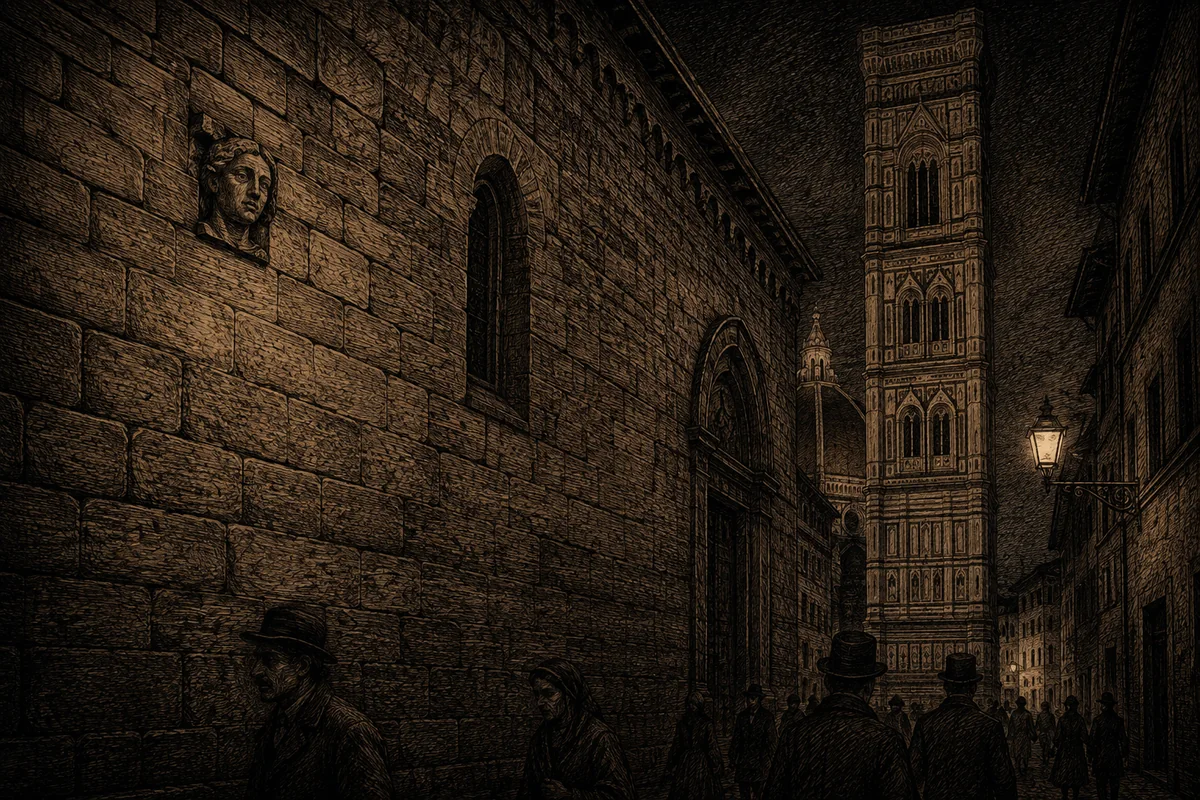
Florence, church of Santa Maria Maggiore, the side on via de' Cerretani, level with the bell tower
La Berta di Santa Maria Maggiore — a woman's head in stone, fragmentary, set high into the outer wall of the church and still visible from the street.
- Variants and dialect names
- la Berta; la testa della Berta; the petrified head of Santa Maria Maggiore. In some variants the protagonist is not «Berta» but a trecca, that is a woman selling greens, or a sacristan
- What is told
- A woman's head in stone, fragmentary, set high into the outer wall of the church and still visible from the street. The most widespread legend makes her a petrified woman: leaning from the window of the bell tower, she is said to have shouted to the crowd not to give drink to the condemned Cecco d'Ascoli, led to the stake on 16 September 1327, because «if he drinks he will not burn any more»; and he is said to have answered her «and you will never draw your head back from there». In a second version the one petrified is a sacristan — a variant that makes explicit the true sense of the story, which is the punishment of cruelty towards a condemned man. In a third, which no tourist site tells, there is no curse at all: the head commemorates a fruit seller who gave the church the bell by which the peasants were signalled the hour to leave the city before the gates closed.
- What it was forthe author’s reading
- An aetiological legend built after the fact upon a pre-existing object: the mechanism by which an anonymous fragment set into a wall draws a story to itself, and the story draws to itself a famous historical event that happened elsewhere. It is the textbook case of stratification, and it can be dismantled layer by layer because every layer has a date.
- Where it is attested
- Document of 20 March 1630: once the demolition of the upper part of the bell tower had begun, the grand-ducal inspector ordered that «the head that was in the bell tower representing a certain ancient memory» be put back — proof that the tradition already existed and that the present position is seventeenth-century. Regest in Luciano Artusi and Roberto Lasciarrea, Campane, torri e campanili di Firenze, Firenze, Le Lettere, 2008, pp. 171-173. Giuseppe Richa, Notizie istoriche delle chiese fiorentine, Firenze, Viviani, 1754-1762, records the bell inscription with the name BERTA. For the burning of Cecco d'Ascoli: Giovanni Villani, Nuova Cronica, and Robert Davidsohn, Storia di Firenze, Sansoni, vol. IV.
- Caution
- The topography contradicts the legend. Cecco d'Ascoli was not burnt in piazza Santa Croce — the version now most widespread online — but, according to Davidsohn, on the bed of the Arno near Porta alla Croce, at the eastern end of the city; Santa Maria Maggiore stands a kilometre to the north-west, and the condemned man did not pass in front of it. The head is in all probability an ancient fragment in reuse, perhaps from a Roman funerary monument, put back where it now is in 1630. The name almost certainly comes from the bell, not the bell from the woman: it is a legendary etymology in reverse. No source maintains that it is an Etruscan or Celtic apotropaic face: that is an invention of recent esoteric popularising. And Cecco d'Ascoli was condemned for heresy — an astrological doctrine that subordinated even the incarnation of Christ to astral influence — not for witchcraft. The legend cannot be traced before the seventeenth century: it is this that keeps it at grade B.
The grade says how well the entry is documented, not how interesting it is. How the grades are assigned.