I bozzi delle fate
Tuscany · The Po plain and the northern Apennines
Fiacciano, comune of Fivizzano (province of Massa-Carrara); pools on the canale dell’Albereda, a tributary of the Rosaro stream, near Pognana, in the Lunigiana
I bozzi delle fate — a series of pools of green, transparent water, set into sandstone in tilted beds, linked by small falls.
- Variants and dialect names
- bozzi delle fate, bozi delle fate; the place is also called cascate di Fiacciano. Bozzo is a Tuscan and Lunigiana word for a pool of still water hollowed out of the rock by the stream.
- What is told
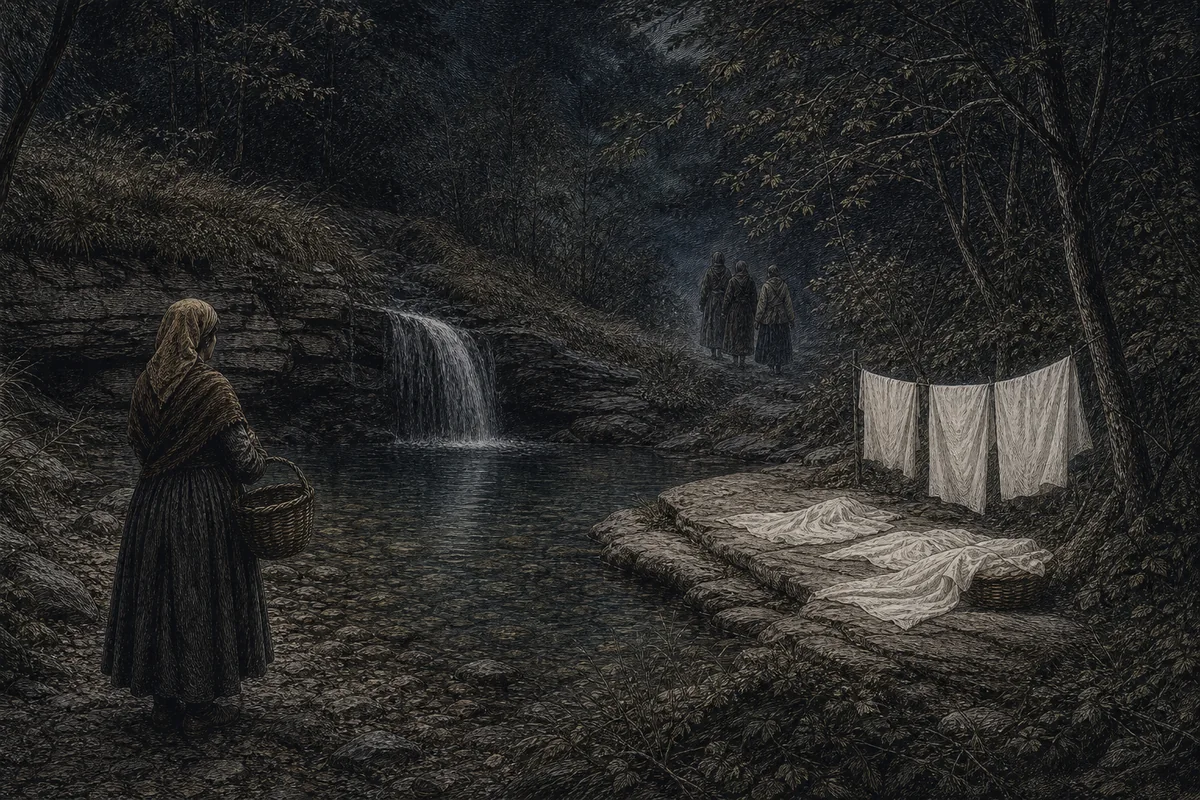
- A series of pools of green, transparent water, set into sandstone in tilted beds, linked by small falls. The story attached to them is very short and always the same: the fairies wash there at night, and in the morning they spread the linen to dry on the big stones round about. No version adds anything else — there is no pact, there is no punishment, there is no witness who sees them. It is a story without a plot: only a gesture, repeated.
- What it was forthe author’s reading
- Supernatural washerwomen are one of the best documented motifs in Europe, and washing is for them not a picturesque detail but the activity that defines them. In the eastern Alps the anguane have exactly this in common, from the Astico to the Isonzo: they wash. In the Veneto their dull thuds are heard in the night near springs and streams; in western Friuli daytime washing prevails instead; and the linen is specifically of flax and hemp. In Brittany the kannerezed-noz, the night washerwomen, wash at the fords, and woe betide anyone who stops to help them wring. Behind the motif there is an elementary fact: the wash-place was where women were alone, outside the village, on the water, and where the water kills whoever slips into it. The night washerwoman is the shape that place takes when it is told.
- Where it is attested
- No written source earlier than the 2000s has been found for the story of the bozzi. The pages that report it — tourist sites, hiking blogs, pages of local guides — cite no collector, no informant, no date and no text. The area's tourist portal, Lunigiana World, describes the place in detail and attributes the name to the atmosphere of the place, not to a legend. — For the comparative motif, which is documented: G. B. Bastanzi, Le superstizioni delle Alpi Venete, Treviso 1888; V. Ostermann, Pagine Friulane, Udine 1891-92, and La vita in Friuli, Udine 1940; A. Nicoloso Ciceri, Tradizioni popolari in Friuli, Reana del Rojale 1983; G. Chiaradia, Le Agane, in «La Loggia» n.s. 7, Pordenone 2003; A. Le Braz, La légende de la mort en Basse-Bretagne, Paris 1893.
- Caution
- The sources are not merely weak: they contradict one another on an elementary point, namely whether a legend exists at all. Some tell of the fairies who wash; the local tourist portal says the name comes from the look of the place. This does not mean the story was invented at a desk, and anyone who reaches the pool understands why the name is what it is: the green water, the pale slabs spread out in the sun, the silence of the gorge. It comes naturally to think that the name was born in just that way, from a resemblance — which is, after all, how most of the fairy place-names of Europe are born. But being born from a resemblance and being born from a story are two different things, and as the sources stand the second is not demonstrated. Anyone who holds a Lunigiana text earlier than 2000 reporting this legend is asked to write: it will end up here, with their name if they wish.
The grade says how well the entry is documented, not how interesting it is. How the grades are assigned.