Om salvàrech
Trentino-South Tyrol · Lombardy · Piedmont · the Aosta Valley · The Alpine arc
The whole Alpine arc, greatest density in Trentino and Valtellina
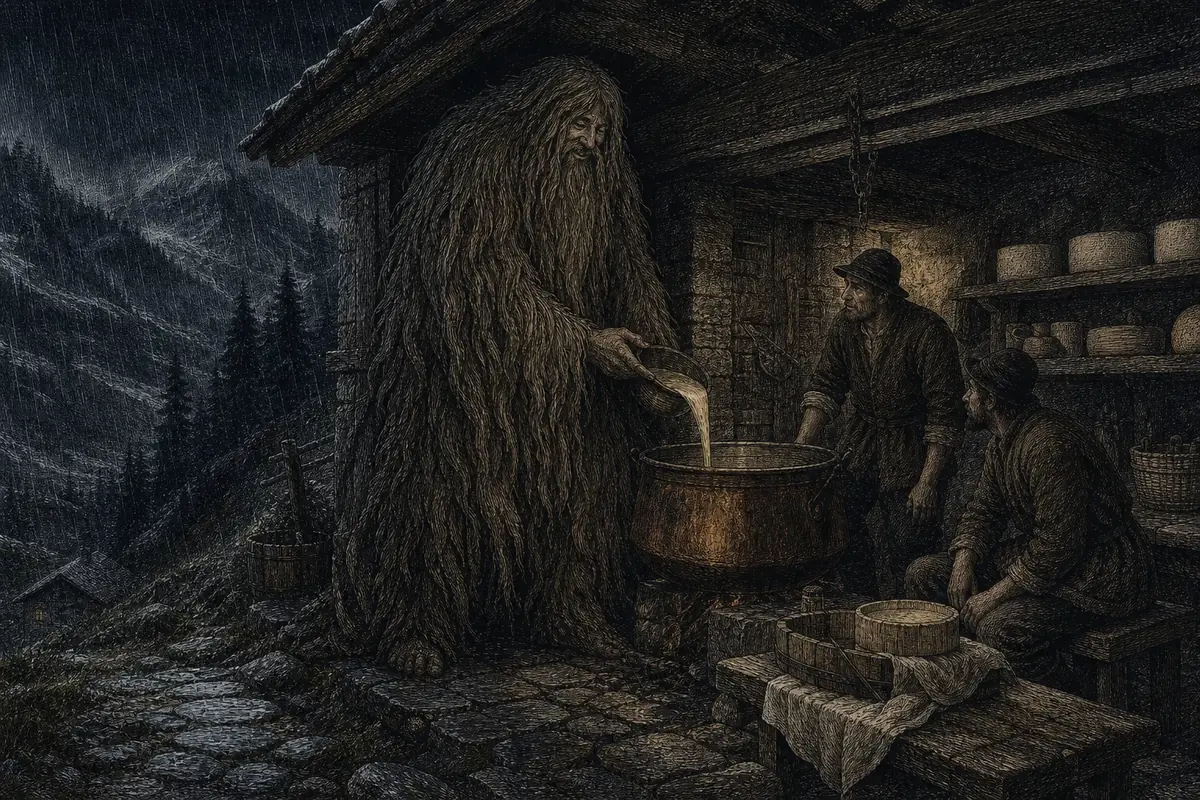
Om salvàrech — gigantic man covered in hair, with hair down to his knees, exceptional strength and sense of smell, yet shy and responsive to kind gestures.
- Variants and dialect names
- Salvanèl, Om selvàdeg, Om Pelòs, Om salvarech, Homo salvadego, Sërvan, Om sarvaj, Salvan, Guriut
- What is told
- Gigantic man covered in hair, with hair down to his knees, exceptional strength and sense of smell, yet shy and responsive to kind gestures. He weeps in fine weather and laughs in the rain.
- What it was forthe author’s reading
- The most solid mythic core of the Alps: the wild man comes out of the wood and teaches men to make cheese. Derided or deceived, he returns to the forest taking the rest of his knowledge with him. It is an aetiological myth of pastoral technique and a warning against the mockery of a guest.
- Where it is attested
- Fresco of the camera picta of the Casa dell’Homo Salvadego at Sacco di Cosio Valtellino (province of Sondrio), at the mouth of the Val Gerola, dated 18 May 1464 and signed «Simon et Battestinus pinxerunt»: it is the oldest iconographic document of the cycle. The hairy figure with the staff bears the scroll that identifies it — «Ego sonto un homo salvadego per natura, chi me ofende ge fo pagura» — and the house is today the Museo dell’Homo Salvadego. Boiardo, Orlando innamorato I, XXII. Museo degli Usi e Costumi della Gente Trentina.
- Caution
- The variant «tiny sprite dressed in red and kind to the poor» is probably a twentieth-century standardisation drawn from children's literature.
The grade says how well the entry is documented, not how interesting it is. How the grades are assigned.