Naddāha
Egypt
Countryside of the Delta and irrigation canals; the strongest written attestation comes from the governorate of Sharqiyya
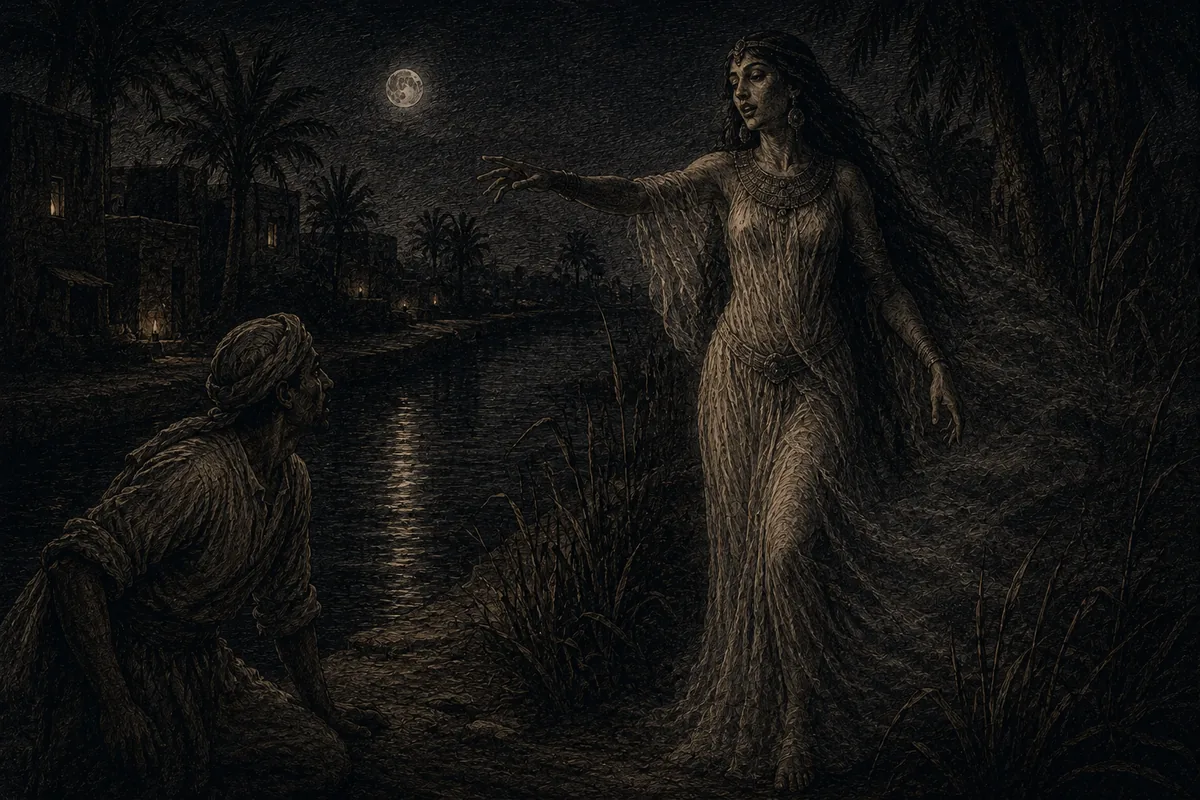
Naddāha — the caller of the Nile: a very tall and very beautiful woman who at night, by the irrigation canals, calls a man by name.
- Variants and names
- Arabic al-Naddāha (النداهة), an intensive feminine form from the Egyptian Arabic verb nadah, «to call someone by name»: literally «the caller». The current renderings as «siren of the Nile» or «naiad» are European glosses, not Arabic names
- What is told
- At night, by the Nile or more often by an irrigation canal, a very tall and very beautiful woman, hair loose and clothes pale, calls a man by name. Only he hears her: any companion remains immune and looks on helpless. The one called enters a kind of hypnosis, walks towards the water and does not come back — drowned, or vanished, or found mute and out of his senses. In some variants the Naddāha falls in love with him and marries him in her kingdom beneath the water, then kills him so that he shall not reveal its secrets. One defends oneself by pronouncing the name of God, by throwing salt at her, by not turning round, by not answering.
- What it was forthe author’s reading
- It serves first of all as a spatial interdiction: it keeps men and boys away from the canals at night, which is exactly where people drown. Secondly it explains the disappearance of a man without accusing anyone — and a recurrent reading in the Egyptian press is that the legend has been exploited, not necessarily created, to pass off murders as supernatural abductions; this is a journalistic hypothesis, not a demonstrated one. In the Egyptian psychologising reading it is, finally, the erotic repressed of the village.
- Where it is attested
- Here one must be strict: there exists no written attestation earlier than the twentieth century. The Naddāha does not appear in the classics of Egyptian ethnography — not in Lane, 1836, not in Blackman, 1927 — and does not emerge in the academic folklore literature as an indexed type under this name. The dated and verifiable anchors are all late and literary: the story and the collection al-Naddāha by Yūsuf Idrīs, 1969-70; the film of the same name by Ḥusayn Kamāl, released on 6 October 1975; Usṭūrat al-Naddāha by Aḥmad Khālid Tawfīq, in the series Mā warāʾ al-ṭabīʿa begun in 1993; and the episode of the Netflix series Paranormal, November 2020, which relaunched her on a global scale.
- Caution
- Grade C is not a judgement on the belief, which is living and extremely widespread: it is a judgement on the documentation, and it needs explaining. The core — a female water spirit who calls by name, in a landscape of canals — is plausibly rural folklore of the nineteenth century or earlier, consistent with the demonology of the jinn of watery places. But its present form, its name as a defined figure and its national diffusion are documentable only from 1969 onwards, and have been massively amplified by literature, cinema and television. Whoever presents her as an «ancient Egyptian legend» asserts what no source supports. One detail worth knowing: in Idrīs's story the Naddāha is not a spirit — it is the city that calls the peasant and destroys him. It is a metaphor built on a belief already known to the reader, which proves that the name was in circulation, but does not say since when.
The grade says how well the entry is documented, not how interesting it is. How the grades are assigned.