Yūrei
Japan
The whole of Japan; poles at Kyoto, Edo-Tokyo (Yotsuya) and Himeji
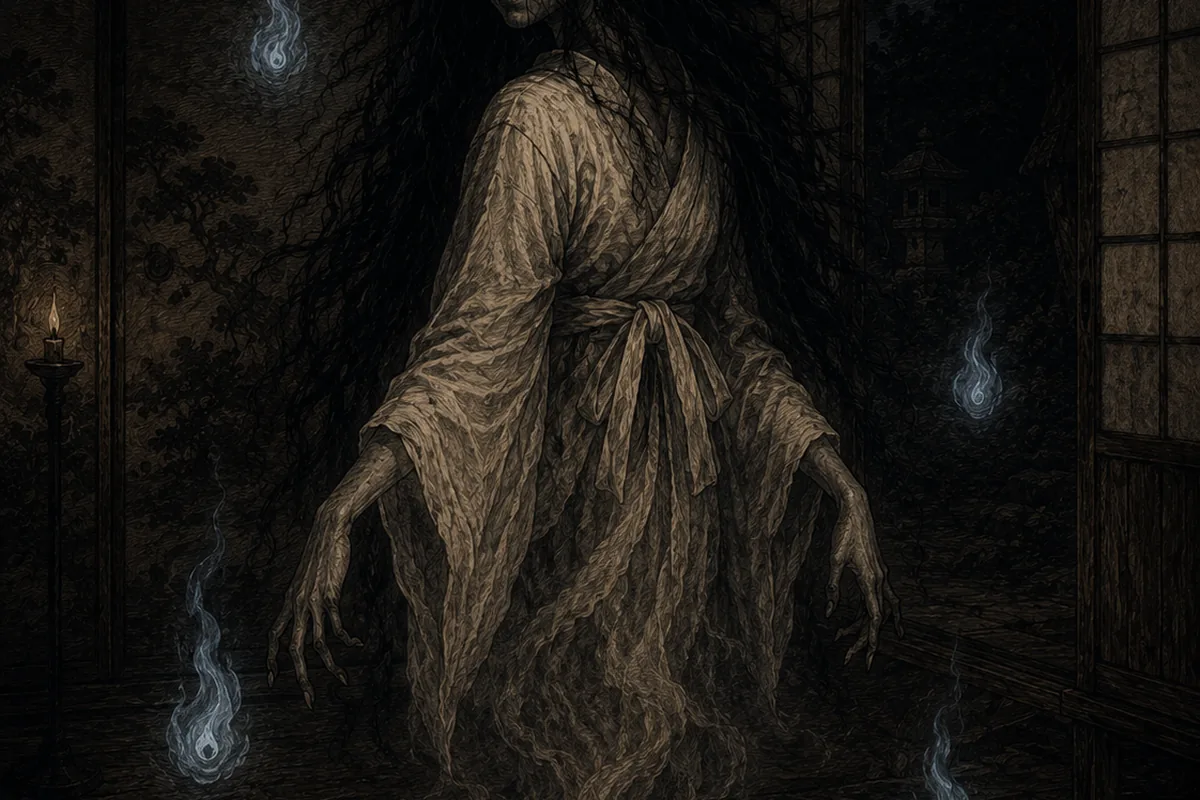
Yūrei — the visual convention is extremely codified: white katabira, that is the funeral kimono fastened the wrong way round, long, dishevelled black hair, hands dangling from the wrists, hitaikakushi, the triangle of white cloth on the forehead, and above all the absence of legs, with the body fading away below the waist, accompanied by the hitodama, floating bluish flames.
- Variants and names
- yūrei; adjacent terms bōrei, shiryō, obake; internal typology onryō, ubume, goryō, funayūrei, jibakurei
- What is told
- The visual convention is extremely codified: white katabira, that is the funeral kimono fastened the wrong way round, long, dishevelled black hair, hands dangling from the wrists, hitaikakushi, the triangle of white cloth on the forehead, and above all the absence of legs, with the body fading away below the waist, accompanied by the hitodama, floating bluish flames. The reikon of those who die with an unresolved emotion, or by a violent death, or without adequate funeral rites, does not make the passage and remains, and an extreme emotion is not needed, because even an innocuous thought may be enough to disturb the death. The yūrei persists until the rites are performed or the conflict resolved: the solution is ritual and not violent, a substantial difference from the Western ghost.
- What it was forthe author’s reading
- It guarantees the observance of ritual obligation towards the dead, that is funerals and anniversaries, and sustains the domestic religiosity of the butsudan and of the offerings to the ancestors. It also offers posthumous justice, because the onryō is typically a woman killed or betrayed by a man of higher rank who obtains in death the revenge impossible in life, and it is a narrative valve on the asymmetries of gender and of class. On the historical plane the fear of the goryō produced genuine state cults, as in the case of Sugawara no Michizane, who died in 903 and was deified as Tenjin.
- Where it is attested
- Roots in the classical corpus, including the ikiryō of the Lady Rokujō in the Genji Monogatari; cult of the goryō attested from the Heian period, 9th-10th century, with the goryō-e rites. Hyakumonogatari Kaidankai, the game of the hundred candles of the Edo period, which generates a publishing genre beginning with Otogi Bōko, 1666. Maruyama Ōkyo, The Ghost of Oyuki, second half of the 18th century, which fixes the iconographic convention of the legless ghost; Ueda Akinari, Ugetsu Monogatari, 1776; Tsuruya Nanboku IV, Tōkaidō Yotsuya Kaidan, kabuki, 1825; Lafcadio Hearn, Kwaidan, 1904; Zack Davisson, Yūrei: The Japanese Ghost, 2015. Living rites: Obon, 13-16 August and in some areas 13-16 July, with mukaebi, okuribi, tōrō nagashi and Bon odori; Gozan no Okuribi at Kyoto on 16 August; Rokudō-mairi at Kyoto from 7 to 10 August.
- Caution
- The canonical iconography is to a large extent a datable artistic product, not a datum of immemorial belief: it is Maruyama Ōkyo in the eighteenth century who fixes the legless ghost, and from there descends the whole visual tradition down to contemporary horror cinema. What should be noted, on the other hand, as a rite still observed and verifiable is the cult of Oiwa at the Oiwa Inari Tamiya shrine of Yotsuya, where actors and productions go to pray before staging Yotsuya Kaidan.
The grade says how well the entry is documented, not how interesting it is. How the grades are assigned.