Popobawa
Tanzania
Zanzibar archipelago: the island of Pemba, where the panics seem to originate, and the island of Unguja; in 1995 the panic spread to the mainland coast
Popobawa — popobawa attacks at night, sometimes accompanied by a sulphurous smell.
- Variants and names
- Swahili popo «bat» + bawa «wing»: «bat wing». But the etymology is to be read as Martin Walsh reads it: the name describes the dark shadow cast at night, not the shape of the entity, which is a shapeshifter and «appears in different shapes and sizes».
- What is told
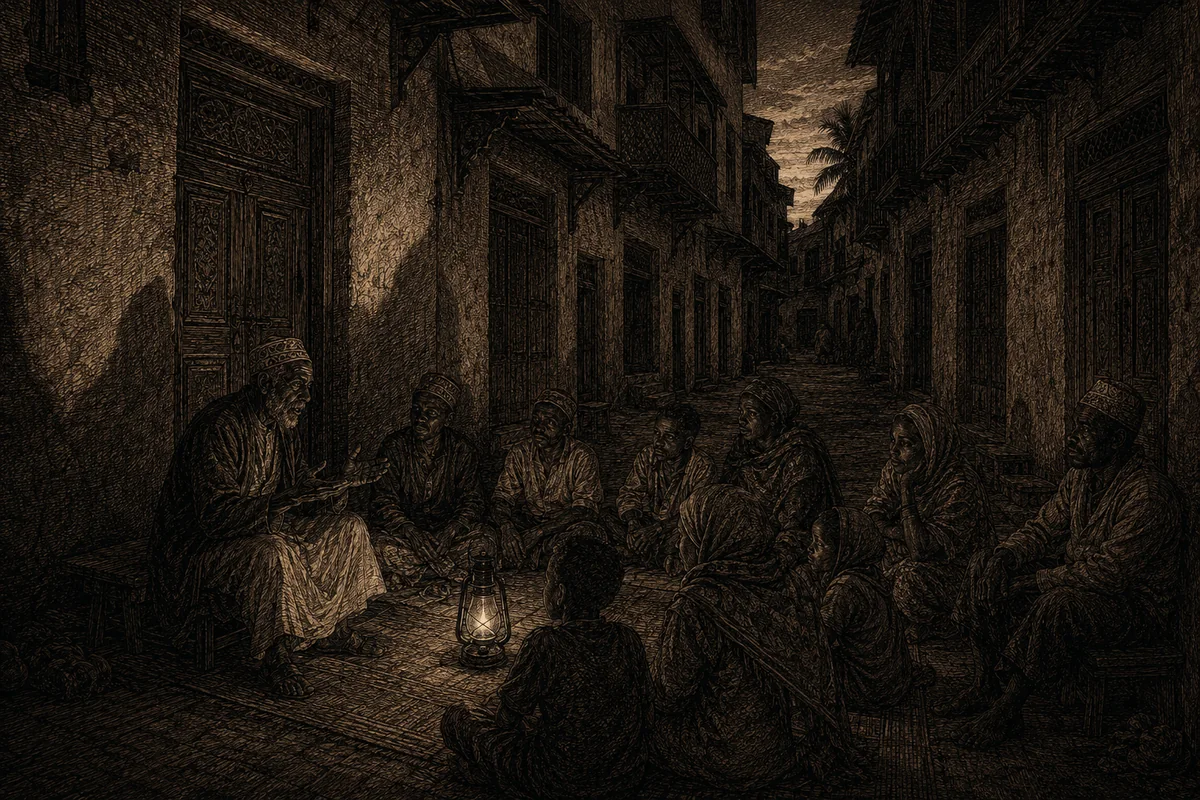
- Popobawa attacks at night, sometimes accompanied by a sulphurous smell. The attacks include physical assault and poltergeist phenomena, but the most feared and most constant element is the sodomising of men and women. And there is a second clause, which is the real engine of the phenomenon: the victim must then say so publicly to the neighbours, or be attacked again. To undergo it and to have to speak. The chronology of the panics, reconstructed by Walsh: a first episode between the late 1960s and the early 1970s on Pemba; the great panic of February-May 1995, which begins in south-western Pemba during Ramadan, reaches Zanzibar Town at the end of March and in April-May arrives at Dar es Salaam and Tanga; then minor episodes in October 2000, in July 2001 and in February-March 2007. For 1995 Walsh establishes three lynchings on Unguja: at Mti Pepo, Zanzibar Town, on 3 April, a man from the mainland, mentally ill, beaten to death by the crowd; at Bumbwini, in mid-April, an unidentified man who died of his injuries while being taken to hospital; at Nungwi, on 28 April, a young man from the Rufiji severely beaten. The body of the first victim, displayed at the mortuary of the Mnazi Mmoja hospital, drew an enormous crowd convinced that Popobawa had been killed — until television announced that he was a psychiatric patient who had come for treatment. That same night the attacks continued.
- What it was forthe author’s reading
- The central thesis of Katrina Daly Thompson is that the object to be studied is not the belief but the discourse: talking about Popobawa is an instrument that Swahili speakers use for their own ends — getting round gender segregation, alluding to homosexuality, discussing female sexuality. The narrative constraint — you must tell of it, otherwise it comes back — is precisely the device that makes it publicly sayable to state a content that is otherwise intractable. Thompson sets it alongside other coastal discursive practices, such as the kanga, the cloths printed with proverbs by means of which Muslim women of the coast convey criticism without violating the ideal of the silent woman. The second function is documented by the events of 1995: the victims of the lynchings shared a profile — being outsiders, mental illness, unusual appearance, possession of amulets, and in all three cases mainland origin. In an island society under electoral tension and with the memory of the violence of 1964, the outsider from the mainland is the available target. By contrast it is notable that the communities with a stronger spirit practice put up collective resistance to the panic: at Kojani, on Pemba, they already knew how an intrusion is dealt with, and they dealt with it.
- Where it is attested
- Katrina Daly Thompson, Popobawa. Tanzanian Talk, Global Misreadings, Indiana University Press, 2017, xii+226 pp., ISBN 978-0-253-02456-5. Explicit declaration: I have not opened the volume. What is attributed to Thompson here is reconstructed from the publisher's description, from the paginated table of contents and from two signed reviews — Amy Nichols-Belo in African Studies Review 60/3, December 2017, and Winifred Lambrecht in Journal of Folklore Research Reviews, 20 June 2018 — both consulted. By the same author: «Swahili talk about supernatural sodomy», in Critical Discourse Studies 11/1, 2014, pp. 71-94, DOI 10.1080/17405904.2013.836115 — not consulted. Martin T. Walsh, «The politicisation of Popobawa: changing explanations of a collective panic in Zanzibar», in Journal of Humanities 1/1, 2009, pp. 23-33 — consulted; by the same author, the papers «Killing Popobawa: collective panic and violence in Zanzibar» (African Studies Association, Indianapolis, 20-23 November 2014) and «Explaining Popobawa» (Centre of African Studies, Edinburgh, 3 February 2010), both consulted, both conference papers, not peer-reviewed articles. Contemporary testimony: Henriette Jansen, «Popobawa is dead!», in Tanzanian Affairs 53, 1996 — observations dated 4 April-4 May 1995 by someone working at the Zanzibar Ministry of Health; consulted. Dated newspaper coverage: The Guardian, 2 October 1995; BBC News, 19 July 2001 and 21 February 2007; The Economist, 13 December 2003.
- Caution
- Popobawa is not ancient folklore. No academic source attests it before the 1960s: it is a documentable phenomenon of the later twentieth century, after the revolution. And the date «1965», which circulates everywhere as though it were precise, is not supported by Walsh's chronology, which gives a range — «late 1960s / early 1970s». «1970» too should be used with caution: it is a precision manufactured downstream.
The link with the electoral calendar does not hold, and Walsh dismantles it. The panic of 1995 broke out six months before the elections of October; the elections of 2005 produced no episode at all; 2000 and 2001 line up only weakly; 2007 has no clear electoral connection. The political explanation emerged in the course of the 1995 panic as a local interpretation, above all among opposition supporters — initially the explanations were not political at all: neglected family spirits, the revenge of a rejected sorcerer, a mother-spirit in one episode involving a whale. The politicisation is an outcome of the process, not its cause.
And then there is the question that gives Thompson's book its subtitle, Global Misreadings. The iconography of the «giant one-eyed bat» is a product of the Western media and of cryptozoology encyclopaedias: the name describes the shadow, the entity is a shapeshifter, and fixing it as a creature with a stable appearance is already the misreading. «Sceptical Westerners explain, Zanzibaris believe» is exactly the dichotomy Thompson attacks — and global jokes deride African beliefs, whereas local joking opens up spaces for discussing taboo subjects: the same laughter does two opposite jobs in the two contexts. «It is just sleep paralysis» is one of the explanations in play, never the solution: it does not explain why the content should specifically be sodomy, nor why it should impose compulsory public narration. And «it is the African incubus», «it is the local vampire» are imported labels: Popobawa does not drink blood and is not a dead person who returns.
A reservation of method that must be declared: the positions of Thompson reported here do not come from her text, which I have not read, but from the publisher, the table of contents and two signed reviews. This entry stays at B for that reason as well.
The grade says how well the entry is documented, not how interesting it is. How the grades are assigned.