Namahage
Japan
Oga peninsula, Akita prefecture, northern Tōhoku
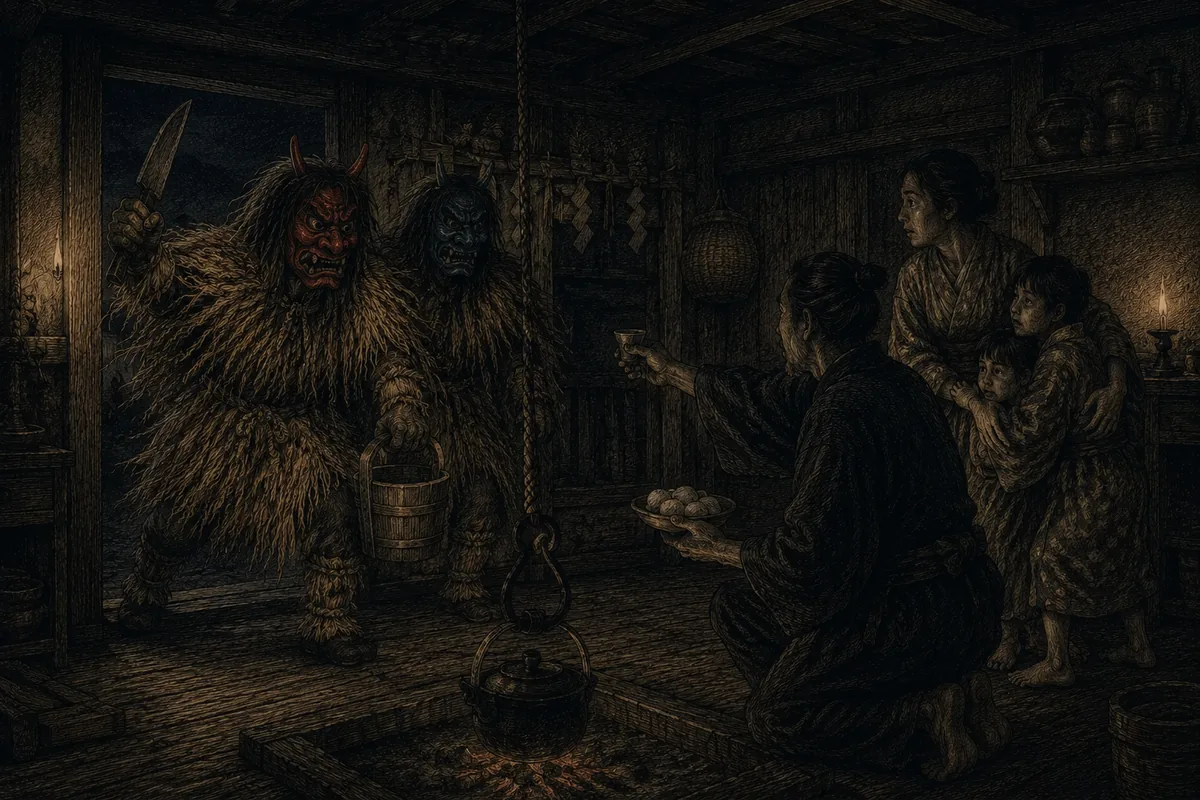
Namahage — on the evening of 31 December young men of the village put on oni masks, red or blue, carved locally and different for each hamlet, straw capes called kede, and take up a wooden knife and a pail.
- Variants and names
- namahage, to be written in hiragana because the kanji spelling 生剥 is considered erroneous by local sources; local variants Nagomehagi and Amahage; cognate rites Nagomehagi in Aomori, Nagami and Suneka in Iwate, Amahage in Yamagata, Toshidon at Koshikijima, Paantu at Miyakojima
- What is told
- On the evening of 31 December young men of the village put on oni masks, red or blue, carved locally and different for each hamlet, straw capes called kede, and take up a wooden knife and a pail. In groups of two or three they go from house to house shouting «There are children who are crying», «There are bad children», «There are idlers», and search the house for the children, scolding them. The master of the house receives them formally, has them sit down, offers sake and food and intercedes for his children, guaranteeing that they will behave well, and the parents may commission the scolding in advance on specific points. They are not demons but visiting kami who come down from the mountain, and they leave behind them the house purified and prosperity for the new year.
- What it was forthe author’s reading
- It is a rite of divine visitation, raihō-shin, with four simultaneous functions recognised by UNESCO as well: pedagogical, because the disciplining of children is carried out by the community and not by the parents, who remain in the role of protectors, in a sophisticated social architecture; male initiatory, because the wearing of the mask falls to men of a given age bracket; cohesive, because it obliges all the houses of the hamlet to a reciprocal ritual contact once a year; and calendrically renewing, with purification and the wish for a good harvest and catch.
- Where it is attested
- First documentary attestation in 1811: the traveller and ethnographer Sugae Masumi describes the rite, called Namomihagi, observed on 8 February 1811, in a text included in his illustrated diaries presented in 1822. In the Edo period the rite fell on the fifteenth day of the first lunar month, the Koshōgatsu, and was moved to 31 December with the adoption of the Gregorian calendar. Institutional recognition: designation as an Important Intangible Folk Cultural Property on 22 May 1978 and UNESCO inscription on 29 November 2018 in the multiple dossier Raihō-shin, ritual visits of deities in masks and costumes, which brings together ten rites and extends the inscription of the Koshikijima no Toshidon of 2009. Research at the Sugae Masumi Centre of the Akita Prefectural Museum. Living festivals: namahage on 31 December in the houses; Namahage Sedo Matsuri at the Shinzan shrine on the second Friday, Saturday and Sunday of February.
- Caution
- No substantial caveat: it is the best-documented entry of the survey, with a dated attestation from a direct observer, state designation, UNESCO inscription and an uninterruptedly living rite. It need only be noted that the four hypotheses about its origin, that is yamabushi ascetics, messengers of the god of the mountain, shipwrecked foreigners read as oni and the legend of the five oni tricked by the crowing of a cock, are competing and none is demonstrated. The etymology, on the other hand, is certain and makes the function legible: from namomi, the low-temperature burn blisters of those who spend the winter crouched beside the hearth, plus hagu, to tear away, hence «he who tears away the scabs of idleness».
The grade says how well the entry is documented, not how interesting it is. How the grades are assigned.