Kelpie
the United Kingdom
Scotland: Highlands and North-East (Aberdeenshire, Banffshire, Morayshire, Perthshire)
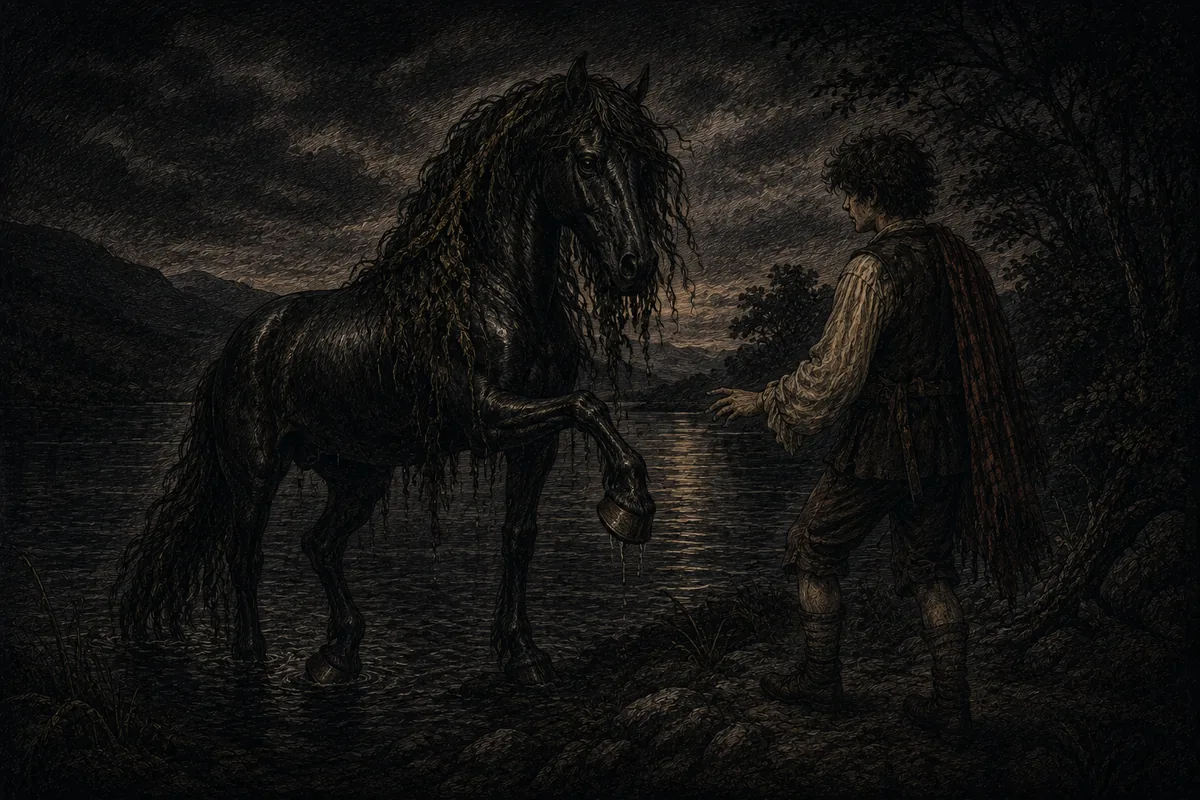
Kelpie — powerful black horse that haunts rivers, burns and deep pools and offers itself as a mount; whoever mounts it stays stuck to its back and is dragged under water and devoured.
- Variants and names
- kelpie in Scots; island parallels nuggle and shoopiltee in Shetland, tangie in Orkney, ceffyl dŵr in Wales, cabbyl-ushtey on Man, aughisky in Ireland, brag and shag-foal in northern England
- What is told
- A powerful black horse that haunts rivers, burns and deep pools and offers itself as a mount; whoever mounts it stays stuck to its back and is dragged under water and devoured. In some versions its hooves are turned backwards. It can take human form, a handsome man or woman, betraying itself by the weed in its hair or by an untransformed hoof, a detail that in the Christianised tradition links it to the Devil. It can be mastered by taking possession of its bridle or by marking it with a cross, and some local legends attribute the building of a mill or a bridge to a subjugated kelpie.
- What it was forthe author’s reading
- A deterrent to keep children away from watercourses, a function explicitly recognised by the folklorists, and a warning to young women about the seductive stranger. It further supplies an explanation of drownings in a society in which the river was a daily and unavoidable danger.
- Where it is attested
- First attestation in a manuscript ode by William Collins composed before 1759 and published in the Transactions of the Royal Society of Edinburgh in 1788. John Francis Campbell, Popular Tales of the West Highlands, four volumes, 1860-62, a fieldwork collection in Gaelic with facing text, digitised by the National Library of Scotland; John Gregorson Campbell, Superstitions of the Highlands and Islands of Scotland, 1900; Walter Gregor, Notes on the Folk-Lore of the North-East of Scotland, Folk-Lore Society, 1881; Katharine Briggs, A Dictionary of Fairies, 1976.
- Caution
- The etymology from Gaelic cailpeach or colpach, that is heifer or colt, is probable but there is no full consensus; there is a minority alternative that invokes kelp, seaweed. Walter Scott uses the term in a broad sense and contributes to the confusion of kelpie and each-uisge in the literary tradition, a confusion that has been passed on to modern popularisation. The Kelpies sculptures at Falkirk, 2013, are contemporary heritage-making and not evidence of rite.
The grade says how well the entry is documented, not how interesting it is. How the grades are assigned.