Vodník
the Czech Republic
Bohemia and Moravia; the motif extends into Sorbian Lusatia and Slovakia
Vodník — a little man of short stature, green in his clothes and often in his hair, from whose left coat-tail water drips continually.
- Variants and names
- Czech vodník, vodní muž; and above all hastrman, a loanword from German Wassermann and an extremely popular form. Dialect variants: hastrmák, hasrman in Silesia; vasrman, vastrman, vasermůn in Moravia. Epithets: zelený pidimužík «little green man», zelenokabátník «the one in the green coat». Sorbian wódny muž. Polish topielec is a kindred but not identical thing: it is the soul of a drowned person, not a demon of the water.
- What is told
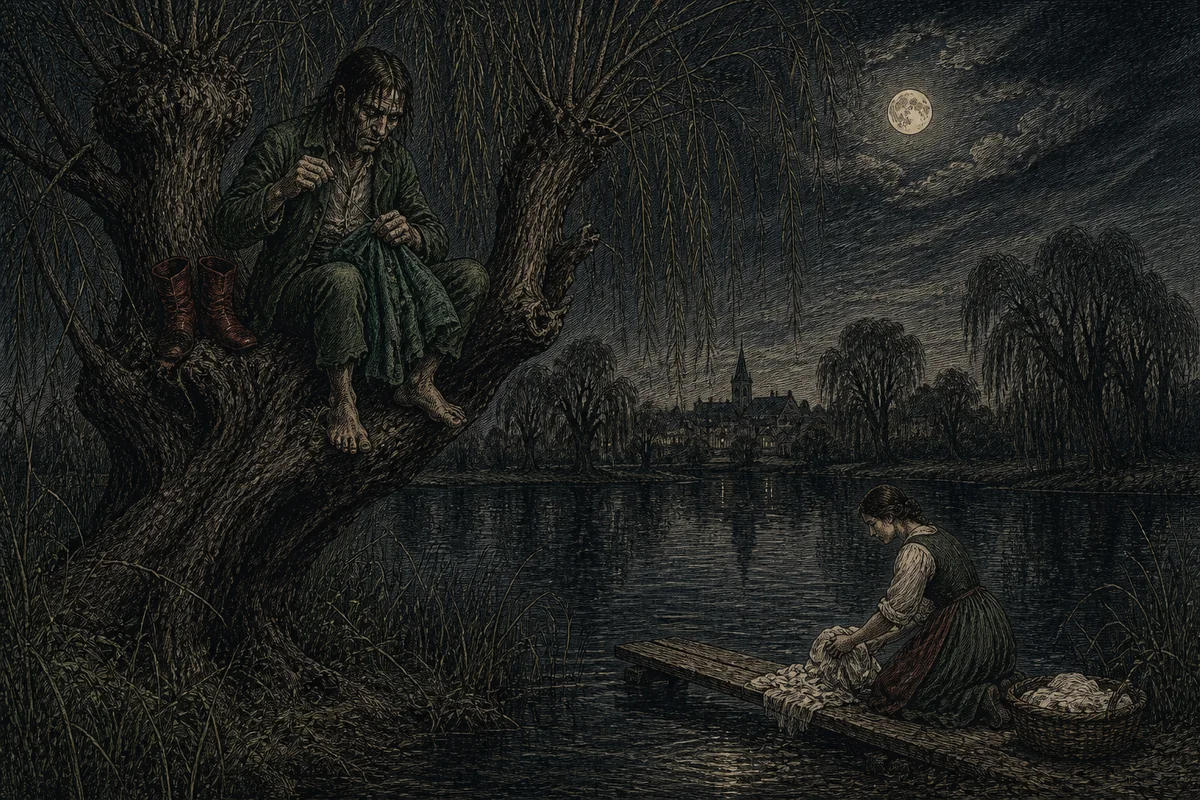
- A little man of short stature, green in his clothes and often in his hair, from whose left coat-tail water drips continually. He lives in ponds, rivers and mill races. At night he sits in the tree above the water and sews his boots. He drowns whoever comes near, and in particular whoever takes his name in vain or scorns him: the girl who lightly declares that she would gladly dance with the vodník is the typical victim. By day he hangs little red ribbons above the water: the child who touches them ends up in it. The souls of the drowned he keeps on the bottom, under upturned earthenware pots.
- What it was forthe author’s reading
- He is the danger of water made a person, and with a precision that tales of fear rarely have: the vodník does not attack in the middle of the river, he attacks on the bank, at the landing stage, at the ford, where people actually go. His work coincides with the map of the real drownings of a peasant society — women washing, children playing on the bank, men crossing. And the little red ribbons hung above the water are the popular formulation of a fact every parent knows: children drown because something draws them towards the edge.
- Where it is attested
- Karel Jaromír Erben, Kytice z pověstí národních, Praha 1853: the ninth ballad in the collection is entitled Vodník, and in the Poznamenání — the learned notes at the end of the volume — Erben records as popular belief the green hair, the boots sewn at night on the poplar and the souls kept under the little pots, noting the Lusatian parallel. Earlier still: Božena Němcová, Vodník, 1844. Ethnography: J. V. Grohmann, Sagenbuch von Böhmen und Mähren, 1863, and Aberglauben und Gebräuche aus Böhmen und Mähren, 1864; Josef Košťál, Vodník v podání lidu českého, in «Český lid» I, 1892; J. F. Urban, O vodníkovi, 1918. An Old Czech gloss of 1418 already attests the term. Modern studies: P. Šidák, Vodník v české kultuře, in «Studia mythologica Slavica» 15, 2012, and Mokře chodí v suše, Praha, Academia, 2018; J. Luffer, Katalog českých démonologických pověstí, Academia, 2014.
- Caution
- Three clarifications about the current image, which is in good part twentieth-century. The souls are under earthenware pots — hrnečky, little pots — and not under porcelain cups, which appear in no nineteenth-century source. The canonical tree is the poplar: in Erben's verse the vodník sews seated on a topol; the willow, which everyone now attributes to him, comes from the watercolour by Josef Lada of 1936, which also gave him the pipe. And the link with mills and millers is not documented in any nineteenth-century Czech collection among those consulted: it appears to come from German-language children's literature of the twentieth century. The ribbon on the hat, finally, is a misunderstanding: the little ribbons are the bait, not the costume.
The grade says how well the entry is documented, not how interesting it is. How the grades are assigned.