Pishtaco
Peru
Peruvian Andes, with documentary epicentre at Huamanga, Ayacucho; parallel forms on the Bolivian altiplano
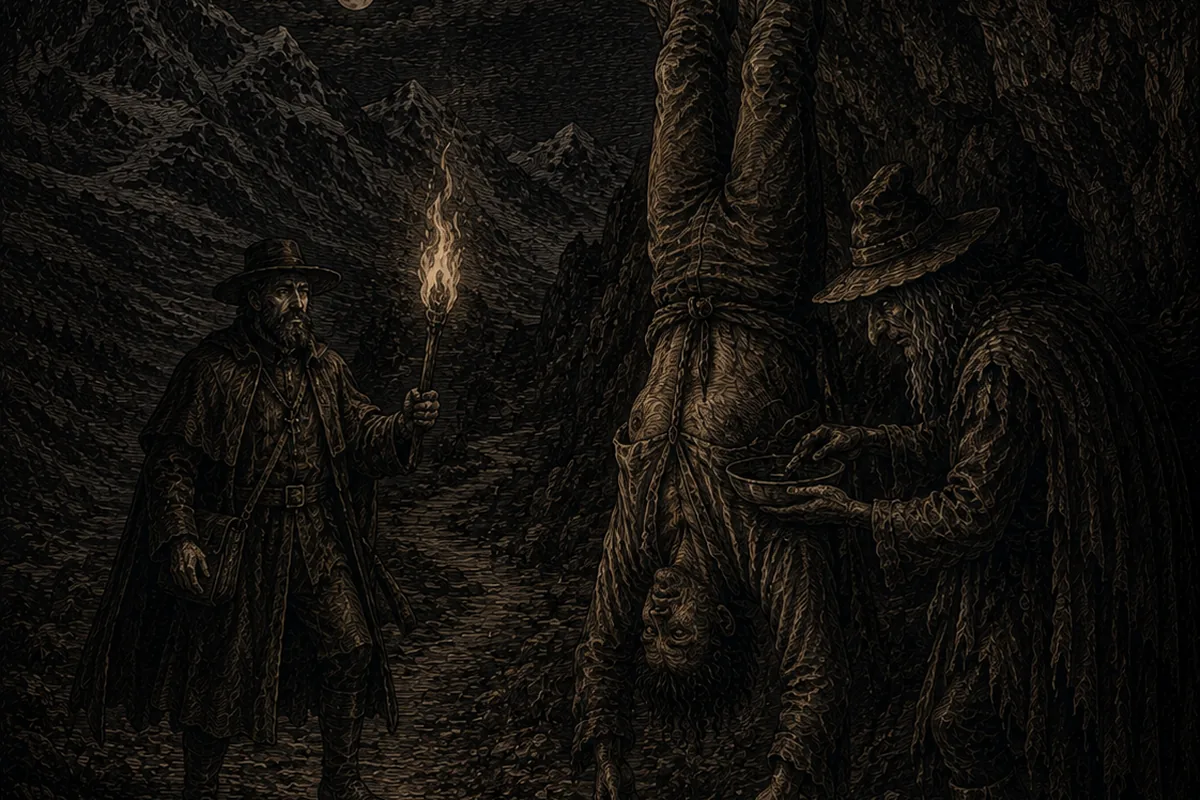
Pishtaco — a stranger who attacks the lone indigenous man, at night or on an isolated road, stuns him with a powder or a smell, hangs him upside down and extracts his fat.
- Variants and names
- Central-northern Quechua pishtaco, from pishtay «to cut the throat, to butcher»; southern Quechua ñakaq or nakaq, from nak'ay, «he who butchers»; Aymara kharisiri and lik'ichiri, the latter from lik'i, fat: «he who extracts the fat»; in Spanish degollador. The semantic core is everywhere technical and of the butcher, not demonic
- What is told
- A stranger who attacks the lone indigenous man, at night or on an isolated road, stuns him with a powder or a smell, hangs him upside down and extracts his fat. The victim sometimes goes home and dies weeks later, wasting away: in Andean physiology fat is vital force. Who the pishtaco is changes with the periods — in the colonial accounts a bearded white man, often a friar; then a mestizo, an engineer, a gringo, a soldier. And the use of the fat changes too, which is the most instructive part: medicine for a European disease in the sixteenth century; the casting of bells and the polishing of the statues of the saints in the eighteenth; soaps and ointments in the nineteenth; lubricant for weapons and machinery; fuel for jet engines in the fifties and sixties; payment of the foreign debt in the eighties; export to European cosmetics laboratories in 2009. The list is a chronological index of the technologies perceived as external.
- What it was forthe author’s reading
- The prevailing hypothesis in anthropology is that the story is an indigenous model of extraction: it makes visible a relationship in which the vital substance of Andean bodies is taken and turned to value elsewhere — labour in the mita, minerals, capital. To this is added the racial and sexual dimension, the white man who disposes of the Indian body. A secondary function, more solid: an alarm code that is triggered when an external and undecipherable actor comes in — a mission, a prospector, a humanitarian organisation, the army.
- Where it is attested
- The oldest known mention is in Cristóbal de Molina «el Cuzqueño», Relación de las fábulas y ritos de los Incas, about 1574-1575, in the passage on the Taki Onqoy, the anti-colonial movement of rejection that arose around 1564 at Huamanga: Molina records that the Indians believed the Spaniards had been sent to collect unto de indio to cure a disease for which there was no remedy in Spain, and that for this reason they fled from the religious. Independent confirmation in Antonio de Herrera y Tordesillas, Historia general, 1601; the term ñakaq is attested in 1723, already associated with the clergy. Studies: Efraín Morote Best, El degollador (Nakaq), Cusco 1951-52, the first monograph; Juan Ansión (ed.), Pishtacos: de verdugos a sacaojos, Lima 1989; Nathan Wachtel, Dieux et vampires, Seuil 1992; Mary Weismantel, Cholas and Pishtacos, University of Chicago Press, 2001.
- Caution
- The point that makes this entry different from almost all the others in the atlas: it is not a pre-Hispanic residue. There is no attestation earlier than the Conquest, and the first one arises already inside a political movement. It is not an Inca myth, it is not a deity, and it is not a vampire — it takes fat, not blood. Nor is it always white: the recent versions include mestizos, policemen, Peruvians. And the sacaojos are not a synonym: they are the urban variant of 1988, when it was said in Lima that foreign doctors were abducting children in the barriadas in order to export their corneas, the schools emptied and some young tourists mistaken for sacaojos narrowly escaped lynching. It should also be said that almost every Andean ethnographer has, sooner or later, been identified as a ñakaq, and that some have been tied up and threatened with death. That the Uchuraccay massacre of 26 January 1983, in which eight journalists were killed by the comuneros, was triggered in part by an identification of the strangers as pishtacos is a hypothesis discussed in the literature, not an established fact.
The grade says how well the entry is documented, not how interesting it is. How the grades are assigned.