Nahual
Mexico
Nahua and Maya Mesoamerica; documentary core at Atenango del Río, Guerrero
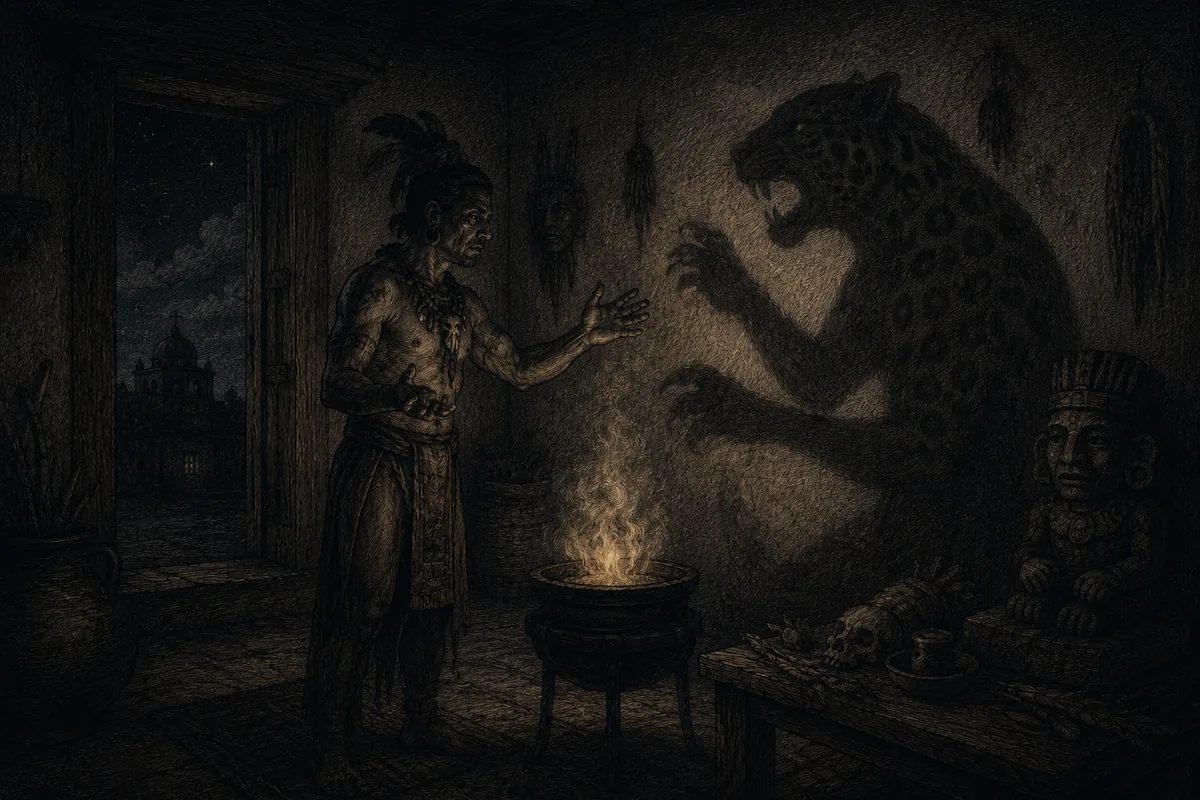
Nahual — a person — not an animal — able to change shape or to act through an animal: coyote, jaguar, dog, owl.
- Variants and names
- Nahuatl nāhualli, plural nānāhualtin, Hispanicised nahual or nagual; the prevailing etymology links it to the root nāhua- «to conceal, to cover». Equivalents in other languages: Maya way, Tzeltal lab, Tzotzil chanul. To be kept separate from the tōnalli, the «heat-destiny» bound to the day of birth
- What is told
- A person — not an animal — able to change shape or to act through an animal: coyote, jaguar, dog, owl. He does so in order to heal, to foretell, to harm. In the colonial sources the nahualli is a ritual specialist with a defined social role, and the same sources distinguish the competent and respected one from the harmful charlatan. Ruiz de Alarcón records the formula in the first person: NiNāhualocēlōtl, «I am a nahualli-jaguar».
- What it was forthe author’s reading
- In small communities nahualism is at once a therapeutic system and a device of attribution: it gives illness and misfortune an identifiable culprit, and gives the one who practises it a real power. A recent study reads the nanahualtin as local intellectuals, whose prestige conflicted directly with ecclesiastical orthodoxy — which indeed persecuted them.
- Where it is attested
- First lexicographical record: Alonso de Molina, Vocabulario en lengua castellana y mexicana, 1571, which glosses it curtly as «bruja». Then Sahagún, Florentine Codex, books III, VI and X. The capital source is Hernando Ruiz de Alarcón, Tratado de las supersticiones y costumbres gentílicas que hoy viven entre los indios naturales de esta Nueva España, manuscript of 1629, drawn up while he was beneficiado of Atenango del Río, because it preserves the incantations in Nahuatl collected on the spot. Then Jacinto de la Serna, 1656, the New Spanish inquisitorial and criminal trials, and twentieth-century ethnography: Foster 1944, Villa Rojas 1947, Aguirre Beltrán 1963.
- Caution
- The confusion to be dispelled is between two things that the classical sources distinguish perfectly well. The tonalli is an animic component received at birth and bound to the calendrical sign: it is internal, everybody has one, and it implies no transformation. The nahualli is a role acquired by a specialist, with an external animal alter ego. In current usage «tonal» denotes the companion animal of one's destiny and «nagual» the one who transforms — but «tonal» in that sense is not the classical Nahua word. The fusion of the two vocabularies crystallises with Brinton in 1894 and is then spread in an entirely fictitious way by Carlos Castaneda: the tonal/nagual pair of Tales of Power, 1974, is literary invention, not ethnography, and is not to be used as a source.
The grade says how well the entry is documented, not how interesting it is. How the grades are assigned.